Triple Memory · Starryear
Photo triptych · 400k+ views, 20k likes
Triple Memory · Starryear
Photo triptych · 400k+ views, 20k likes
Showcase
Description
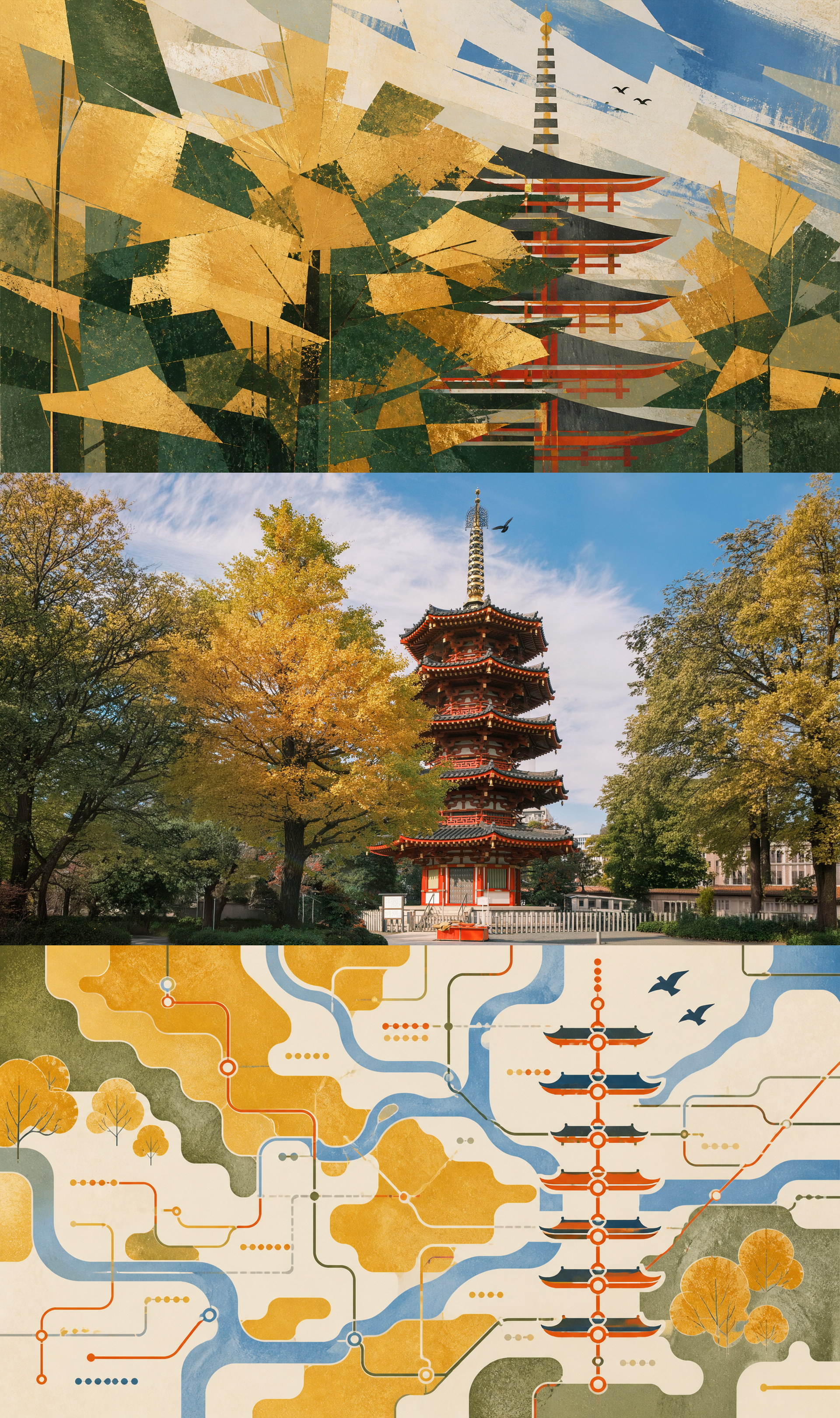
Turn a single user-uploaded photo into a triptych with continuous visual logic: the top panel draws the subject or core space inward, distilling it into an abstract form that is stable, concentrated, and still retains its identity; the middle panel preserves the real original photo as irreplaceable photographic evidence; the bottom panel releases the photo’s colors, contours, textures, and spatial relationships outward, creating a dispersed, transformed, and more surreal new setting. The final image reveals the difference between convergent and diffuse abstraction while allowing viewers to trace their connection to the original photo. This Skill works with single photos of people, animals, objects, architecture, interiors, or natural scenes. The abstract results develop from the photo’s own subject relationships, compositional direction, color relationships, and visual rhythm rather than applying fixed patterns, generic filters, or unrelated decorative styles. It pays particular attention to the number, identity, orientation, and proportions of subjects, as well as important spatial relationships, ensuring that the middle panel remains the original photo without replacement. You’ll receive a finished source-driven triptych, along with a brief summary of the key visual DNA used for the two abstract panels above and below, making it easier to understand which clues the convergent and diffuse treatments extracted from the original image.
Recommended by
Shuting@YouMind
Why we love this skill
Turn one photo into a precise gather–original–diffuse triptych. Both abstract panels remain traceable to the source image while moving inward or outward, avoiding fixed decoration and balancing recognizability with exploration.
Related Skills
View all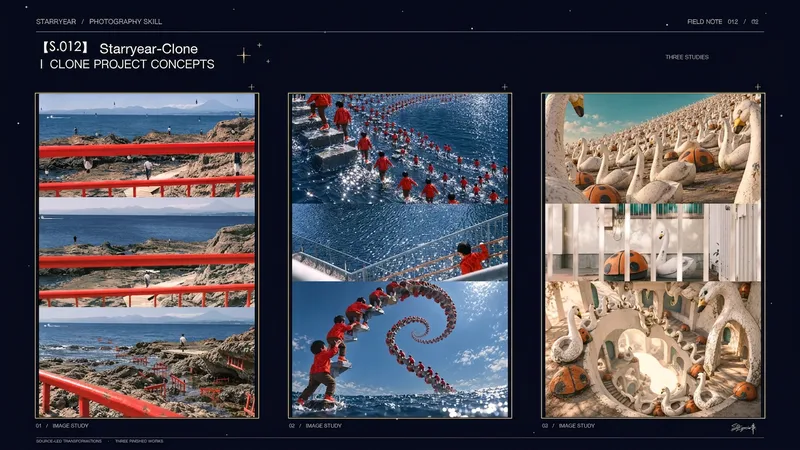 Image
Image[S.012] Year Clone · Photo
Turn one photo into a borderless vertical triptych: the center preserves an unaltered crop of the original image as clear evidence of the scene, while the top and bottom each clone and invert a different subject from the photo. The result is a surreal image rooted in the original environment. The top panel can focus on a primary subject such as a person or animal, while the bottom panel works well with boats, buildings, railings, landmarks, or other clearly structured objects. Each generated area retains one recognizable subject at a clear scale, while allowing smaller inverted forms to blend into the foreground, background, water, rocks, roads, or building edges. The original scene’s lighting, perspective, occlusion, materials, and depth of field are maintained. Ideal for photographic collages with separately duplicated and inverted people and objects, source-photo-driven surreal triptychs, and visual experiments that preserve features such as landmarks, mountains, and skylines. The final output is a single vertical 2:3 image with no text, border, watermark, or decorative title.
 Image
ImageS.011 YearGrid Starryear
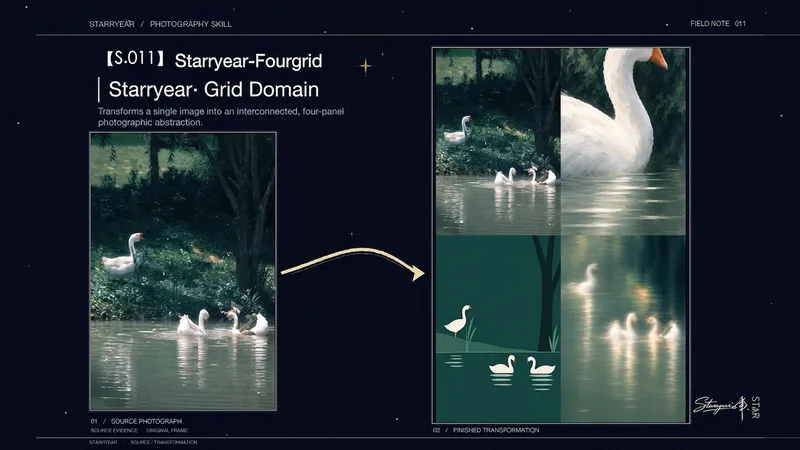
Distill one photo into a complete 2:3 portrait four-panel abstract poster. While preserving evidence from the original photo, it explores different visual distances and emotional tones within the same scene. The finished piece follows the viewing order of “original evidence, enlarged abstraction, minimalist structure, and dreamlike afterimage”: key contours, spatial relationships, and color cues from the photo remain recognizable, while textures, light, reflections, or materials are reorganized into abstract expressions. This Skill is suited to four-photo layouts, four-panel grid posters, editorial-style visual work, and artistic reinterpretations based on a single photo. The three transformed panels share the original photo’s color relationships and visual DNA while clearly distinguishing enlarged details, sparse structures, and optical illusions—avoiding four duplicated filter treatments or an unrelated collage. The imagery emphasizes restrained textures, clear functional sections, and an overall balance that remains effective at thumbnail size. It works with photos of people, animals, architecture, nature, objects, and subjects with distinctive lighting or material qualities. The final output is a single, consistently proportioned portrait four-panel image ready for use, with no extra versions, borders, or unrelated decoration.
 Image
ImageS.006 · Starryear Four-Grid
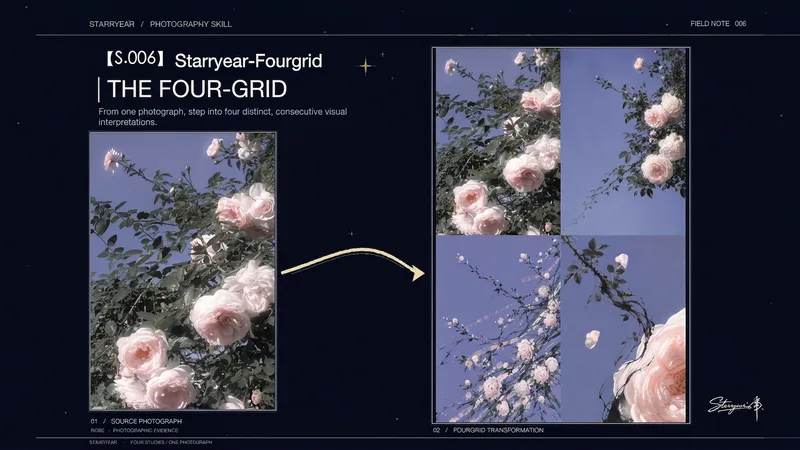
Turn a single photo into a vertical 2:3 ink four-panel artwork. The original image remains as the top-left panel, while three distinct visual expressions extend from the photo's own colors, compositional relationships, motion paths, and spatial rhythms. The final work is not a standard collage or four filters, but a continuous transformation from photographic evidence to poetic memory, dot-and-line rhythm, and surreal space. The second panel distills the photo's atmosphere in a semi-abstract, moist, and subtly veiled style. The third transforms observable directions, intersections, repetitions, and variations in density into restrained dot-and-line structures, moving beyond the outlines of specific objects. The fourth preserves the original image's spatial grammar and layering, replacing real objects with photo-derived folds, interfaces, passages, or other non-representational forms to create a surreal world whose source remains recognizable. Colors and visual features are extracted anew from each uploaded photo, avoiding fixed themes, palettes, or compositions. Use it to create ink four-panel artworks, one-photo-into-four transformations, source-image abstractions, and editorial-style visual posters. The result is a complete, unified vertical artwork with no text or borders.
Information
- Version
- v6
- Last updated
- Runtime credits
- Usage-based
- Models
- Auto