
Organizational Structure Analysis
Power analysis, position diagnosis, insights
Organizational Structure Analysis
Power analysis, position diagnosis, insights
Showcase
Description
Based on sociological theory, it deeply analyzes organizational power structures, diagnoses personal positions, and provides actionable insights. It automatically identifies the type of need, prioritizes a framework for precise analysis, helping users see the situation clearly and understand power dynamics.
Related Skills
View all
Multi-Framework Analysis
Turn complex problems into structured, multi-perspective analyses that can be reviewed, verified, and used to support next steps. Whether you are evaluating career choices, business and product decisions, social phenomena, controversial issues, trending topics, innovations, or abstract concepts, this Skill first clarifies the subject, goals, constraints, known information, and key unknowns. It then selects complementary cognitive frameworks based on the task, avoiding a pileup of concepts or repeated versions of the same conclusion. The analysis clearly distinguishes between information provided by the user, verified facts, general principles, assumptions, inferences, and content that still needs validation. It places evidence, mechanisms, counterevidence, alternative explanations, and uncertainty within a clear chain of reasoning. For time-sensitive, controversial, specialized, or high-risk facts, it can use targeted web searches and verify original sources. When sources conflict, it preserves the differences rather than filling gaps with unverified data or overly certain claims. The final output typically includes a problem profile; the framework selection and analysis of each framework; areas of agreement and disagreement across perspectives; sensitive variables; blind spots and failure conditions; and conditional conclusions with confidence levels. It does not replace professional medical, legal, investment, tax, or other advice. Instead, it helps you identify the factors that truly affect judgment and design minimal validation steps, information-gathering plans, decision gates, or reversible next steps. Simple questions can be condensed into a brief assessment, while complex or multi-subject tasks can be developed into a complete analytical report.
 Research
First-Principles Insight
This skill helps you see through complex surfaces and get back to the most fundamental physical facts and logical origins. Whether you're dealing with a tricky business challenge, an abstruse theoretical concept, or a disruptive innovation that must begin from scratch, it applies rigorous logical deconstruction to help you question assumptions that are taken for granted, identify the key elements that drive a system, and distill penetrating, essential insights. During analysis, it guides you through a complete thinking exercise that moves from deconstruction, to questioning, to reconstruction. By scanning across dimensions such as causality, systems, and value, it precisely distinguishes phenomena from essence, filters out distracting secondary information, and pinpoints the key leverage points of a problem. This approach not only helps uncover root causes, but also frees you from fixed mindsets and allows you to build simpler, more scientific frameworks for understanding. Building on deep essential findings, this skill also offers a systematic strategy for generating innovation. It can leverage multiple thinking modes, such as combinatorial innovation, constraint inversion, and analogy transfer, to tailor diverse solutions for you, from incremental improvements to cross-domain integration. In the end, you'll receive a structured report containing the deconstruction process, core questions, essential insights, and actionable recommendations, giving you a solid logical foundation for decisions in a complex and ever-changing environment.
Deep Insight Commentary
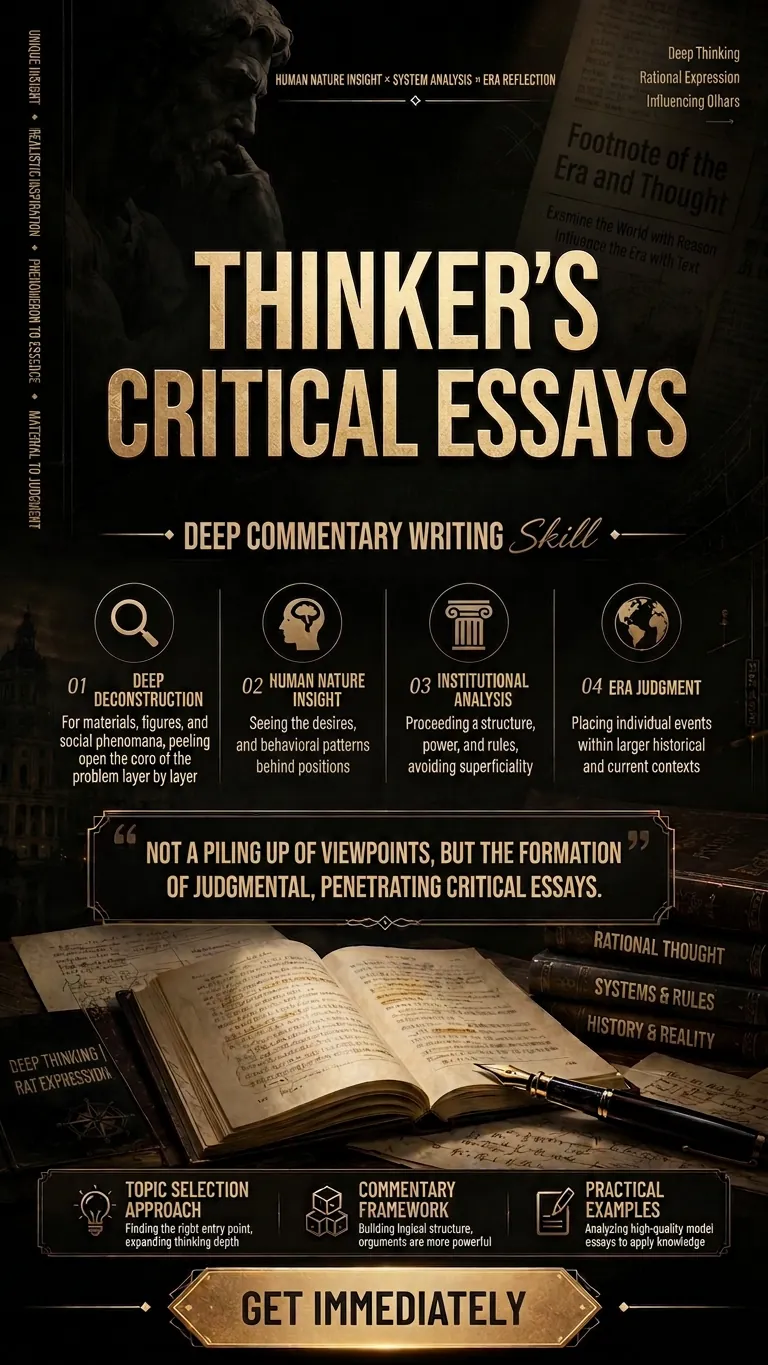
The Sage's Commentary helps you deeply analyze materials, people, or social phenomena, going beyond the surface to reach the core. Based on reading, it integrates insights from history, institutions, human nature, and inner depth to provide unique perspectives and practical inspiration. Whether you're taking book notes, analyzing historical figures, commenting on social phenomena, or deconstructing political power structures, this tool helps you start from the text, deconstruct common sense, and deeply analyze structure, human nature, institutions, and the trends of the era, ultimately forming personal judgments that guide action. It advocates learning from history and breaking attachments with the heart, not blindly following authority or being trapped by emotions—seek the truth first, then judge. You can use it to organize scattered ideas into layered long-form writing or elevate ordinary material into thought-dense articles. It's especially suited for analyzing literary character psychology, reinterpreting classical ideas in modern contexts, and reflecting on personal situations and creative challenges, as well as deep discussions on topics like AI and knowledge production in the information age. In the end, it provides judgments that are both sharp and restrained, rather than empty slogans or feel-good platitudes.
Information
- Version
- v2
- Last updated
- Runtime credits
- Usage-based
- Models
- Auto