
Deep Insight Commentary
Distilled sage wisdom for deep analysis
Deep Insight Commentary
Distilled sage wisdom for deep analysis
Showcase
Description
The Sage's Commentary helps you deeply analyze materials, people, or social phenomena, going beyond the surface to reach the core. Based on reading, it integrates insights from history, institutions, human nature, and inner depth to provide unique perspectives and practical inspiration. Whether you're taking book notes, analyzing historical figures, commenting on social phenomena, or deconstructing political power structures, this tool helps you start from the text, deconstruct common sense, and deeply analyze structure, human nature, institutions, and the trends of the era, ultimately forming personal judgments that guide action. It advocates learning from history and breaking attachments with the heart, not blindly following authority or being trapped by emotions—seek the truth first, then judge. You can use it to organize scattered ideas into layered long-form writing or elevate ordinary material into thought-dense articles. It's especially suited for analyzing literary character psychology, reinterpreting classical ideas in modern contexts, and reflecting on personal situations and creative challenges, as well as deep discussions on topics like AI and knowledge production in the information age. In the end, it provides judgments that are both sharp and restrained, rather than empty slogans or feel-good platitudes.
Related Skills
View all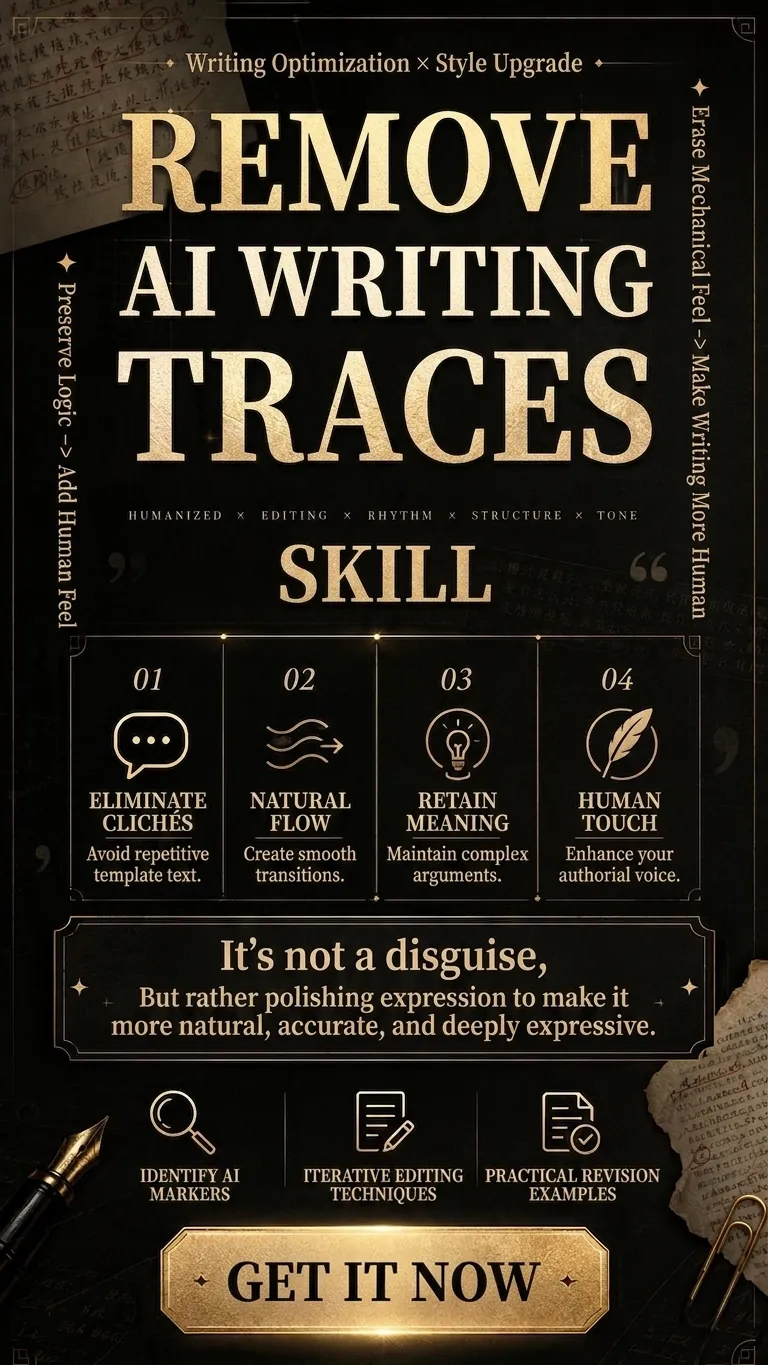 Write
AI Writing Humanizer
Want to eliminate the common 'industrialized' traces in Chinese AI text, giving your writing genuine human warmth and depth? This skill focuses on removing formulaic expressions in AI writing, injecting lively judgment, natural rhythm, unique emphasis, rich details, and authentic tone. It is especially adept at handling in-depth content such as comments, personal essays, historical analysis, political philosophy, social observations, reading notes, and long-form WeChat articles. By identifying and rewriting rigid aspects—from word choice and sentence structure to overall argumentation—this skill helps you transform grand, universally correct narratives into specific, nuanced insights, giving your writing a smooth and natural flow. Without altering the original meaning, it carefully diagnoses AI traces, such as identifying vague clichés, repetitive sentence patterns, and overly balanced tones. It replaces these mechanical elements with more concrete and insightful expressions, infusing your article with the author's personal thoughts and judgments rather than a cold logical construct. Additionally, for issues that mere polishing cannot solve, it points out where facts, examples, or arguments are needed, ensuring both depth and breadth. The result is a Chinese article that is not only clear in viewpoint but also full of human touch and personalized expression. It retains necessary professionalism while removing exaggerated adjectives and stiff connectors, making the text as natural as breathing—powerful yet warm, and far from being 'correct nonsense'.

Research Paper Deconstruction
Submit an empirical research paper and receive a deep deconstruction report to help you master the essence of academic writing. This tool is based on the methodology of 'Deconstructing Papers: Understanding Academic Writing through Close Reading,' systematically analyzing the paper from diagnosing the research question, constructing the GAP, connecting theory and materials, to sentence-by-sentence close reading of key paragraphs, layer by layer, revealing the internal logic and writing techniques of the paper. You will receive a structured analysis report that includes an assessment of the specificity and essential nature of the research question, tracking of the GAP logical chain and identification of its strategy type, as well as a detailed examination of the quality of the 'two-way' connection between theory and real-world materials. The report will also specially select the strongest and weakest paragraphs, providing sentence-by-sentence logical function annotations and technique comments, and offering specific revision suggestions for areas that can be improved. This report not only helps you understand the writing secrets of high-level papers but also points out common writing mistakes, allowing you to learn while reading and improve while analyzing. Whether evaluating the depth of the research question, optimizing the narrative of the literature review, or enhancing the rigor of the discussion section, this tool provides powerful guidance to help you write more insightful and persuasive academic works.
 Write
Human-Voice WeChat Writing
Turn a hot event, social phenomenon, workplace or relationship issue, personal experience, industry observation, product material, or existing draft into a WeChat Official Account article with a clear stance, genuine emotion, and shareable tension. Instead of settling for a safe “everyone has a point” perspective, it helps you find an angle that fits your target readers, identify the real conflicts and pain points, and use specific scenes, everyday details, and memorable judgments to make the article sound like it was written by a real person with experience, preferences, and an honest awareness of their limits. Along with a ready-to-publish article, it also produces a publication blurb of no more than 120 characters. This is not a summary of the full piece, but a hook designed to spark curiosity and suspense with as few words as possible, encouraging people who see it in their feeds to open the article. Throughout the process, it also applies originality and citation controls: the article does not use long passages copied from third parties; wherever possible, information is paraphrased, and any necessary quotations are kept brief with sources listed together at the end. This helps avoid being classified by the platform as low-originality content that may receive less distribution. It also organizes the creative decisions, title directions, and core points of the article, then prepares authorial responses for realistic comment scenarios such as factual challenges, opposing views, personal experience sharing, and out-of-context quotations. This makes it easier to handle discussion after publication. For hot topics, controversial events, and high-risk subjects such as law, medicine, and finance, it distinguishes known facts, reasonable inferences, and the author’s judgment, avoids fabricated information, and flags details that still need additional sources or verification. It is suited to WeChat Official Account writers, independent media editors, and content teams working on social observation, workplace expression, relationship perspectives, personal growth, and industry commentary. It is especially useful when you want to move beyond overly neutral writing and an AI-like voice without relying on personal attacks, exaggerated claims, or unnecessary conflict to gain attention.
Information
- Version
- v4
- Last updated
- Runtime credits
- Usage-based
- Models
- Auto
