
NSSF Topic Incubation
4-stage dialogue: from vague to quality draft
NSSF Topic Incubation
4-stage dialogue: from vague to quality draft
Showcase
Description
Helps young humanities and social science teachers applying for the National Social Science Fund for the first time. Starting from vague research directions, it uses a four-stage dialogue incubation process (direction analysis → theory reconstruction → argument draft → self-check optimization) to ultimately produce a high-quality topic and argument draft ready for submission.
Why we love this skill
The NSSF Topic Incubation skill is a four-stage conversational guidance skill. It helps young teachers refine vague research interests into high-quality NSSF candidate topics, and provides professional draft proposals and review-level self-check optimization suggestions. It is highly practical.
Related Skills
View all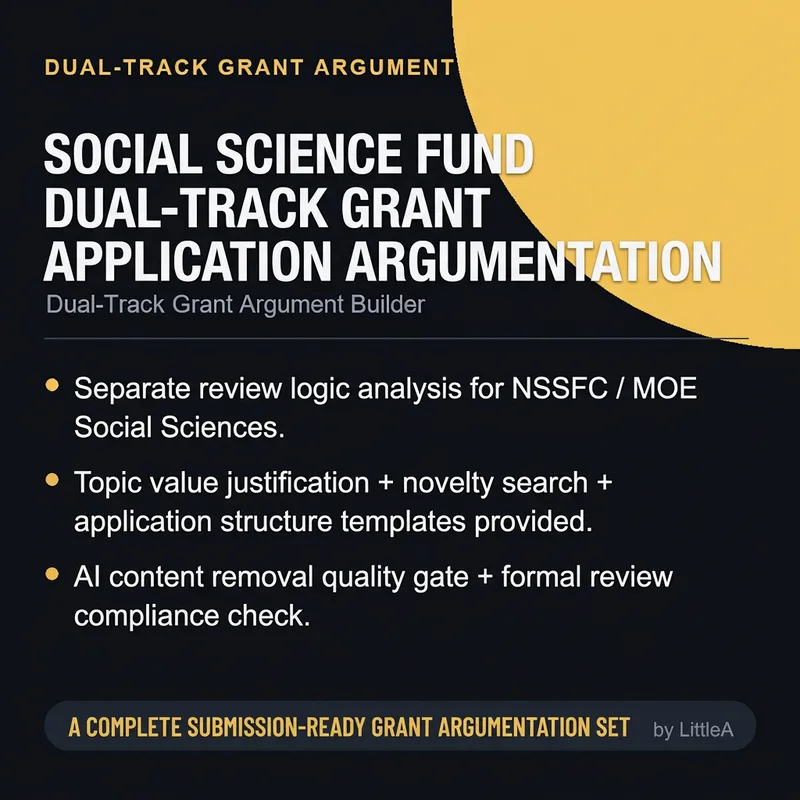 Write
Social Science Grant Proposal Generator
A combined grant proposal generator for the National Social Science Fund and the Ministry of Education Humanities and Social Sciences Research Projects, using the dual-track proposal method. Triggered when users ask about applying for national social science grants, writing Ministry of Education project proposals, simultaneous applications, word count allocation for blind review forms, feasibility sections, narrowing broad topics, drafting the background section, removing AI phrasing in proposals, literature searches, quota limits, youth project selection, anonymizing blind review forms, or project proposal generators. Using the dual-track proposal method (eligibility gate, topic argument, dual-track generation, AI phrasing removal, and formal review), it produces topic value arguments, literature search conclusions, the full proposal text (formatted for social science blind review forms or Ministry of Education Form B), an AI-phrasing-revised edition, and formal review red-line self-checks. Version 2.0.0. ## Overview A combined project proposal generator for the National Social Science Fund and Ministry of Education review tracks: clears prerequisite exclusion gates, helps narrow broad directions into specific genuine research questions, generates full proposal texts according to dual-track formats, and passes the AIGC < 10% quality gate and rejection-level formal reviews. Covers frequent pain points such as application procedures, simultaneous submissions, word count distribution, narrowing topics, removing AI tone, quota calculations, and blind review anonymization. ## What You Will Get 1. Topic value argument and literature search conclusions (3 targeted topic options, search comparison, and gap positioning) 2. Full proposal text (according to the selected track: 8 sections for social science blind review forms or 5 columns for Ministry of Education Form B) 3. AI-phrasing-revised edition (machine tone scan and natural phrasing comparison) 4. Formal review red-line self-check checklist (quotas, anonymity, word counts, and disciplines, rejection-level) ## Best For University humanities and social science faculty (lecturers and associate professors), early-career researchers, regional college teachers, postdoctoral researchers, and research administrators applying for national, ministry, or provincial social science planning grants.

Social Science Topic Master
Whether you are a novice researcher or an experienced scholar, whether you want to start from scratch to conceive a research direction or hope to optimize an existing topic, the 'Social Science Topic Master' can provide you with professional, systematic guidance. This tool is based on best practice methodologies for topic proposal writing, aiming to solve core challenges researchers face during topic selection: unclear direction, difficulty in refining research questions, ambiguous value judgment, and non-standard academic expression. Through step-by-step interactive guidance, this tool intelligently identifies your research needs and disciplinary background, providing customized theoretical perspective recommendations and policy clues. You will receive high-quality academic topic titles and undergo scientific diagnosis using the 'Five Criteria for a Good Question' to ensure the rigor and innovation of your topic. Ultimately, this tool outputs a structured complete topic proposal, including the academic title, topic element breakdown, results of the five-criteria test, key points for value argumentation, and policy and literature support. In addition, we provide two sets of detailed optimization suggestions: a 'Quick Fix' version and a 'Deep Optimization' version, helping you to improve key issues in a short time or to make systematic long-term enhancements, thereby significantly increasing the success rate of your topic proposal.

Social Science Topic Selection
Helps researchers start from scratch to select a research topic, or diagnose and optimize an existing proposal. It addresses common pain points: lacking direction, struggling to formulate questions, difficulty judging value, and inability to express academically. Based on best practices in project proposal methodology, the skill provides step-by-step interactive guidance to produce high-quality topic proposals.
Information
- Version
- v3
- Last updated
- Runtime credits
- Usage-based
- Models
- Auto
