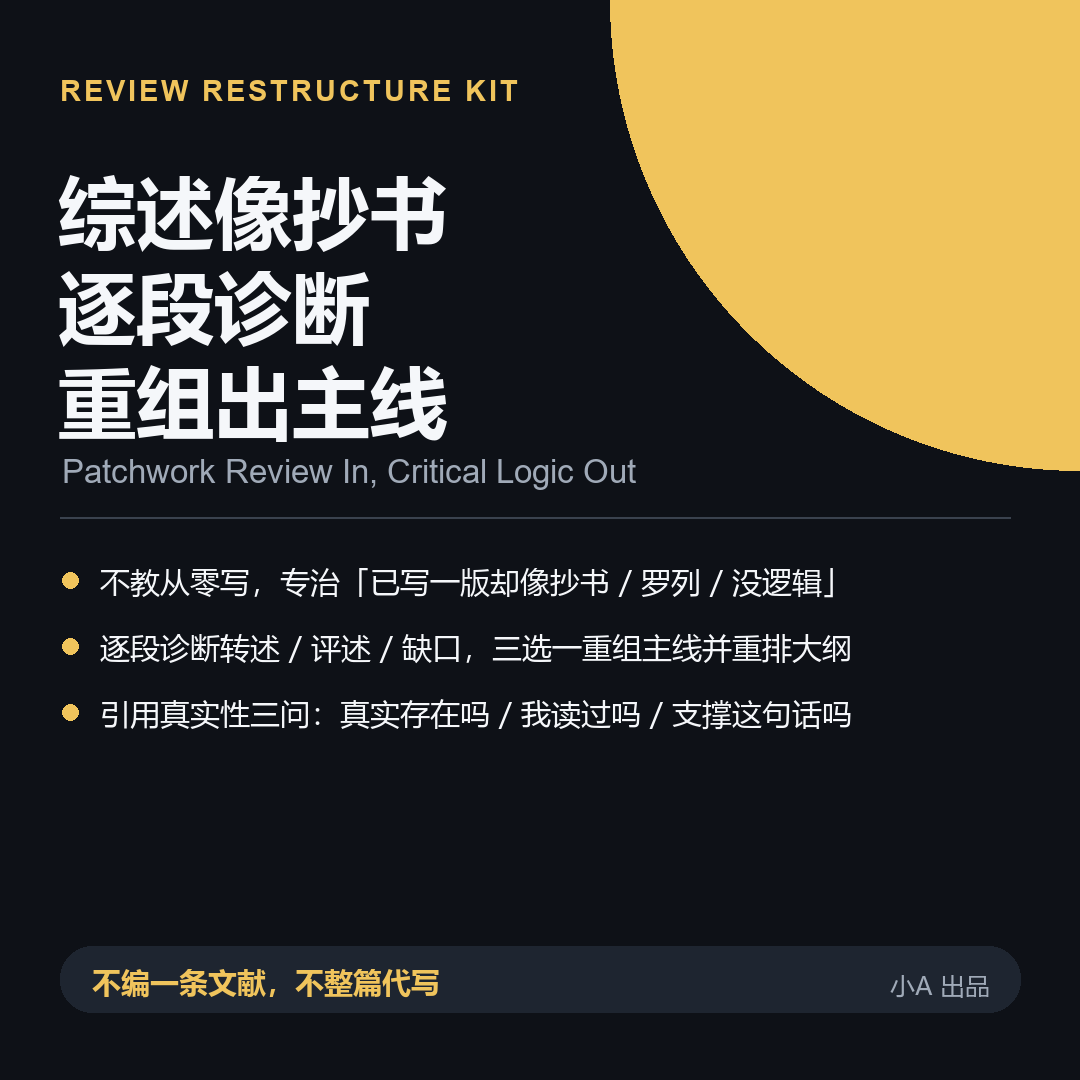
Literature Review Redesigner
Diagnose, reorganize, and refine literature reviews
Literature Review Redesigner
Diagnose, reorganize, and refine literature reviews
Showcase
Description
Finished a literature review draft only to hear it feels like a book report or a disconnected list of sources? This tool is built specifically for revision, not writing from scratch: paragraph-by-paragraph diagnosis, a choice of three thematic threads, actionable rewriting methods, and rigorous citation verification. ## Summary **Stop struggling with drafts dismissed as mere book reports. Transform a list of summaries into a coherent logical thread without generating fake citations.** ## Details The hardest part of a literature review isn't reading; it's spending weeks compiling dozens of sources into a draft only to be told it lacks logic, feels piecemeal, or reads like a simple summary of who said what. The root cause is usually a missing narrative thread that ties the literature together. This skill specializes in restructuring. First, it tags your draft paragraph by paragraph—identifying pure paraphrase, critique, or research gap—and flags questionable citations. Next, it offers three distinct organizing threads (by problem, by debate, or by gap), explains the rationale, and outlines a new structure. It then guides you on how to revise each section: using comparative sentences, highlighting disagreements, stating your judgment, and concluding with research gaps. It provides precise revision methods rather than writing the text for you. Crucially, it includes citation verification. Every reference is evaluated for authenticity, first-hand reading, and true support. AI-suggested references are verified thoroughly, and unverified entries are removed to prevent fabricated citations that reviewers easily spot. Finally, it uses a reverse-reading technique to test the logical thread. **This is a guidance-only skill**: it delivers diagnostics, threads, outlines, and revision methods without full ghostwriting, reference fabrication, or guaranteed approval. You remain responsible for verifying all sources.
Why we love this skill
Designed for literature reviews that read like disjointed lists. It diagnoses drafts, establishes clear thematic lines, and provides structural revisions and citation checks without fabricating references.
Best for
Students and researchers with a draft who need to clarify logical threads and reduce list-like literature summaries.
How to use this Skill
Provide your input
Provide your existing literature review draft, research question or topic, and discipline or use case. Include references if available.
Run the Skill
The skill diagnoses paragraph types, analyzes logical issues, and selects an organization thread based on problems, debates, or gaps.
Review your result
Receive a diagnostic report, a reorganized outline, paragraph-by-paragraph revision suggestions, and a citation check checklist without fabricated quotes.
Related Skills
View all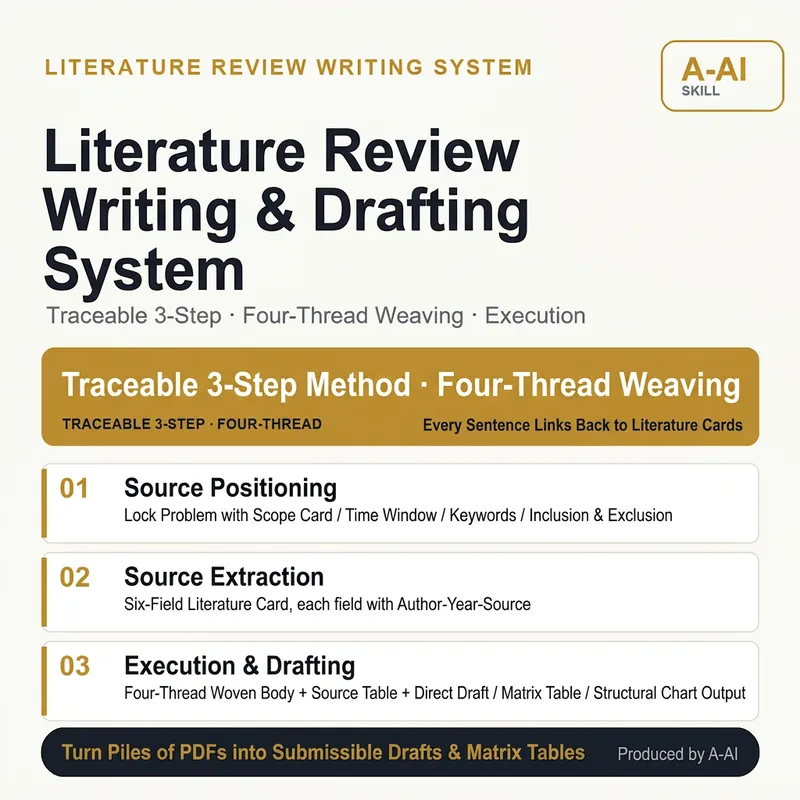 Write
Literature Review Builder
Struggling with a monotonous literature review or missing citations? The three-step provenance method and four-line weaving help you locate, extract, and weave content so every sentence links back to a literature card. Execution upgrade: upon authorization, directly receive a review draft, literature matrix table, and four-line structure diagram, organizing only what you have read without inventing citations. **Core Value**: Beyond templates—after authorization, receive the review draft, literature matrix table, and four-line weaving diagram directly; every step anchors to verifiable public standards without making up a single citation. **Best For**: Graduate students and early-career researchers writing research proposals, thesis chapters, or grant foundations; anyone with piles of unorganized literature, monotonous reviews, or unreferenced claims. **What to Input**: Service goal + concise research question + read literature list (PDF, notes, or citations) + discipline + target format. **What You Get**: 8 content items (verification card, scope card, 6-field card library, citation authenticity check, four-line outline, body draft, traceback table + gap, self-check + authoritative anchor check) + 5 finished items (authorization record, review draft, literature matrix table, four-line structure diagram, acceptance table). Replaced with a ready-to-paste content package when tools are unavailable. ## Exclusive Methodology: Three-Step Provenance & Four-Line Weaving Reviews read like laundry lists because claims lack sources and literature is not broken down. This method addresses precisely that: 1. **Provenance Location**: Scope cards lock in your research question, time window, keywords, database, and inclusions/exclusions to set boundaries. 2. **Provenance Extraction**: Create 6-field cards for each source—claim, method, finding, limitation, key quote, association—with (author, year, source). Never write about what you haven't read or invent page numbers. 3. **Provenance Weaving**: Weave timeline, theme, method, and debate into the body, linking each paragraph to card numbers for balanced critique. Output a citation traceback table and 3 gaps. Remember: Every claim links back to a literature card. ## Evidence-Based Public Standards Anchored in public standards rather than guesswork: GB/T 7714-2015, APA 7, COPE, PRISMA 2020 (applicable only to systematic or scoping reviews). Clear boundaries are marked, deferring to target school or journal requirements. ## Version 1 Update: From Templates to Finished Files This version turns content into usable files. It detects tool capabilities, informs you of generation plans, and proceeds upon confirmation: - **Review Draft**: Four-line format with provenance and references, ready for Word; - **Literature Matrix Table**: Row-by-row 6-field cards ready for Excel; - **Four-Line Structure Diagram**: Maps your cards and relationships. **No generation tools?** Receive a ready-to-paste content package with full text, Markdown matrix, and prompts. ## Details ### Why Reviews Become Laundry Lists It happens when you write without breaking down cards. The three-step method breaks down sources first, then weaves them logically. ### Three Steps 1. **Location**: Scope card + inclusion/exclusion. 2. **Extraction**: 6-field cards with source info and citation checks. 3. **Weaving**: Four-line body text + critique + traceback table + 3 gaps. + **Authoritative Anchoring**: Verifiable public standards. + **Execution Delivery**: Tool detection → authorization → output → acceptance. ### What It Does Not Do - **Only processes read content**: No invented citations, authors, years, sources, page numbers, or data. - **No fake generation**: Clearly marks missing tools and provides paste-ready packages. - **No publication guarantees**: Focuses on clarity and rigor. - **No forced authority**: Applies standards only when appropriate. - **Honest resource usage**.
 Write
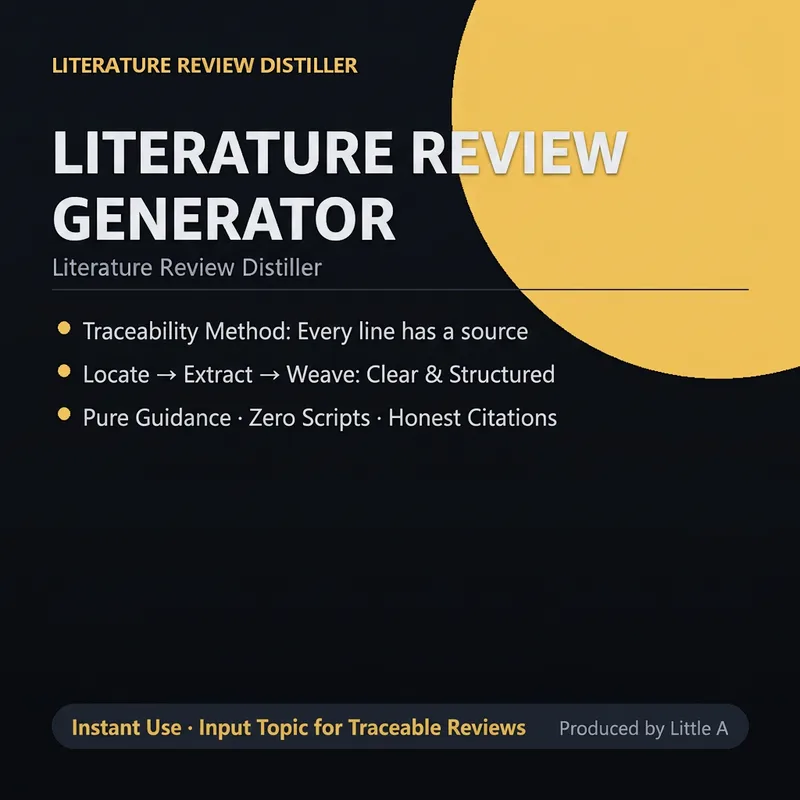
Literature Review Builder
Help graduate students, early-career faculty, and researchers turn a pile of scattered literature (PDFs, notes, keywords) into a logically clear literature review where every claim can be traced and used directly in a paper. The three-step source-tracing method guides you through scope definition, individual paper extraction, and four-line weaving, providing templates and editable intermediate outputs throughout without fabricating citations. Ideal for research proposals, thesis background chapters, and grant applications when you are stuck organizing too many papers or finding research gaps.
 Write
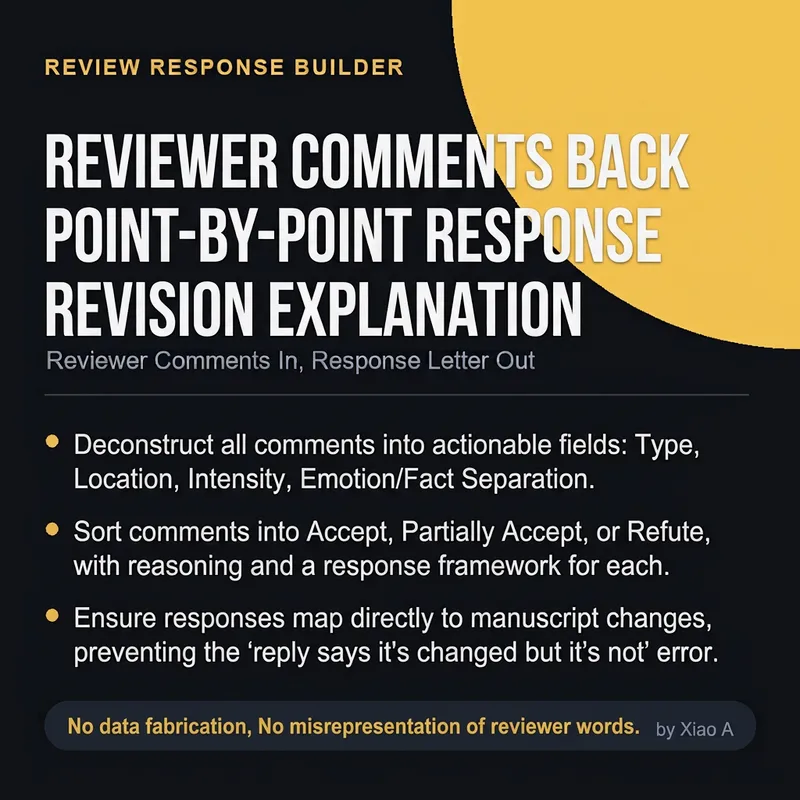
Peer Review Response Generator
Struggling to respond to a mountain of peer review comments? This Skill parses feedback into actionable items, sorts them by acceptance status, provides structured response templates, creates a mapping table between replies and manuscript edits, and assembles a professional response letter and revision checklist. After receiving dozens of comments, the hardest part is categorizing them, prioritizing edits, and respectfully rebutting points without provoking reviewers. This workflow breaks down reviews into structured fields: type, location, demand strength, and feasibility. It separates reviewer tone from actual requested actions. Incoming comments are triaged into three categories: accept, partially accept, or rebut, with clear determination criteria and proven response frameworks. Rebuttals follow strict red lines to remain professional and evidence-based. The critical step is the revision mapping table, which ensures every promised change matches actual manuscript edits, preventing discrepancies. Finally, it formats a numbered response letter and a revision checklist for your supervisor. **Note**: This is a guidance-only Skill. It delivers worksheets, response frameworks, and checklists. It does not write manuscript text, fabricate experimental data or literature, or guarantee acceptance.
Information
- Version
- v3
- Last updated
- Runtime credits
- Usage-based
- Models
- Auto
- Use cases
- Writing & contentResearch & analysisLearning & education
- What you get
- ReportDocumentPlan
