
Research Literature Gap-Matrix Analyzer
9-agent gap detection engine powered & gap-geometry analysis
Research Literature Gap-Matrix Analyzer
9-agent gap detection engine powered & gap-geometry analysis
Showcase
Description
Detects, classifies, and justifies literature gaps across 9 dimensions using semantic similarity and gap-geometry analysis. Transforms a research question plus 10–50 abstracts into a structured academic report with confidence scores, gap geometry matrix, relationship graph, filling strategies, and publication-ready sentence templates. Step 2-step (Gap Geometry + Deep Analysis) Sub-agent 9 (6 detection + 3 synthesis) Control Point Adaptive — 1 for ≤20 summaries, 2 for >20 summaries Language English Framework components of the skill: The bridge metaphor — the mathematical formulation X ≠ Y but X ≈ Y 4-region gap geometry (Redundancy / Gap Region / Hidden Gap / Irrelevant) 9-sub-agent architecture — Context, Method, Variable, Theory, Time, Finding, Semantic-Gap, Composition-Gap, Dependency-Gap Relationship graph — similar_to, belong_to, compose_with, depend_on Threshold calibration by discipline — social sciences (0.60), engineering (0.70), default (0.65) Set of rules for elements to be included or excluded (5+5) Selection based on confidence score — 70%+ threshold, maximum of 3 gaps Sample text ready for publication — clearly marked as AI-generated Adaptive checkpoint — approval mechanism that adjusts automatically based on the number of summaries
Related Skills
View all Research
 Topic & Gap Finder
Suggests original, workable research topics and gaps from your area of interest and literature knowledge; provides a research-question draft and feasibility note for each. Who it's for: graduate students and researchers looking for a thesis or article topic.
 Research
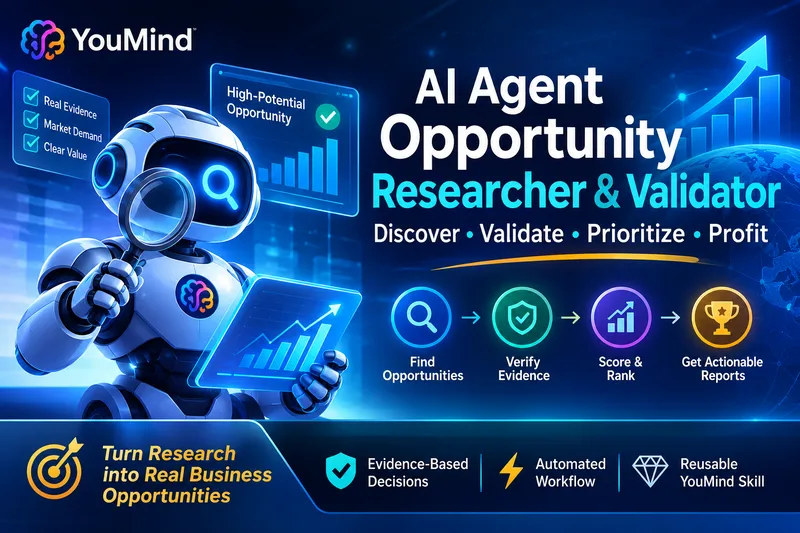
AI Agent Opportunity Researcher
AI Agent Opportunity Researcher & Validator is an evidence-first market research and product validation skill that discovers, investigates, scores, and documents real-world problems you can turn into sellable AI Agent Skills, automated workflows, developer utilities, downloadable digital products, and micro-SaaS tools. Instead of generating generic startup ideas, this skill runs a repeatable 6-stage validation workflow: 1. Discover: Scans official changelogs, API deprecations, GitHub issues, support forums, reviews, and regulatory updates (prioritizing the last 24-72 hours plus persistent problems with recent triggers). 2. Extract the Problem: Maps who experiences the pain, workflow triggers, frequency, consequences, and current workaround costs. 3. Verify Evidence: Tags every claim as FACT, DIRECT_EVIDENCE, INFERENCE, HYPOTHESIS, or UNKNOWN and tracks 4 dates (publication, event, reported, and accessed) to filter out stale or republished news. 4. Analyze Competition: Compares commercial SaaS, open-source tools, existing skills, built-in platform features, and manual workflows—rejecting AI complexity whenever a simple script, checklist, or spreadsheet suffices. 5. Score & Gate (100-Point Rubric): Evaluates candidates across 9 weighted dimensions, 4 independent confidence ratings (Problem, Solution, Demand, Willingness to Pay), and hard override gates for contradicted claims, tool infeasibility, or critical security/licensing risks. 6. Design Validation Experiments: Assigns GO TO PROTOTYPE, VALIDATE FURTHER, or REJECT OR DEFER, complete with a $0-$50, <=7-day validation experiment, measurable pass/fail thresholds, a 16-section Markdown report, and a JSON export ready for downstream prototyping.
 Research
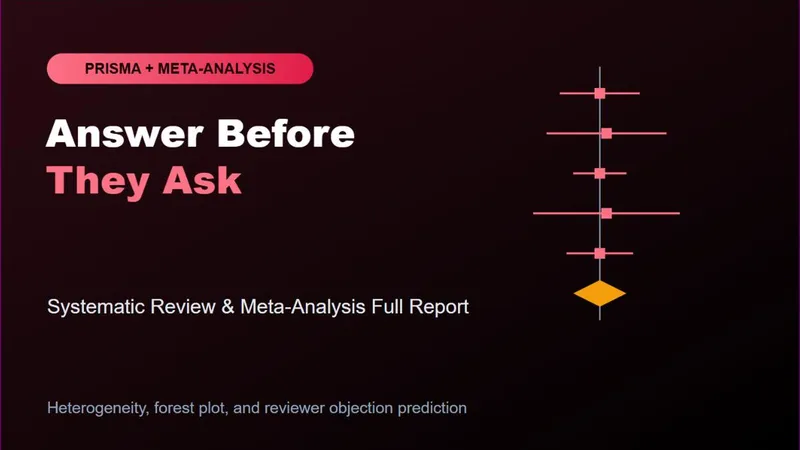
Meta-Analysis Full Report Writer
Produces a complete Methods + Results + Limitations text compliant with PRISMA 2020 and the Cochrane Handbook from your meta-analysis statistics (pooled effect size, I², Q, tau², publication bias indicators). Never misinterprets the I² value (including the "percentage of variance" framing); avoids overstated causal language (uses cautious phrasing like "findings are consistent with..." instead of "evidence demonstrates that"). At the end, it also offers at least 3 questions a reviewer might ask along with defense sentences. Suitable for: researchers writing a meta-analysis paper who want to strengthen the methods section before journal submission. What it does not do: it does not perform statistical calculations from raw data (you must already have your R/RevMan/CMA output) — it only converts and interprets your results into academic text.
Information
- Version
- v2
- Last updated
- Runtime credits
- Usage-based
- Models
- Auto
