
Journal Fit Advisor
Rejected? It's about fit, not quality.
Journal Fit Advisor
Rejected? It's about fit, not quality.
Showcase
Description
Rejected? It's not necessarily bad writing—it's not writing like this journal. 「Journal Fit Advisor」doesn't boast about the journal's ranking. It does one thing: break down real samples from your target journal, show you exactly what it prefers, and help you revise your paper paragraph by paragraph to fit better. 🎯 How it helps Submit a target journal → Extracts real preferences across six dimensions: topic, structure, theory, methodology, language, argumentation → Diagnoses where your paper falls short → Provides actionable rewrites (2-3 versions each for title, abstract, introduction, conclusion). ✨ Why trust it • Each preference is labeled with evidence level: official statement (A), sample inference (B), cautious guess (C). If it's a guess, it says so. • Cross-checked for uniqueness: every feature asks 'Do other similar journals do this too?' Only retains true differentiators. • No fabrication: no fake impact factors, no fake acceptance rates, no promises of acceptance. Lowers confidence if material is insufficient. • Plus a 'Journal Style Prompt Card' – copy and paste into any LLM to instantly write in that journal's style. 💬 How to use it ·“Analyze the topics and writing style of Journal XX over the last three years” ·“I want to submit to Journal XX – run a submission fit diagnosis for me” ·“Rewrite my abstract to sound more like Journal XX” ·“How long are titles in Journal XX typically?” (quick answer for short questions) 👥 Who it's for: graduate students, early-career researchers, authors wanting to self-check before submission. ⚠️ Boundaries: It provides observable style analysis, not the editor's true thoughts, nor a guarantee of acceptance. Cross-journal topic selection, pure title polishing, and chapter ghostwriting will be redirected to more appropriate tools.
Related Skills
View all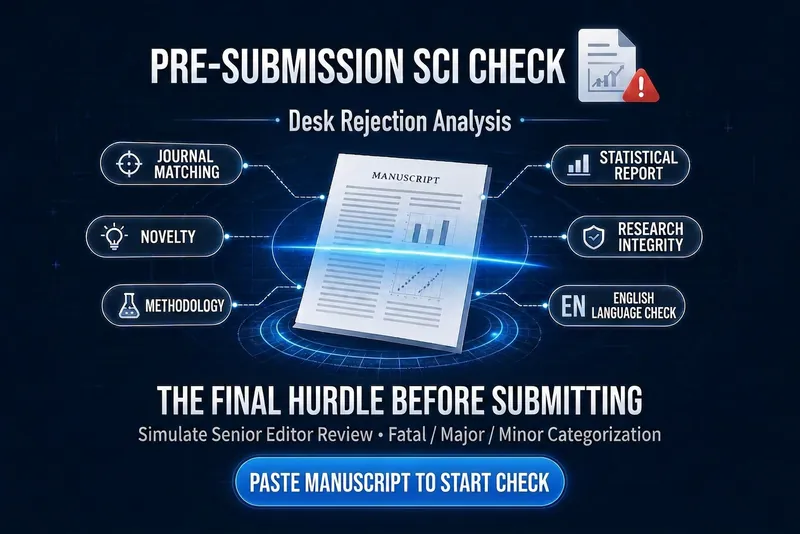
SCI Desk Reject Pre-check
You spend months writing a manuscript, submit it—and three days later receive a rejection letter with no review comments. The editor-in-chief didn't even send it out for peer review; it was a desk rejection. 「SCI Desk Reject Pre-check」offers the initial screening perspective of a seasoned handling editor, helping you ensure quality before submission. What does it check? 📌 Journal Fit — Whether the topic aligns with the target journal's scope 🔍 Novelty and Contribution — Can the editor-in-chief identify your core contribution in 30 seconds? ⚗️ Methodology and Reproducibility — Design flaws and description gaps that trigger red flags 📊 Statistics and Quantitative Reporting — Issues in data presentation, significance, sample size, etc. 🛡️ Research Integrity and Ethics — Ethics approval, conflicts of interest, plagiarism check, AI disclosure, data availability 📝 Structure and Readability — Broken logic chains, weak abstracts, buried key information 🌐 English Language Risk — Whether language quality might trigger a language-based desk rejection All issues are categorized as 'Fatal / Major / Minor', each with actionable revision suggestions. Suitable for any SCI discipline: physics, chemistry, materials, engineering, life sciences, computer science, environment, geosciences, and more. Send your manuscript (or abstract + methods section) and start the check.
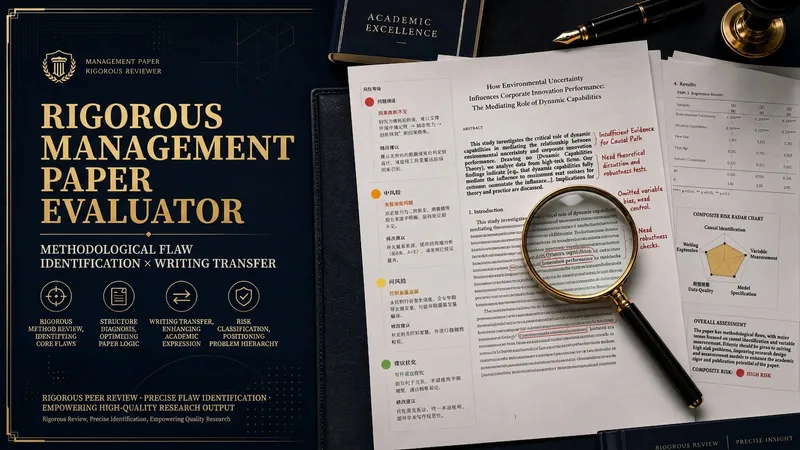
Management Paper Strict Review
Have you encountered these problems? ❌ You cited a seemingly authoritative paper, only to have reviewers question, 'This study has severe endogeneity issues.' ❌ When writing a literature review, you're unsure whether a paper's conclusions are trustworthy. ❌ After reading dozens of papers, you still don't know how to apply others' writing techniques to your own paper. ❌ Before submission, you want to check for methodological risks but don't know which hard flaws top journal reviewers focus on. This Skill helps you: ✅ Quick mode (15–25 min): Determine whether a paper is worth reading in depth and can be cited confidently. ✅ Deep mode (45–60 min): Check methodological flaws item by item like an AMJ/ASQ/SMJ reviewer. ✅ Quantitative credibility rating: 🔴 Not citable / 🟠 Use with caution / 🟡 Reference only / 🟢 Safe to cite – at a glance. ✅ Writing transfer task card: Turn techniques from others' papers into executable tasks for your own Introduction/Methods/Results/Discussion sections. Covers seven methodology types: Quantitative regression, experimental studies, quasi-experimental causal identification, fsQCA, case studies, grounded theory, mixed methods. Output includes: - Six-area deep reading (theoretical dialogue, mechanism pathways, construct operationalization, method-data fit, contribution critique, writing techniques) - P1/P2/P3 risk levels (fatal/important/arguable) - Counterfactual testing (can the model explain reverse scenarios?) - Boundary condition check (5 dimensions: market/regulation/capital/technology/competition) - Writing transfer task card (specific techniques directly applicable to your own paper) In a nutshell: It is not a gentle paper summarizer. It's a strict academic writing assistant that helps you discover, 'Where can't this paper be trusted? What is worth learning from it? How can I apply it to my paper?' Suitable for you if you are: 📚 PhD/master's students writing literature reviews 📝 Management researchers preparing submissions to top journals 🔍 Reviewers needing quick paper quality assessments 📖 Paper writers wanting to learn top journal writing techniques
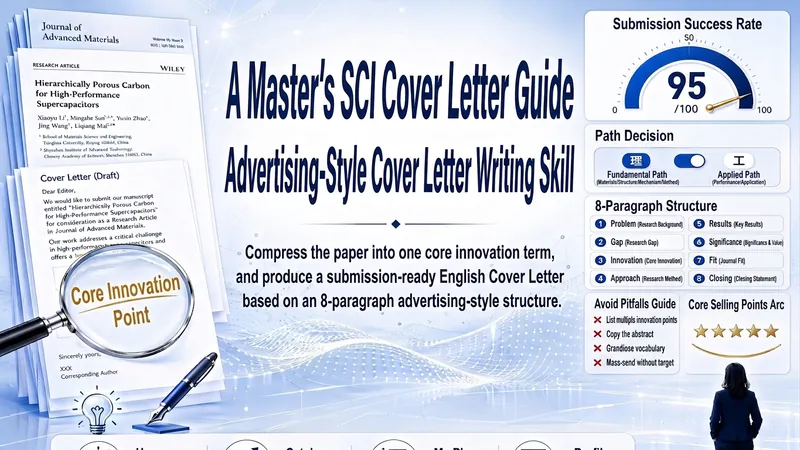
SCI Cover Letter Slow Teacher
This skill treats your journal submission cover letter as an advertisement for your paper. It first forces you to compress your research into a single core innovation point ("one word") and decide whether it follows the "science" route (material/structure/mechanism/method) or "engineering" route (performance/application). Then, it generates an 8-section English cover letter ready for submission: a four-sentence selling arc covering problem, innovation, data, and significance; journal matching information; and standard declarations. It uses the most concise, objective language (rejecting flashy words like "employs" or "shatter the ceiling") and fits within one page. Including a figure is mandatory: for performance types, it provides literature comparison scatter plots or tables; for mechanism/structure types, it actively diagnoses your existing figures (five-point check), gives a redraw list, and directly outputs an SVG draft. It can also critique an existing draft, pointing out common flaws such as listing multiple innovations, lacking data, copying the abstract, or having no journal targeting, and rewrite it. Compatible with universal agents like Claude Code and Codex. Trigger phrases include "help me write a cover letter", "submit to SCI", "is this letter good", and "which figure should I show the editor".
Information
- Version
- v5
- Last updated
- Runtime credits
- Usage-based
- Models
- Auto