
Sprout | Thesis Change Monitor
Track changes that could shift your thesis.
Sprout | Thesis Change Monitor
Track changes that could shift your thesis.
Showcase
Description
You don't need to watch one company every day. Once you start following a company, it's easy to fall into a routine: Checking the news, earnings reports, interviews, analyst reports, and stock price every day… Because you're always worried: “What if there's an important change I missed?” The problem is that most updates don't actually change anything. New product launches, management interviews, analyst price-target increases, stock-price moves, repeated media coverage… You consume a lot of information, yet still don't know: Did anything really happen that should make me reassess this company?
Recommended by
Shuting@YouMind
Why we love this skill
It filters for evidence that can change your investment thesis—not recycled news—while distinguishing rumors, orders, revenue, and profit, and calmly showing when an update isn’t worth your attention.
Best for
For everyday investors who want less news noise and only want to focus on changes that could alter their investment thesis.
How to use this Skill
Provide your input
Enter the company or asset you follow, your current view, why you follow it, and how long you want to monitor it. You can also provide existing monitoring information.
Run the Skill
Run an investment change check to see whether new facts have emerged that could affect your original thesis.
Review your result
Get a brief conclusion: no action needed, your thesis is stronger or weaker, or it may need to be reassessed, along with follow-up items to watch.
Related Skills
View all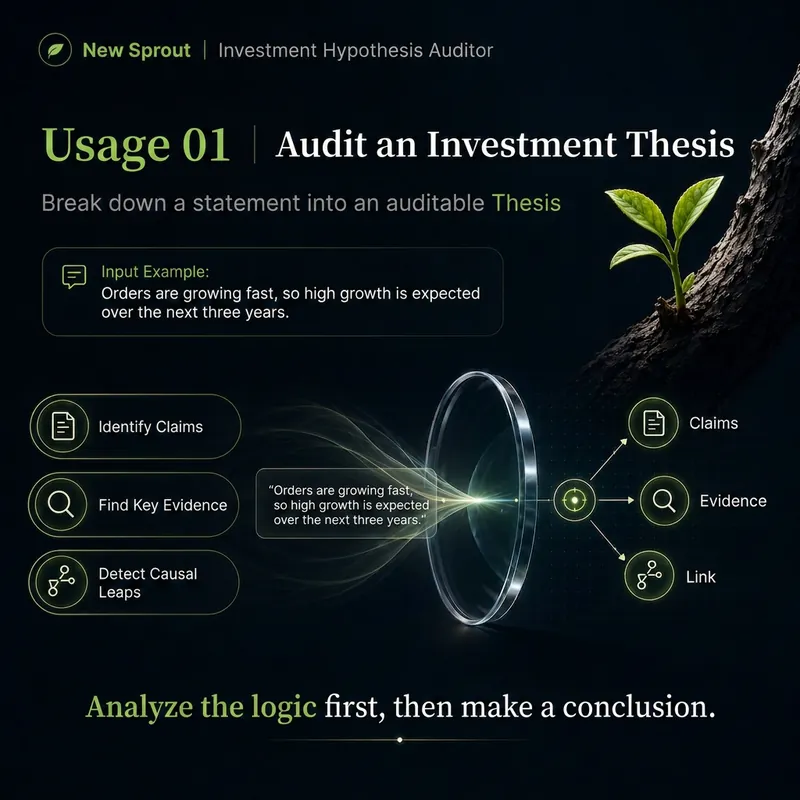 Research
Sprout | Thesis Auditor
Don't help prove my thesis. Help audit it. Many investment judgments fail not because the data is entirely wrong, but because accurate data supports an overextended conclusion. For example: “AI orders are abundant, so profits will definitely grow rapidly over the next three years.” “The company's business is strong, so the stock is cheap right now.” “Customers keep increasing, so the company has already achieved network effects.” “Management says the technology is leading, and it is stated in the financial report, so the moat has been proven.” 「Sprout | Thesis Auditor」does not help you find more reasons to prove yourself right. It breaks your investment thesis into an auditable Critical Path and checks each layer: Facts → Evidence → Causal Relationships → Hidden Assumptions → Commercialization → Economic Outcomes → Valuation By prioritizing primary sources, it answers the questions that truly matter: Which parts have already been supported by evidence? Which are merely reasonable inferences? Which necessary link is most fragile? Is there counterevidence that genuinely attacks the Thesis? What evidence is most likely to change the conclusion? It ultimately assigns one of five ratings: SUPPORTED / PARTIALLY SUPPORTED / FRAGILE / BROKEN / INSUFFICIENT DATA The conclusion must be traceable to specific Necessary Claims and evidence, rather than a vague “on balance” assessment.
 Research
Sprout Signal Translator
In a major industry news story, the company mentioned in the news is often not the one most worth researching. A surge in NVIDIA demand could reshape the server, power, and cooling industries; rapid growth at a private AI company could actually generate revenue for cloud providers, chip designers, and networking suppliers; and a highly publicized CEO speech may not have changed any economic facts. Sprout Signal Translator first verifies the event, then traces the value chain: What happened → What assumption changed → Where is the money flowing → What is the next bottleneck → Who already has the capability to solve it → Has the market already been revalued. It looks for both direct beneficiaries and potential losers, Picks & Shovels, and Emerging Sprout Candidates whose “mature core business provides a safety net while a new industry provides growth options.” When it cannot find a reliable economic transmission path, it allows the output NONE. It does not provide BUY / SELL recommendations, price targets, or return promises. Its goal is not to predict the next skyrocketing stock, but to translate industry changes into research leads worth validating further.
Stock Picking Decision Engine
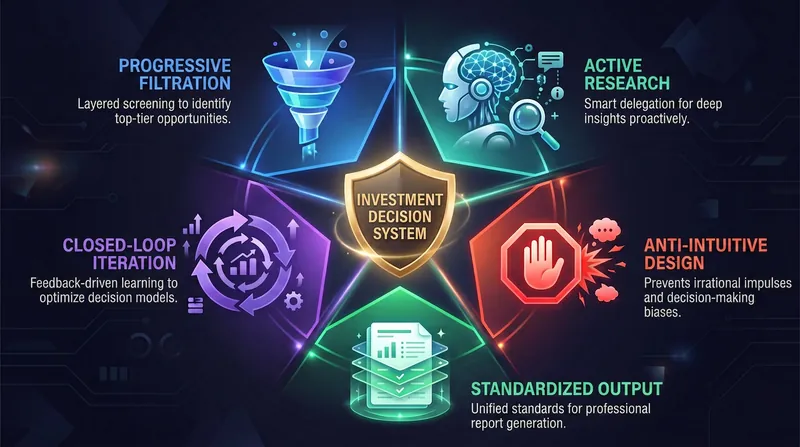
Every investor has experienced these moments: • 📝 Impulse buying that ends in regret — you see a stock rise for three days, your hand itches, you place an order, and end up buying at the top. • 🤔 Deciding without enough research — you read one analysis article and think you 'get it,' but you can't even explain how the company makes money. • 💸 Not knowing when to sell — you won't sell when you're winning, you can't accept selling at a loss, and in the end you get hurt on both sides. • 🎭 Being swept up by market sentiment — you panic when others panic, get greedy when others get greedy, and forever chase rallies and dump stocks on declines. • 🔄 Repeating the same mistakes — with no review system, every trade starts from scratch. The investment decision system was created to solve these problems. It is not a tool that helps you find reasons to buy; it is a decision brake system that helps you identify the moments when you 'shouldn't buy.' There is only one core principle: a good company ≠ a good stock.
Information
- Version
- v4
- Last updated
- Runtime credits
- Usage-based
- Models
- Auto
- Use cases
- Research & analysisInvestment & finance
- What you get
- Brief