
Is It Worth It? Decision Pro
One review: dashboard, report & 90-day plan
Is It Worth It? Decision Pro
One review: dashboard, report & 90-day plan
Showcase
Description
One decision due diligence, delivered as a four-part package. “Is It Worth It?” doesn’t give you a simple “do it” or “don’t do it.” Instead, it treats a life decision like an investment due diligence process: first, it measures your personal priorities (the answer can differ for someone earning 5,000 a month versus 50,000), then checks four red lines—legal, health, financial, and relationship risks. It searches academic papers and official data, models the costs, benefits, and evidence levels, calculates a 10-year total, and runs sensitivity analysis. Finally, it stress-tests the decision with a pre-mortem, base rates, and a bias checklist, then designs a “minimum viable experiment” to buy information at low cost. You’ll receive: ① An interactive decision dashboard (web): a four-dimension radar, value-for-money gauge, 10-year cash flow, draggable sensitivity sliders to see when the conclusion flips, an evidence pyramid, risk matrix, 90-day action map, saveable review ledger, and 3:4 share cards. ② A decision due diligence report (document): conclusion, calculations, evidence chain, risks, and actions—ready to archive or print. ③ A 90-day action map: what to validate in week 1, where the stop-loss line is, what conditions trigger an exit, and when to review. ④ A decision review ledger: record predictions and outcomes to improve your judgment calibration. Suitable for: graduate school vs. work, whether to change jobs, whether to buy a home, whether to start a business, whether to pursue a PhD, whether to end a relationship, whether to accept an offer, whether to have surgery, and whether to move to another city. The method is rigorous: every piece of evidence is labeled A/B/C with its original source; figures are recorded together with confidence intervals; if something can’t be found, it says so plainly; and all rating formulas are公开 so you can recalculate them yourself. The methodology pays tribute to the open-source project “The High Value-for-Money Life Guide” (github.com/eternity4719/HowToLiveBetter), with four upgrades: personalized weighting, a 10-year total, falsification stress tests, and “buying information.”
Recommended by
Dancang
Why we love this skill
Turns “Is it worth it?” uncertainty into an auditable, calculable, and falsifiable personal decision system—with evidence grading, 10-year accounting, sensitivity analysis, experiments, and a 90-day action map.
Related Skills
View all
High-Value Decision Advisor
When you are grappling with 'whether to do something', 'whether to choose a certain option', 'whether it's worth investing resources', or want to review 'why that decision turned out the way it did', this Skill acts like a warm project evaluation advisor, helping you break down vague thoughts into assessable evidence. It is suitable for: - Career choices: whether to change jobs, switch careers, join a startup, pursue graduate studies; - Education and growth investments: whether to enroll children in classes, buy courses, commit to a long-term learning plan; - Project and opportunity evaluation: whether to start a project, take on a partnership, invest resources; - Relationships and life choices: whether to confess feelings, move, change living arrangements; - Historical decision review: review a resignation, postgraduate exam, investment, partnership, or relationship choice. It automatically adjusts the depth of reasoning based on the decision magnitude: - Lightweight decisions: quickly clarify key variables and give brief advice; - Medium-weight decisions: structured analysis around necessity, feasibility, risk, timing, and alternatives; - Heavyweight decisions: full project-style reasoning, outputting risk warnings, directional recommendation, and action paths; - Review-type questions: helps you reconstruct the judgment chain at that time, identify prediction biases and transferable lessons. You can start like this: - 'Should I sign my child up for a 20,000 per year English class?' - 'Should I leave my stable job for a startup?' - 'I want to review my decision last year to resign and study for graduate exams.' - 'I'm not sure whether to confess my feelings, can you help me analyze it?' - 'Is this opportunity worth my time and money?' In the end you will get: - A clear directional recommendation: recommend to proceed / recommend to hold off / recommend to gather more information before deciding; - The confidence level and key uncertainties for each recommendation; - The risks you most easily overlook; - The next minimal validation step. Note: It will not pretend to be certain with insufficient information and make decisions for you; it will help you see the decision basis, risk boundaries, and what to verify next.
First Move Pro
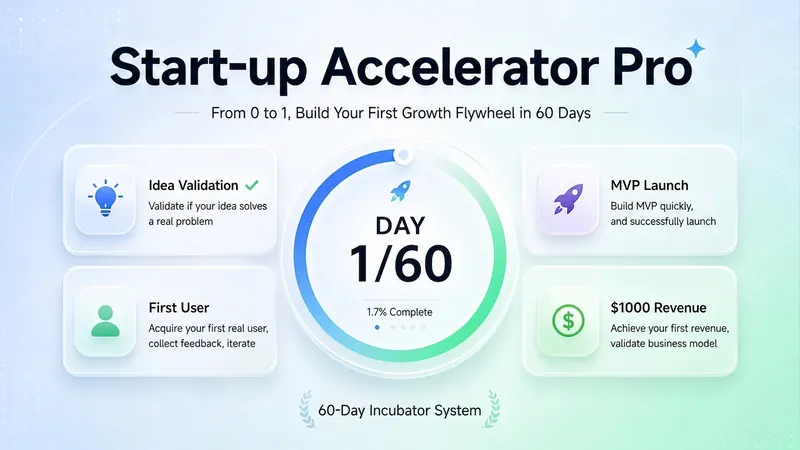
90% of indie developers get stuck in one of two places: they have an idea but don't know if it can make money, or they built something but can't sell it. This isn't a one-time diagnosis—it's a reusable monetization system that you can use for every new product. ## What You'll Get ### 1️⃣ 4-Step Monetization Framework (Reusable) • Demand validation: Quickly validate if an idea is worth pursuing in 7 days (where to validate, what to ask, how to decide) • MVP launch: Build a minimum chargeable version in 30 days (which tools, how far to go) • Cold-start customer acquisition: Find your first 10-50 paying users (where to find them, how to reach them, how to price) • Growth flywheel: A concrete path from $0 to $1000 (which metrics to track, which levers to optimize) ### 2️⃣ Visual Dashboard Templates (Ready to Use) • Feishu Multidimensional Table / Notion dashboard templates • 4 phases × key actions × completion status • Visual progress, no more confusion ### 3️⃣ Key Metrics Tracking Table (Data-Driven) • Validation phase: How many people validated? How many willing to pay? • MVP phase: Launched? How many users? • Cold-start phase: Customer acquisition cost? Conversion rate? • Growth phase: MRR? Churn rate? ### 4️⃣ Milestones + Kill Switch (Rational Decision Making) • What are the "pass conditions" for each phase? • When should you persist? When should you quit? • Decide with data, not gut feeling ## Why Is This System Worth 1999 Credits? ✅ Reusable indefinitely: Not a one-time diagnosis—you can use this system for every new product ✅ Save time: Save 2-4 weeks of detours per product = 80-160 hours = $4000-8000 in value ✅ Reduce risk: Validate demand with data, avoid building for 3 months only to find no one wants it ✅ Visual clarity: Dashboard + tracking table, clear progress, no more anxiety ## Who Is This For? ✅ People with ideas but unsure if they can make money ✅ People with a product but haven't sold it yet ✅ People who want a side hustle but don't know where to start ✅ People who built a product but failed and want to find the problem ✅ Content creators who want to build products with AI tools (Cursor, Bolt.new) ## Who Is This Not For? ❌ People who only want encouragement (this system will honestly say 'this direction won't work') ❌ People unwilling to put in the time to execute (we give you the system, but you have to do the work) ❌ People expecting overnight riches (this is a systematic 60-90 day path, not quick money) ## Final Deliverables 1. Monetization Diagnostic Report (Long Document) • Your phase assessment + core issue diagnosis • Action checklist for the 4-step monetization framework • Key metrics + Kill Switch 2. Visual Dashboard Template (Feishu/Notion) • Task dashboard for 4 phases • Key metrics tracking table • Milestone checklist 3. One Key Decision Recommendation • Is this direction viable? • If not, which direction should you pivot to? Saving you 2-4 weeks of detours is 100 times more important than sweet talk.
Should I Do It? Analysis
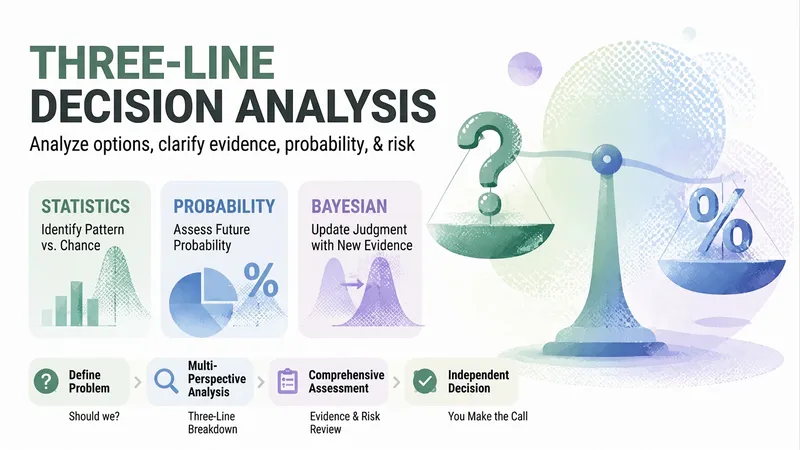
Turn the vague uncertainty of “Should I do X?” into a clearly bounded decision analysis that can be checked and updated over time. Whether you’re considering leaving your job to start a business, investing in a project, buying an asset, or making a career or life choice, you can provide text, tables, documents, or screenshots to organize your options, time horizon, major costs, how much risk you’re willing to accept, and how much confidence you need before acting. The analysis examines the question through statistics, probability theory, and Bayesian reasoning: checking whether samples are reliable and whether an observed pattern is more likely a real trend or a coincidence; breaking down possible future scenarios and comparing probabilities, expected returns, and tail risks; then combining prior beliefs with new evidence to determine which information is truly discriminating and how your judgment should be updated. User-provided facts, public information, and analytical assumptions are clearly separated. When reliable data is lacking, uncertainty is not concealed behind false precision. You’ll receive a replayable decision framework that includes new information worth verifying, actionable next steps, triggers for reassessment, and key evidence still needed. It won’t make the decision for you or present assumptions as facts. Instead, it helps you see the evidence, probabilities, costs, and risks clearly, leaving the decision in your hands.
Information
- Version
- v9
- Last updated
- Runtime credits
- Usage-based
- Models
- Auto
