
Phoebe English Polisher
Error-free English, more authentic language
Phoebe English Polisher
Error-free English, more authentic language
Showcase
Description
Designed for native Chinese authors or Chinese translations, it elevates your articles to international publishing standards while preserving the original meaning and Chinese perspective, giving you a final polish before submission. This Skill has multiple editing capabilities, including correcting spelling, grammar, and punctuation errors; optimizing word choice and sentence structure; and eliminating translationese to ensure the article conforms to English readers' reading habits. It also evaluates the article's arguments, evidence, structure, and reasoning, identifying potential logical gaps or areas needing additional context. 1. Polish paragraph by paragraph, marking each change clearly in bold. 2. Attach Chinese translation and revision notes for each paragraph, explaining why the change was made. 3. Overall analysis of article structure, logic, and argument strength. 4. Extract a glossary for easy reuse. Suitable for: policy commentary, international current affairs, columns, academic submissions, and international communication pieces. Special note: It does not automatically output a clean version; you need to decide whether to accept changes to avoid version confusion.
Why we love this skill
This skill offers deep editing for English articles by native Chinese speakers, correcting not only language errors but also optimizing at cultural and logical levels to ensure authentic, internationally impactful content.
Related Skills
View all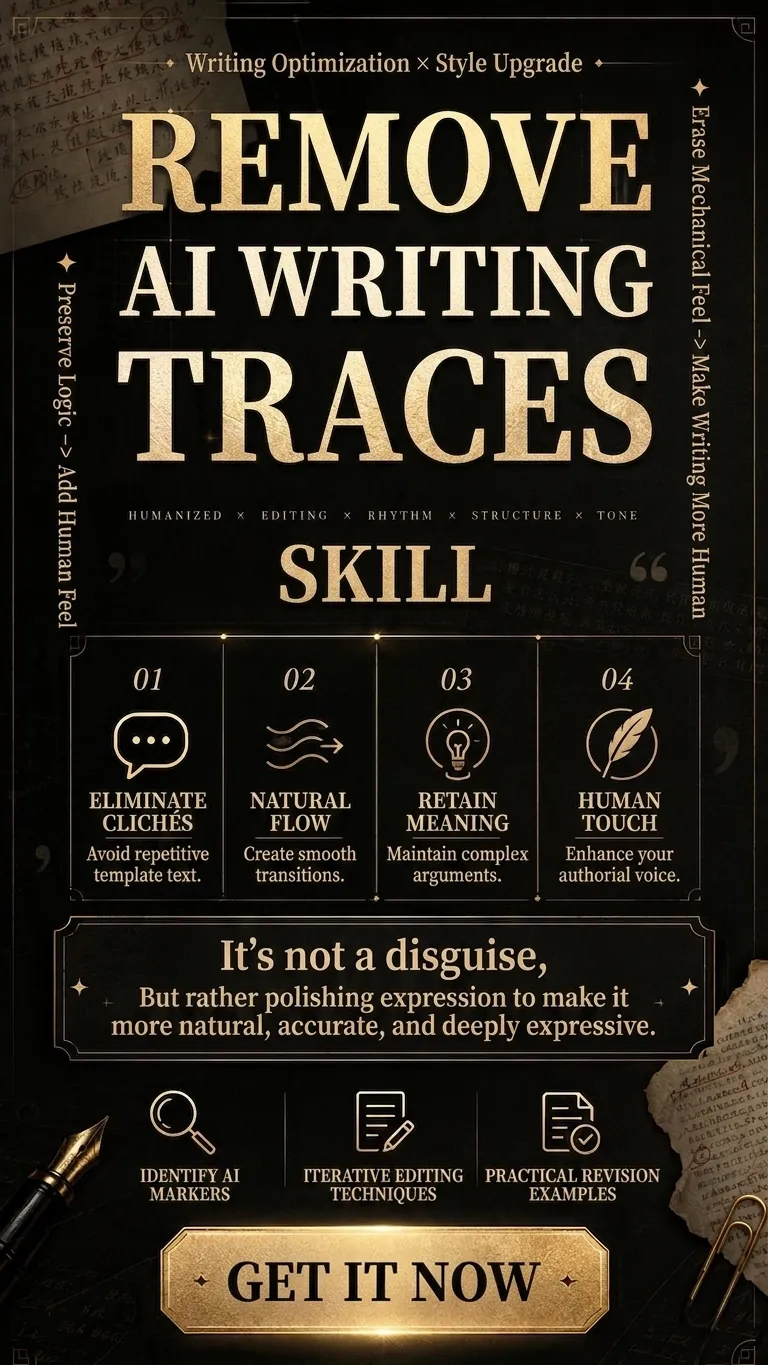 Write
AI Writing Humanizer
Want to eliminate the common 'industrialized' traces in Chinese AI text, giving your writing genuine human warmth and depth? This skill focuses on removing formulaic expressions in AI writing, injecting lively judgment, natural rhythm, unique emphasis, rich details, and authentic tone. It is especially adept at handling in-depth content such as comments, personal essays, historical analysis, political philosophy, social observations, reading notes, and long-form WeChat articles. By identifying and rewriting rigid aspects—from word choice and sentence structure to overall argumentation—this skill helps you transform grand, universally correct narratives into specific, nuanced insights, giving your writing a smooth and natural flow. Without altering the original meaning, it carefully diagnoses AI traces, such as identifying vague clichés, repetitive sentence patterns, and overly balanced tones. It replaces these mechanical elements with more concrete and insightful expressions, infusing your article with the author's personal thoughts and judgments rather than a cold logical construct. Additionally, for issues that mere polishing cannot solve, it points out where facts, examples, or arguments are needed, ensuring both depth and breadth. The result is a Chinese article that is not only clear in viewpoint but also full of human touch and personalized expression. It retains necessary professionalism while removing exaggerated adjectives and stiff connectors, making the text as natural as breathing—powerful yet warm, and far from being 'correct nonsense'.
 Write
SCI Paper Revision
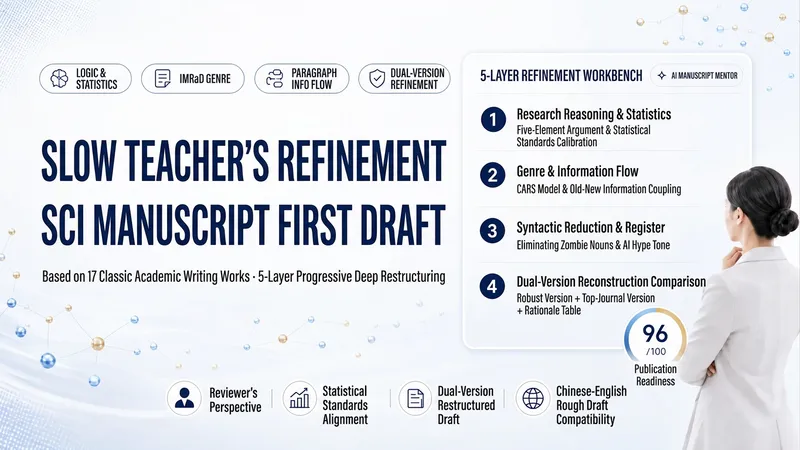
This goes beyond basic vocabulary polishing. It acts like an experienced mentor with peer-review expertise, helping you refine your early SCI draft toward top-journal standards. It places the [Original ❌] and the [Polished Version ✅] side by side, explaining in plain language why each change was made. [Paste Any Draft Directly] Whether it is a bilingual draft, a single section (Abstract, Introduction, Methods, Results & Discussion, Conclusion, figure captions), a full manuscript, a Cover Letter, or a Response to Reviewers, you can send it directly. [How to Use This Skill (Three-Step Reading Method)] Step 1 (Read the full paragraph preview for rhythm): After you submit your draft, each version (Robust Version A / Advanced Version B) begins with an underlined full-paragraph preview without Chinese explanations. Spend 15 seconds reading it from start to finish to sense the flow and rhythm. Step 2 (Review sentence-by-sentence comparisons and reasoning): Next, review the sentence-by-sentence breakdown. The [❌ Original (with strikethrough)] and [✅ Polished (bold and underlined)] are aligned right next to each other. Each sentence includes [💡 Writing Tip] explaining the awkwardness of the original, the rationale for the change, and underlying English writing principles. Step 3 (Select a version for a clean, copy-ready text): Reply with your choice of A or B (or request minor adjustments), and it will remove all underlines and notes to provide a clean, copy-ready English draft for your Word document. [3 Core Safeguards] 1. Preempts reviewer critiques by closing logical and statistical loopholes (such as treating P > 0.05 as proof of no effect, mismatched comparisons, or missing control experiment premises); 2. Avoids overly long, breathless sentences, keeping standard sentences within the 15–25 word golden range with a natural mix of sentence lengths; 3. 100% zero fabrication of data and literature, clearly marking missing values or error bar definitions for you to verify.
 Write
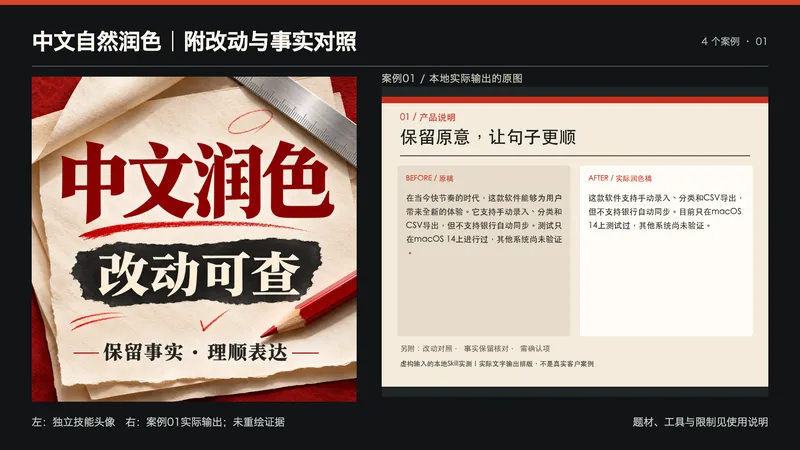
中文自然润色|附改动与事实对照
适用人群:需要精修中文文章、产品说明、工作总结或个人表达的写作者。 你需要提供:原稿、使用场景、修改力度,以及必须保留的原句。可以只指定一段或一个标题。 如何处理:先标记数字、否定、计划状态和观点归属,再删除空话、理顺句段,回查新稿与原文的差异。默认轻度润色,清楚的句子保留,不凭空增加数据或个人感想。 最终交付:可复制润色稿、实质改动对照、事实保留核对及需确认项。原稿的真实性仍须根据资料另行核实。 使用:粘贴原稿并说明修改范围;阅读修改稿与对照表,确认原意和事实后使用。只需文字模型,推荐GPT;具体型号由平台选择,不需要生图或外部API。 四张展示图是最终技能由本地GPT主代理实际执行的虚构输入输出,排版展示原稿与修改稿;不是客户案例,也未追加YouMind运行测试。结果取决于输入与模型,发布前仍需核对。 不适用:判断作者身份、保证通过AI检测、补造经历或自动发布。不承诺传播、审核或商业效果。 展示说明:首张为独立技能头像与案例01实际输出的并排排版,用于横向缩略展示;不是新增案例,也未让生图模型重绘证据。其余三张对应案例02—04。 独立头像为本地ImageGen原创概念视觉,不是研究或润色结果;具体图像模型ID未由工具返回。
Information
- Version
- v4
- Last updated
- Runtime credits
- Usage-based
- Models
- Auto
