
E-Commerce Thesis Check Guide
13-command e-commerce UG thesis workbench
E-Commerce Thesis Check Guide
13-command e-commerce UG thesis workbench
Showcase
Description
Stuck on your e-commerce undergraduate thesis? Does your current status section read like a company intro? Is your strategy section just the classic "strengthen promotion, improve service" four-piece set? Did you only realize two weeks before your defense that your title doesn't match your content? This skill is a revision workbench designed for e-commerce undergraduates. Its 13 commands help you check: whether the title is correct, whether the framework holds up, whether the paragraph arguments have loopholes, whether sentences are smooth, whether the same indicator has inconsistent definitions across chapters, why the defense teacher asks a certain question, and where follow-up questions might come from. In a word: AI won't write your thesis for you, but it helps you see where the problems are, how to fix them, and what to do next. What it cares about most: It will not fabricate data for you, will not write company facts for you, and will not write entire paragraphs of text for you. All revision suggestions leave a placeholder like 【Please replace with your real data】 so that you fill in with the authentic materials you collected yourself—so the thesis you submit is yours, not AI's. When checking sentence by sentence, each sentence's issues are categorized into two types: 【Structural issues】 that need content addition or rewriting, and 【Language issues】 that are suitable for polishing—so you won't use smooth wording to mask empty content, and you can clearly see which sentences are truly revised after editing. Coverage: mainstream e-commerce directions such as online marketing, store operations, short videos, live streaming sales, cross-border, private domains, agricultural product e-commerce, and more. From first draft self-check, chapter-by-chapter proofreading, version comparison to defense preparation, multiple rounds of follow-up. 【For advisors】 Teachers supervising e-commerce undergraduate theses can also use it this way: have students first run /check to diagnose the four layers of issues—framework, evidence, paragraphs, sentences—and then come for a meeting with the diagnostic report. This way, your grading time can focus more on judgment and direction rather than reading through everything to find problems. The /compare command can also directly compare the student's first draft and second draft to see if the revisions are adequate. Not suitable for: master's/doctoral theses, journal submissions, or non-e-commerce undergraduate theses. v2.2.1 early version. Feedback from students and advisors is welcome to help us make this revision workbench even smoother.
Related Skills
View all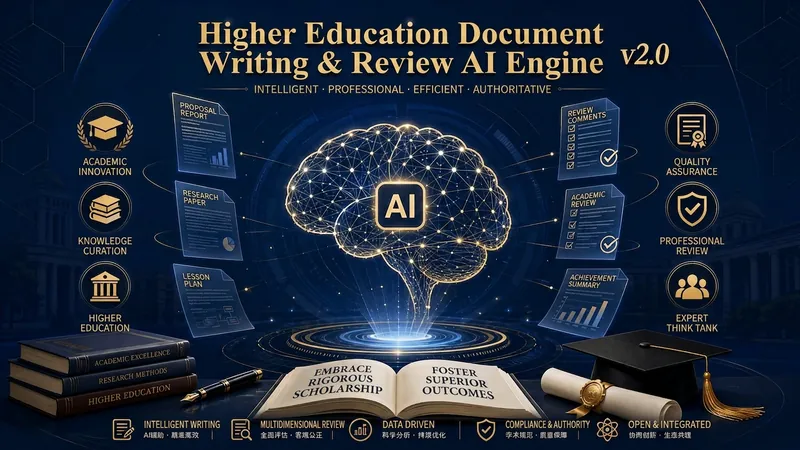
HE Document Write&Review v3.0
🎯 Got your application rejected? Can't find the highlight for your proposal? Don't know where to start with review comments? Three real scenarios: 🔸 Scenario 1: Application season anxiety—Reviewer feedback: "Insufficient theoretical support, vague policy basis." Unsure which documents to cite or which theoretical framework to use. 🔸 Scenario 2: Proposal writing dilemma—In charge of course construction plan: objectives, tasks, pathways, evaluation… each part needs writing, but you feel the logic is not rigorous enough and worry about being questioned on "feasibility" during review. 🔸 Scenario 3: Review dilemma—Need to write peer review comments: must point out issues while maintaining professionalism, be well-founded but not too harsh. How to strike the balance? 💡 What can this system do for you? Not just give advice—it writes, revises, and reviews for you directly. 📝 Writing Mode: From topic to final document Enter your topic and existing materials. The system automatically identifies the document type (application/proposal/report/review). Automatically matches authoritative policy documents and theoretical support. Generates content chapter by chapter, each with evidence, logic, and facts. Key promise: Never fabricates data; clearly tells you what's missing. 🔍 Review Mode: Expert-level diagnosis Upload your text. Professional scoring across 7 dimensions (value, alignment, completeness, innovation, feasibility, support, expression quality). Precisely identifies problem areas. Provides specific revision suggestions + example rewrites. Not general advice, but paragraph-level specific guidance. ✏️ Revision Optimization Mode: Precision enhancement Strengthens arguments based on existing text. Optimizes expression, eliminates empty talk and clichés. Standardizes terminology and logic. Improves overall competitiveness. ⚡ Three Core Mechanisms (Unique) 🛡️ Firewall Mechanism Built-in "fact boundary": User-provided real data is never fabricated; policy basis must have sources; theoretical support cannot be misapplied. Every sentence you see can be traced back to its source. 🔄 Multi-core Adversarial Engine One core writes, another specifically checks for errors. Like having a strict auditor watching, ensuring no "unsubstantiated facts," "logic gaps," or "policy mismatches" occur. 📊 Stepwise Guidance Doesn't ask you 20 questions at once—identifies the most critical gaps and asks only the 3–5 most necessary questions. After each stage, clearly tells you "what's done," "what's missing," and "what to do next." 🎯 Scope of Application (All Higher Education Scenarios) ✅ Teaching achievement award applications (institutional/provincial/national) ✅ Quality engineering project applications (top courses/teaching teams/textbooks, etc.) ✅ Course construction plans, major construction plans ✅ Major self-assessment reports, course acceptance reports ✅ Expert review comments, peer reviews ✅ Education reform project applications, closing reports 🚀 User Experience Writing an application from scratch: Provide the topic and basic materials → System identifies document type, takes inventory, matches policies and theories → Generates outline → Writes chapter by chapter → Consolidates → Get a draft in 1 hour. Reviewing existing text: Upload document → System automatically scores → Lists main issues → Provides revision suggestions and example rewrites → Get review report in 20 minutes. Optimizing existing plan: Provide existing text and optimization direction → System diagnoses weaknesses → Strengthens arguments, optimizes expression → Get optimized version in 30 minutes. 👉 Try it now—make higher education document writing no longer a burden. This is not just a writing assistant; it's an intelligent engine that understands higher education rules, review standards, and professional expression.
 Write
SCI Paper Revision
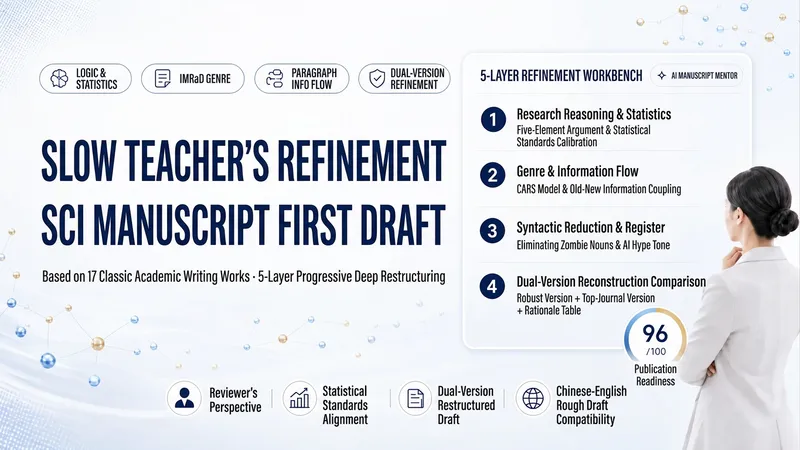
This goes beyond basic vocabulary polishing. It acts like an experienced mentor with peer-review expertise, helping you refine your early SCI draft toward top-journal standards. It places the [Original ❌] and the [Polished Version ✅] side by side, explaining in plain language why each change was made. [Paste Any Draft Directly] Whether it is a bilingual draft, a single section (Abstract, Introduction, Methods, Results & Discussion, Conclusion, figure captions), a full manuscript, a Cover Letter, or a Response to Reviewers, you can send it directly. [How to Use This Skill (Three-Step Reading Method)] Step 1 (Read the full paragraph preview for rhythm): After you submit your draft, each version (Robust Version A / Advanced Version B) begins with an underlined full-paragraph preview without Chinese explanations. Spend 15 seconds reading it from start to finish to sense the flow and rhythm. Step 2 (Review sentence-by-sentence comparisons and reasoning): Next, review the sentence-by-sentence breakdown. The [❌ Original (with strikethrough)] and [✅ Polished (bold and underlined)] are aligned right next to each other. Each sentence includes [💡 Writing Tip] explaining the awkwardness of the original, the rationale for the change, and underlying English writing principles. Step 3 (Select a version for a clean, copy-ready text): Reply with your choice of A or B (or request minor adjustments), and it will remove all underlines and notes to provide a clean, copy-ready English draft for your Word document. [3 Core Safeguards] 1. Preempts reviewer critiques by closing logical and statistical loopholes (such as treating P > 0.05 as proof of no effect, mismatched comparisons, or missing control experiment premises); 2. Avoids overly long, breathless sentences, keeping standard sentences within the 15–25 word golden range with a natural mix of sentence lengths; 3. 100% zero fabrication of data and literature, clearly marking missing values or error bar definitions for you to verify.
Proposal Readiness Checker
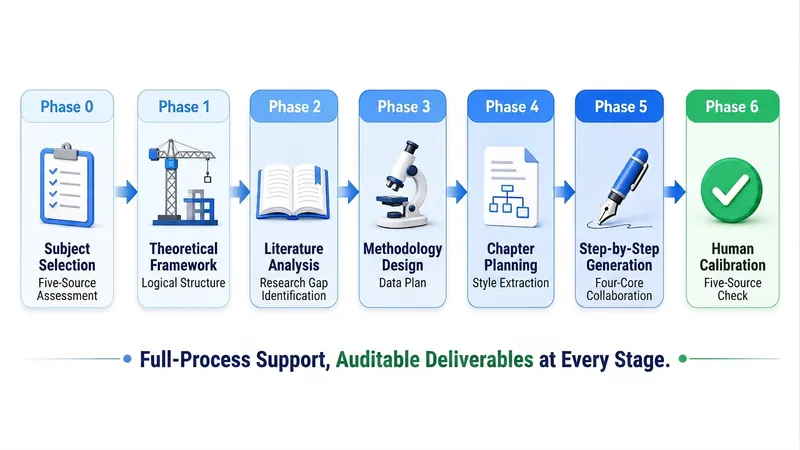
Before you spend dozens of hours writing your thesis, take ten minutes to run a structured checkup. This skill does only one thing: It diagnoses, not writes. It tells you whether your topic can hold up, whether your materials are sufficient, what's missing, where to fill the gaps, and in what order. Then it gives you an actionable missing-material checklist and search queries. It will not write your introduction, literature review, methods, or discussion. Four steps: 1. Discipline diagnosis: Classify your work into 1A Humanities/Arts, 1B Social Sciences, 2A Science/Engineering, or 2B Agriculture/Medicine/Life Sciences, and load the corresponding regulatory red lines; 2B triggers a mandatory ethics review block. 2. Topic checkup: Examine the topic from three dimensions—momentum, shape, and wording—to judge whether the research unit can be operationalized, whether the research question can be answered, and whether the topic has been done to death. 3. Material checkup: Register your existing literature into an M1/M2… material library, verify each entry against the four elements (author/year/title/verifiable locator), and compute the true coverage rate. 4. Gap list and search queries: Specify how many papers of what type are missing and which piece of evidence is lacking, and provide search queries ready to paste into databases (including Boolean keyword combinations, time ranges, and screening criteria). When to use it (trigger phrases): "Help me check my proposal" "Can this topic work?" "Do I have enough literature?" "My proposal was sent back" "I want to confirm before starting to write" — for graduate students who have just set a direction but haven't started writing; for those whose proposal was rejected but don't know why; for those with a pile of literature but unsure if it's enough to begin; for those wanting to confirm whether the topic is worth the investment before committing fully. Deliverables: A Proposal Checkup Report document + a Five-Source Readiness Scorecard (each level has behavioral criteria, not vague scoring) + a prioritized list of missing materials + search queries + an archive code. The archive code is compatible with the Academic Paper Full-Process Writing System v4.0; after the checkup, paste it there to continue writing without re-stating your discipline, topic, or journal. What this skill explicitly does not do: It does not write the main text, generate reference lists, or fabricate authors, years, volumes, issues, pages, or DOIs. Any literature found via online search is flagged with ⚠️ "needs verification" and must be verified by you before use. This skill does not promise any acceptance or passing outcome.
Information
- Version
- v4
- Last updated
- Runtime credits
- Usage-based
- Models
- Auto
