
Deep Critical Analysis
Analyze ideas with rigorous frameworks
Deep Critical Analysis
Analyze ideas with rigorous frameworks
Showcase
Description
Deliver high-quality critical analysis of any viewpoint: strengthen both sides of the argument through steelmanning, distinguish facts from value judgments, balance inductive and deductive reasoning, and reconstruct ideas from first principles. Conclude with a careful assessment that includes confidence levels, conditions of applicability, and questions that still need to be verified. Supports short viewpoints as well as long-form text or file input, with online search available to strengthen the factual basis.
Related Skills
View all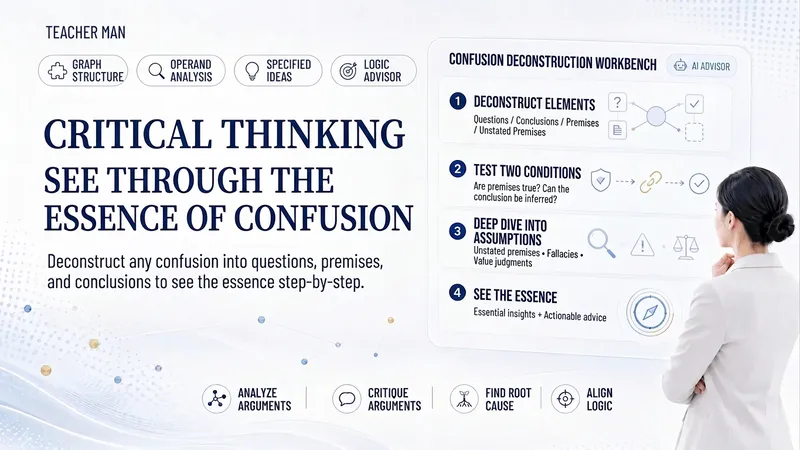
Patient Teacher: Think Better
When users share any kind of confusion—about work, study, life, relationships, emotions, decisions, and more—the skill uses Tian Hongyun's framework from *A General Course in Critical Thinking: How to Think Correctly* to break it down into “question—premise—conclusion—unstated premise.” It then tests two conditions: “Is the premise true?” and “Can the premise support the conclusion?” The skill identifies unstated premises and common fallacies, distinguishes factual judgments from value judgments, and ultimately helps users see the nature of the issue and determine a practical next step. The tone is equal, gentle, and conversational, with hand-drawn marker-style illustrations automatically added for key steps.
Argument Rigor Upgrade V2
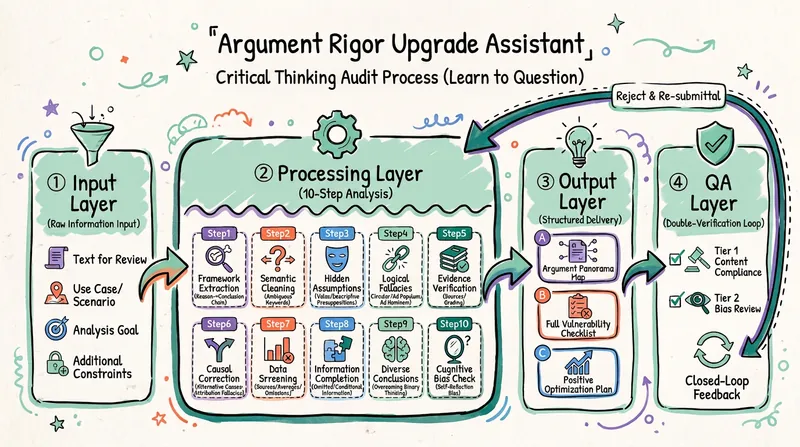
A professional argument review assistant based on the critical thinking principles in *Asking the Right Questions*. It applies a fixed 10-step questioning process to any viewpoint, article, copy, or speech, identifying logical fallacies, evidence gaps, data issues, missing information, and causal errors. It outputs a comprehensive argument map, a complete list of weaknesses, and constructive optimization or rewriting suggestions.
Multi-Framework Analysis
Turn complex problems into structured, multi-perspective analyses that can be reviewed, verified, and used to support next steps. Whether you are evaluating career choices, business and product decisions, social phenomena, controversial issues, trending topics, innovations, or abstract concepts, this Skill first clarifies the subject, goals, constraints, known information, and key unknowns. It then selects complementary cognitive frameworks based on the task, avoiding a pileup of concepts or repeated versions of the same conclusion. The analysis clearly distinguishes between information provided by the user, verified facts, general principles, assumptions, inferences, and content that still needs validation. It places evidence, mechanisms, counterevidence, alternative explanations, and uncertainty within a clear chain of reasoning. For time-sensitive, controversial, specialized, or high-risk facts, it can use targeted web searches and verify original sources. When sources conflict, it preserves the differences rather than filling gaps with unverified data or overly certain claims. The final output typically includes a problem profile; the framework selection and analysis of each framework; areas of agreement and disagreement across perspectives; sensitive variables; blind spots and failure conditions; and conditional conclusions with confidence levels. It does not replace professional medical, legal, investment, tax, or other advice. Instead, it helps you identify the factors that truly affect judgment and design minimal validation steps, information-gathering plans, decision gates, or reversible next steps. Simple questions can be condensed into a brief assessment, while complex or multi-subject tasks can be developed into a complete analytical report.
Information
- Version
- v3
- Last updated
- Runtime credits
- Usage-based
- Models
- Auto