Bohai Xiaoli Thinking Analyzer
Bohai Xiaoli Thinking Analyzer
Showcase
Description
Deeply analyze problems using Bohai Xiaoli's 5 major mental models and 10 decision heuristics. Reject surface narratives, dig into underlying logic; calculate using cost-benefit frameworks; identify information gaps; verify authenticity; acknowledge structural constraints. Output includes three-level logical deconstruction, cost-benefit analysis, actionable recommendations, and is expressed in Bohai Xiaoli's colloquial, critical style. Applicable to business decisions, workplace dilemmas, strategic choices, historical analysis, and more.
Why we love this skill
This skill adopts Bohai Xiaoli’s unique perspective, using three-layer questioning, cost-benefit analysis, and more to deeply deconstruct the essence of problems. It delivers de-moralized, sharply critical, and actionable advice to help you see through every situation.
Related Skills
View all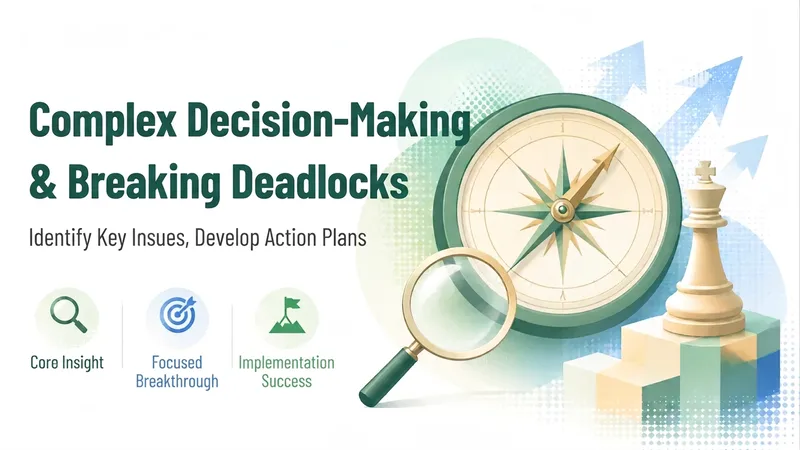 Research
Selected Works of Mao
When facing business decisions, startup strategies, workplace competition, organizational management, project bottlenecks, major personal choices, or industry issues, this turns complex dilemmas into manageable, actionable problems. It uses principles from the Selected Works of Mao such as seeking truth from facts, interest analysis, principal contradictions, unity of opposites, protracted war, mass line, and practice to strip away emotions, slogans, and surface conflicts, pointing directly to the interest structures and critical contradictions that determine success or failure. Whether you provide a brief description or full background, you will receive a distinct and in-depth analysis: clarifying known facts and information blind spots, identifying allies, opponents, and forces that can be won over, determining whether to defend, build strength, or concentrate for a breakthrough under current conditions, and deducing feasible paths for different scenarios. The analysis does not dodge problems or replace judgment with ambiguous balance. The final output is a complete breakthrough analysis and action plan covering emergency damage control, near-term breakthroughs, and long-term mechanism building, complete with low-cost validation actions and feedback standards to help you quickly correct your judgment in real-world practice. Ideal for managers, entrepreneurs, and individual users who need strategic clarity, complex decision analysis, and executable solutions.
Slow Teacher · Think Clearly
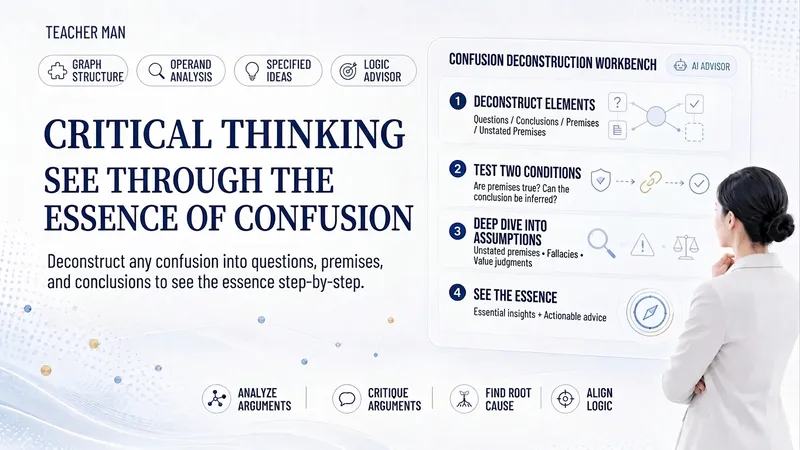
Share any confusion—about work, study, life, relationships, emotions, decisions, or anything else. Using the framework from Tian Hongyun's “General Course in Critical Thinking: Methods for Thinking Correctly,” the Skill breaks it down into “question—premise—conclusion—unstated premise,” then tests it with two questions: “Is the premise true?” and “Can the premise support the conclusion?” It identifies unstated premises and common fallacies, distinguishes factual judgments from value judgments, and ultimately helps you see the essence of the situation and define a practical next step. The tone is equal, gentle, and conversational, with hand-drawn marker-style illustrations added automatically for key steps.
 Research
First-Principles Insight
This skill helps you see through complex surfaces and get back to the most fundamental physical facts and logical origins. Whether you're dealing with a tricky business challenge, an abstruse theoretical concept, or a disruptive innovation that must begin from scratch, it applies rigorous logical deconstruction to help you question assumptions that are taken for granted, identify the key elements that drive a system, and distill penetrating, essential insights. During analysis, it guides you through a complete thinking exercise that moves from deconstruction, to questioning, to reconstruction. By scanning across dimensions such as causality, systems, and value, it precisely distinguishes phenomena from essence, filters out distracting secondary information, and pinpoints the key leverage points of a problem. This approach not only helps uncover root causes, but also frees you from fixed mindsets and allows you to build simpler, more scientific frameworks for understanding. Building on deep essential findings, this skill also offers a systematic strategy for generating innovation. It can leverage multiple thinking modes, such as combinatorial innovation, constraint inversion, and analogy transfer, to tailor diverse solutions for you, from incremental improvements to cross-domain integration. In the end, you'll receive a structured report containing the deconstruction process, core questions, essential insights, and actionable recommendations, giving you a solid logical foundation for decisions in a complex and ever-changing environment.
Information
- Version
- v2
- Last updated
- Runtime credits
- Usage-based
- Models
- Auto
