
Audio to Actionable Checklist
Convert live streams, podcasts, or audio chats into step-by-step actionable guides.
Audio to Actionable Checklist
Convert live streams, podcasts, or audio chats into step-by-step actionable guides.
Showcase
Description
Best for: Content creators and small business owners who listen to live streams, podcasts, and audio chats to learn, but struggle to remember or know where to start. How to use: 1. Provide material: Upload an audio recording or transcript, and describe what you are currently working on in two or three sentences. 2. Run: It first reviews the full recording, breaks down the speaker's actual methods into steps complete with original quotes and figures, calculates the cost of each approach, and tailors them to your own work. 3. View results: A document in five parts: a one-sentence summary, the speaker's step-by-step method, the cost of each approach, a checklist you can follow, and which parts need to be discounted or adapted for you. If you get stuck, you can reach out for Q&A: 99 RMB per question, with a response within 24 hours. WeChat: JT_M0726
Recommended by
Dancang
Why we love this skill
Transforms lengthy recordings into executable, step-by-step checklists, preserving original quotes and key metrics while outlining costs, trade-offs, and tailored action plans.
Related Skills
View all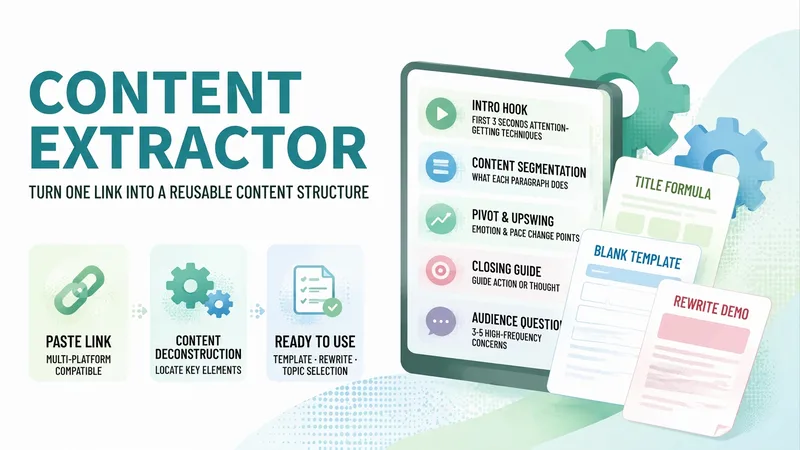
Short-Form Content Extractor
You come across a particularly well-made piece of content and want to learn its structure, but don’t know where to start. **Content Extraction Sheet** breaks down a link from Douyin, Xiaohongshu, WeChat Official Accounts, Bilibili, Weibo, or Zhihu into a practical structure you can use right away: what technique the first three-second hook uses, how many sections the content has and what each one does, where the transitions and emotional build-ups appear, and what the ending calls viewers to do. It then gives you three highly practical resources: an abstracted headline formula, with three examples adapted to your field; a blank structure template with fill-in fields; and a rewritten example based on a topic you choose. It also finds 3–5 questions viewers genuinely care about in public comments, which can become topics for your next piece of content. The honest boundary comes first: when the link content is accessible, it will clearly say “based on the original.” When it isn’t, it will say so plainly and give you a three-step method for obtaining the material—never inventing content from a link alone. Strict rules: no downloading videos, removing watermarks, bypassing login or paywalls, reposting original content, rewriting to disguise plagiarism, or extracting other people’s personal information.
 Research
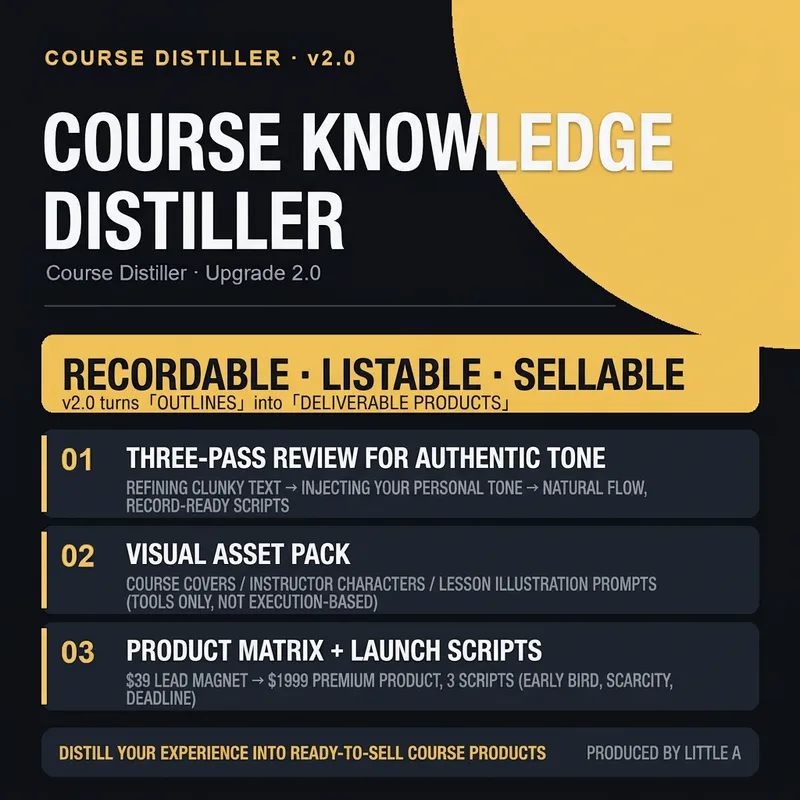
Course Knowledge Distiller
Distill scattered experiences, articles, or materials into structured, ready-to-sell course products. A six-step process guides you through positioning, knowledge extraction, course architecture, lecture-by-lecture handouts, exercise lists, and commercial listing copywriting. It provides templates and editable intermediate outputs throughout without fabricating your content. It is ideal for those who want to create courses or bootcamps and monetize their expertise but get stuck on not knowing how to teach. ## What It Solves Many people get stuck feeling that while they know how to do something, they do not know how to teach it or turn their wealth of experience into a course. The Course Knowledge Distiller does not make up content for you; instead, it guides you through six steps to productize your real expertise: Positioning -> Knowledge Extraction -> Outline Creation -> Lecture Handouts -> Exercise Lists -> Launch Copywriting and Pricing. ## Target Audience - Individual creators looking to build courses, bootcamps, paid columns, or communities - People with industry experience, case studies, or hard-earned lessons who want to monetize them - Those holding articles, book excerpts, or notes who want to turn them into structured courses ## What You Get (Deliverables) A ready-to-use course positioning statement A pyramid-structured course outline (modules, lectures, objectives, duration) Lecture handout drafts (five-part structure per lecture: hook -> explanation -> demonstration -> practice -> summary) Exercises and takeaways/templates for each module Copy-and-paste course listing copywriting plus pricing suggestions What you know can already make money—this Skill helps you distill your experience, articles, and notes into a course that is ready to launch. ## Why It Is Reliable Provides templates and editable intermediate outputs throughout, keeping you in control of your content without black-box substitutions. Built-in methodologies include the five-part lecture format, pyramid structure, pricing anchor method, and landing page framework. Includes a complete case study: distilling Excel weekly report automation into a ¥99 mini-course, letting you follow along easily.
 Write
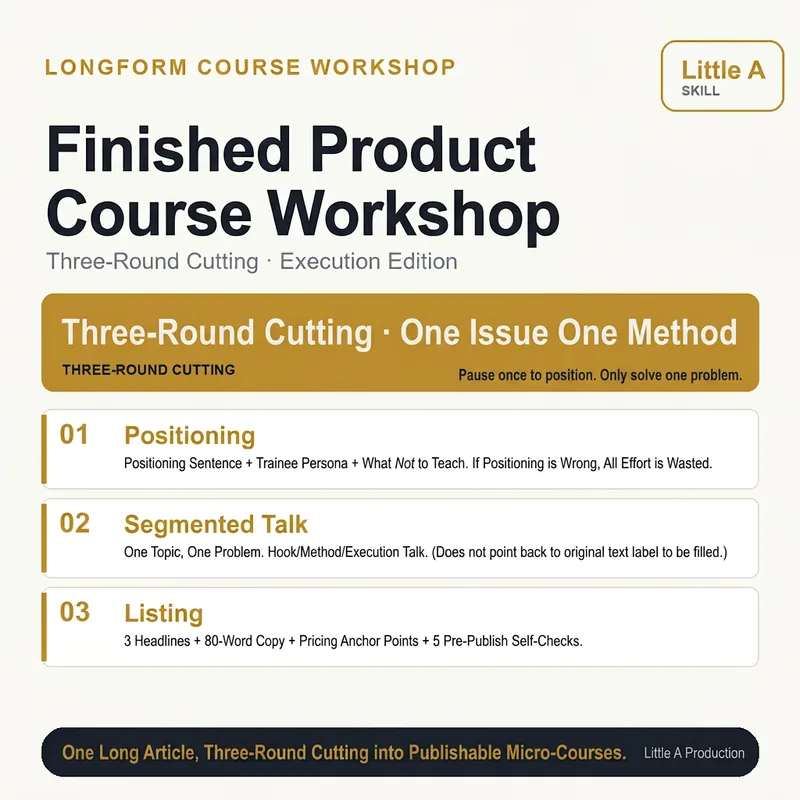
Micro-Course Rescuer
Turn a long text into a breakdown table, lecture handouts, and publishing copy for a 3-part mini-course through three rounds of segmentation. Uses only the source text without inventing anything. **Core Selling Point**: Beyond planning tips—directly generates your course profile, 3-part breakdown table, lecture handouts, and publishing kit. Each lecture solves one real problem, and every point links back to the source text. **Best For**: Content creators and knowledge bloggers looking to quickly test the waters; anyone with a long text, notes, or book excerpt who doesn't know how to structure it into a course. **Input**: A source text (1,800+ words of long text, notes, book excerpt, or draft) + goal (free lead-magnet course or low-priced entry-level course). **Output**: 8 content pieces + 4 finished pieces (12 total). Course profile, breakdown table, lecture handouts, and publishing kit are generated one by one. If tools are unavailable, a copy-pasteable package is provided with unproduced items marked. ## [Exclusive Methodology] Three-Round Segmentation · One Problem Per Lecture If your positioning is wrong, the next two rounds are wasted—so the first round must pause to confirm the course profile, which is the most efficient step in the entire workflow. 1. **Anchor**: Positioning formula "Help [who] achieve [result] in [scenario] using [method]" + 3 student persona questions + clarify what "not to teach" (cut anything the source text cannot support or exceeds capacity). 2. **Segment**: Each lecture solves one real problem (lecture titles written as questions); default hook lecture -> method lecture -> practical lecture; each point maps to a source paragraph, unmapped items marked as [To Be Added], no fluff. 3. **Publish**: 3 titles from result/pain-point/scenario angles + 80-word short copy (pain point -> what you get -> who it's for -> call to action) + pricing anchor + 5 pre-release self-checks. Remember it in one sentence: **Pause to anchor first, solve one problem per lecture.** ## [Grounded in Rules] Standards Based on Current Official Guidelines Anchored only in real public standards: target platform skill package guidelines, copyright duplication and fair use, AI-generated content labeling requirements, and restrictions on absolute terms and earnings promises in publishing copy. **Any fields, clauses, or rules that are unclear will be marked as "To Be Verified"—never filled from memory**; rules unrelated to this scenario are explicitly marked as not applicable. ## [v1 New · From Intermediates to Finished Files] Older versions provided editable intermediates; this version turns content **into ready-to-use files**: first detects your current session's tool capabilities, tells you what is about to be generated and the consumption cost, and only acts after your confirmation— - **Breakdown Table + Course Profile File**: Positioning sentence, what not to teach, 3 lecture problem titles, and corresponding source paragraphs in one table; - **Lecture Handout Drafts**: Five-section format per lecture (hook/explanation/demonstration/practice/summary) + take-away checklist, written as an editable draft; - **Publishing Kit + Checklist**: 3 titles, 80-word short copy, pricing anchor, and 5 pre-release self-checks. **No generation tools in the session?** Delivers a "ready-to-paste finished content package"—formatted entirely in Markdown, ready to use when copied into Word or tables. **Never pretends to generate, never invents file paths.** ## [Details Page Body] ### What Boundaries Are Maintained The service scope is clear: **only arranges your provided real material into a breakdown table / lecture handout drafts / publishing kit**. If you lack workflows, course content, cases, qualifications, data, or student reviews, they remain [To Be Added]; the skill will not invent them just to make the table look nice. It does not copy others' works, cites sources, and does not promise platform review or publishing results. ### Core Architecture 1. Anchor: Positioning sentence + student personas + what not to teach, pause to confirm; 2. Segment: One problem per lecture + five-section handout + take-away checklist; 3. Publish: 3 titles + 80-word short copy + pricing anchor + 5 self-checks. + Authoritative anchoring layer + execution delivery layer (detect -> authorize -> output finished product -> accept/fallback).
Information
- Version
- v3
- Last updated
- Runtime credits
- Usage-based
- Models
- Auto
