
Audience Psychology Engine 3.0
Find drop-off points with minimal changes
Audience Psychology Engine 3.0
Find drop-off points with minimal changes
Showcase
Description
Judges the content experience through the psychology of a real viewer sitting in front of a screen. It supports four types of work: script review (scripts, outlines, episode breakdowns, and dialogue), storyboard guidance (storyboard tables, shot scripts, storyboards, director plans, and AI video shot prompts), cut review (rough cuts, fine cuts, finished films, AI-generated videos, and sample short dramas or comic dramas), and film analysis (breaking down others’ work and extracting techniques worth adapting). It defaults to simulating an average casual viewer, switching to the best-fit core audience for niche, IP, or platform content. It gives the conclusion first, followed by a human-like viewing curve and 1–3 minimal revision suggestions. It includes human-aesthetic and AI-feel checks, checks for immersion breaks in AI-generated visuals, anti-pleasing guardrails, and evidence anchors. It does not fabricate viewer data or conduct heavy audits.
Recommended by
Dancang
Why we love this skill
Grounded in real-viewer reactions, it pinpoints hooks, drop-off points, and immersion breaks, then prioritizes the smallest fixes using genre psychology, aesthetic texture, and evidence anchors.
Best for
Ideal for screenwriters, directors, and editors who need to quickly find drop-off points and actionable minimal revisions.
How to use this Skill
Provide your input
Provide a script, outline, dialogue, storyboard, shot script, video clip, frame grab, or other work, and say what you want to improve.
Run the Skill
Evaluate the viewing experience for the target audience, identify moments that attract, lose, or drive viewers away, and analyze why using the source text, shot numbers, or timecodes.
Review your result
Get a conclusion-first viewing curve, the biggest issue, 1–3 minimal revision suggestions, and highlights worth keeping.
Related Skills
View all Video
AI Motion Comic Storyboard Master
1. Continuity First: Keep scenes, lighting, and core character features highly consistent across shots. Shot transitions must follow audiovisual logic. 2. 50-Second Golden Pacing: Strictly control the total duration to 50 seconds, divided into 5 to 7 core storyboards. 3. Vivid Expressions & Actions: Avoid empty psychological descriptions. Express all emotions through micro-expressions, body movements, and physical reactions. 4. Multi-dimensional Audio Visual: Accurately match each storyboard with visual descriptions, prompts, voiceover, dialogue, environmental sound effects, and background music emotions. The ultimate director in AI short dramas. Input a script or a single idea to generate a complete 50-second production plan with core storyboards, camera work, bilingual prompts for Kling, Seedance, or Midjourney, voiceover copy, and timed sound effects. Features a character cross-stage consistency locking mechanism to prevent visual drift.
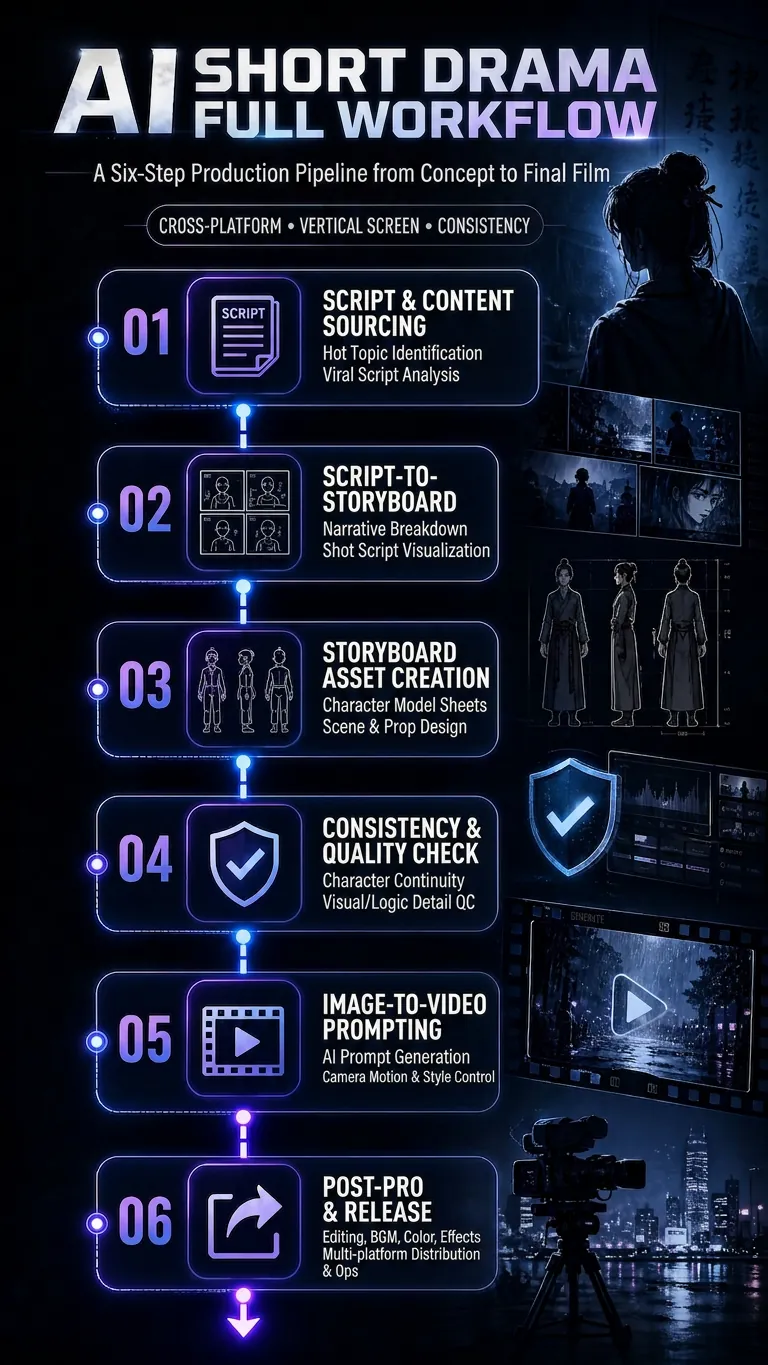
AI Short-Drama Workflow v5
Turn a concept, novel, or script into an executable AI video production plan, covering three formats: AI short drama, AI comic drama, and AI live-action drama. The Skill includes a complete six-step production pipeline: find scripts and hit copy → adapt the script into a shot list (including shot language and dialogue-duration adjustments) → design shot assets (character turnarounds, scene concept art with physical lighting, and material details) → consistency checks and pre-generation quality control (asset binding, cross-shot consistency, and P0/P1 blocking gates) → image-to-video prompts (Vidu/Jimeng/Doubao standard templates + Jimeng Seedance first/last-frame template) → final-cut production and publishing quality control. By default, the workflow uses no subtitles or background music, retaining only dialogue and necessary sound effects. Supports locked visual styles including realistic cinematic, 2D Chinese animation, and 3DCG Chinese animation. Designed for scaled production on vertical platforms such as Douyin, Kuaishou, WeChat Channels, and Xiaohongshu.
 Write
Short Drama Creator
Transform a vague idea, existing script, or performance data into a clearer short-form drama plan with strong dramatic action. Whether you want to deconstruct a piece, optimize a draft, or create a short drama from scratch, you can focus on character situations, visible conflicts, and sustained suspense to find content directions that are truly worth shooting and watching. You can provide a one-sentence idea, genre, character settings, episode outlines, dialogue, script snippets, images, or data. The system analyzes core dilemmas, opening conflicts, visual details, dialogue, and episode-ending hooks based on your platform, length, audience, and creative constraints. It highlights strengths and weaknesses, providing ready-to-use scenes, dialogue, episode designs, or revised versions instead of abstract advice. For data analysis, it carefully evaluates changes by distinguishing metrics, samples, and timeframes; when referencing public information, it clearly separates facts, sources, and creative speculation. Perfect for short video scriptwriters, drama planners, and content creators for script diagnosis, creative development, episode planning, and pre-production polishing.
Information
- Version
- v4
- Last updated
- Runtime credits
- Usage-based
- Models
- Auto
- Use cases
- Writing & contentImages & designResearch & analysis
- What you get
- ReportPlan
