Thinking Models Master
Thinking Models Master
Showcase
Description
Use 24 practical thinking models to help validate AI outputs, improve prompts, divide work between people and AI, and guard against hallucinations, sycophancy, and overconfidence.
Related Skills
View all
Top 10 Mental Models - Coach
A thinking coach based on the top 10 mental models of humanity. Enter your problem or decision scenario, and the AI will automatically call the best matching mental model to help you analyze, break down, and review. You can also specify a model for deep thinking. Supports three modes: problem analysis, decision assistance, and post-event review.
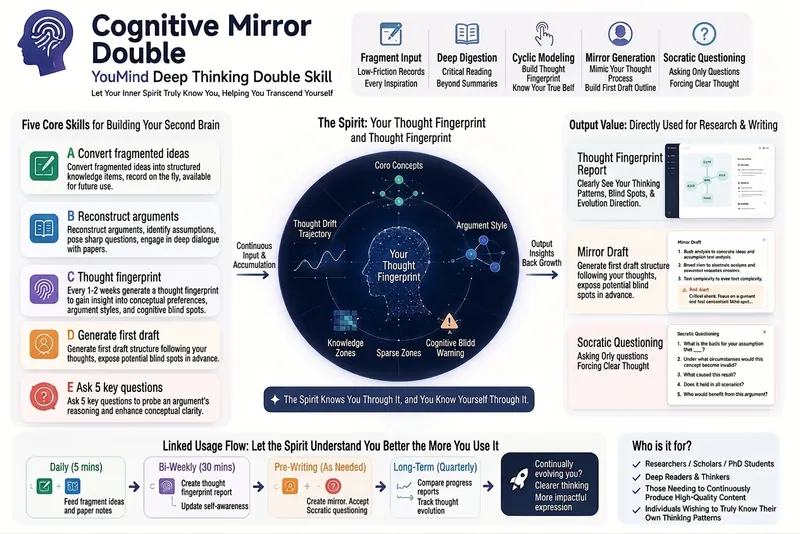
CogMirror|YouMind ThinkPrint
Cognitive Mirror is not just an ordinary note-taking tool; it is a personal cognitive modeling Skill for deep thinkers. It uses 'low-friction input, periodic modeling, mirror generation, and Socratic questioning' as its core mechanisms to help you continuously turn daily fragmented thoughts, paper reading notes, research judgments, and writing inspiration into personal knowledge assets that can be accumulated, reflected upon, and recalled. The system has five built-in lightweight Skills: Fragmented Note Digester: structures scattered ideas; Paper Critical Reader: helps you reconstruct arguments, identify assumptions, and ask sharp questions; Thinking Fingerprint Generator: periodically analyzes your conceptual preferences, argumentation style, and cognitive blind spots; Mirror Draft Generator: generates initial frameworks that 'read like you wrote them' based on your thinking patterns; Socratic Questioner: specifically attacks the weakest points of an argument. It does not think for you, but continuously trains your second brain, allowing your knowledge base to gradually develop its own judgment, problem awareness, and writing style.
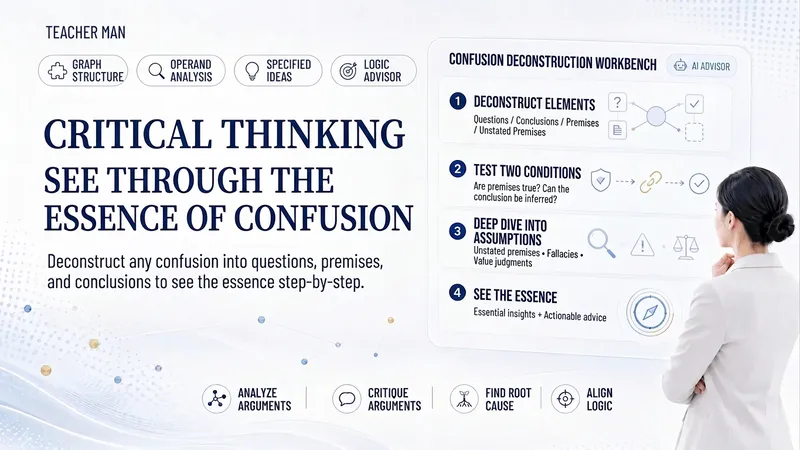
Patient Teacher: Think Better
When users share any kind of confusion—about work, study, life, relationships, emotions, decisions, and more—the skill uses Tian Hongyun's framework from *A General Course in Critical Thinking: How to Think Correctly* to break it down into “question—premise—conclusion—unstated premise.” It then tests two conditions: “Is the premise true?” and “Can the premise support the conclusion?” The skill identifies unstated premises and common fallacies, distinguishes factual judgments from value judgments, and ultimately helps users see the nature of the issue and determine a practical next step. The tone is equal, gentle, and conversational, with hand-drawn marker-style illustrations automatically added for key steps.
Information
- Version
- v2
- Last updated
- Runtime credits
- Usage-based
- Models
- Auto