TRIZ Research Innovation Coach
Use TRIZ to turn dilemmas into bold topics
TRIZ Research Innovation Coach
Use TRIZ to turn dilemmas into bold topics
Showcase
Description
TRIZ Research Innovation Coach is a system for discovering innovative research problems and generating research topics for academic work. Centered on TRIZ contradiction resolution, the nine-screen method, laws of evolution, resource analysis, and thinking-trap diagnosis, it uses a rigorous AFP-style step-by-step process to transform vague research challenges into clear scientific questions, actionable research plans, and theoretically compelling topic directions. The system also includes dual review by a thinking coach and an academic editor, assessing research subjects, theoretical mechanisms, evidence pathways, methodological fit, and degree of innovation. It helps users overcome common challenges such as “I can’t find an innovation,” “I can only compromise,” and “my methods are limiting me,” while building transferable and reusable innovative thinking skills.
Related Skills
View all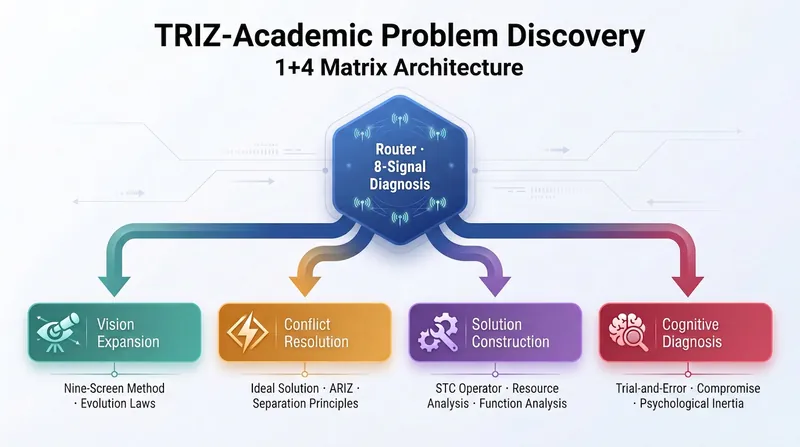
TRIZ-Academic Problem Discovery v2.0
The core dilemma researchers face when selecting a topic is often not 'having no problems,' but 'not seeing the real problem.' TRIZ-Academic Problem Discovery v2.0 uses the AFP 3.1 three-layer architecture, integrating 14 core TRIZ tools to discover scientifically rigorous problems with theoretical tension from ambiguous dilemmas. Core Capabilities: 1. 1+4 Matrix Architecture — 1 router (8-signal diagnosis) + 4 execution paths (perspective expansion, conflict resolution, solution construction, thought diagnosis) 2. Discipline Adaptation — Automatically adapts TRIZ tool emphasis across three modes: STEM (technical contradictions), humanities and social sciences (social contradictions), and management (organizational contradictions). 3. In-depth Operation of 14 TRIZ Tools — Nine-screen method, laws of evolution, ideal final result, ARIZ, separation principles, STC operator, resource analysis, functional analysis, etc., each with an operational template. 4. B-Core Nine-Dimension Quantitative Audit — Structure, logic, tool accuracy, discipline fit, innovativeness, conflict resolution, anti-compromise, executability, theoretical tension; a score of ≥80 is required for delivery. 5. Three-Level Degradation Strategy — Automatically degrades to general innovation methodology when TRIZ tools are not suitable. Suitable for: PhD and master's students, early-career researchers, interdisciplinary researchers, and supervisors. Supports both Chinese and English.
 Research
First-Principles Insight
This skill helps you see through complex surfaces and get back to the most fundamental physical facts and logical origins. Whether you're dealing with a tricky business challenge, an abstruse theoretical concept, or a disruptive innovation that must begin from scratch, it applies rigorous logical deconstruction to help you question assumptions that are taken for granted, identify the key elements that drive a system, and distill penetrating, essential insights. During analysis, it guides you through a complete thinking exercise that moves from deconstruction, to questioning, to reconstruction. By scanning across dimensions such as causality, systems, and value, it precisely distinguishes phenomena from essence, filters out distracting secondary information, and pinpoints the key leverage points of a problem. This approach not only helps uncover root causes, but also frees you from fixed mindsets and allows you to build simpler, more scientific frameworks for understanding. Building on deep essential findings, this skill also offers a systematic strategy for generating innovation. It can leverage multiple thinking modes, such as combinatorial innovation, constraint inversion, and analogy transfer, to tailor diverse solutions for you, from incremental improvements to cross-domain integration. In the end, you'll receive a structured report containing the deconstruction process, core questions, essential insights, and actionable recommendations, giving you a solid logical foundation for decisions in a complex and ever-changing environment.

STEM PhD Topic Diagnostician
Already have a PhD dissertation topic but unsure whether it is rigorous, innovative, and feasible? This Skill is designed to diagnose existing topics—not randomly generate topics from scratch or merely polish the wording. It breaks down the research subject, core variables, mechanisms, outcome measures, and research boundaries in your topic. Based on the Chinese and English literature, experimental foundation, samples, methods, equipment, timeline, and budget you provide, it assesses the topic’s rigor, novelty, and feasibility, while identifying risks such as “innovation” based only on changing materials, confounded variables, insufficient evidence for the proposed mechanism, an uncontrolled sample matrix, and chapters that cannot build progressively. The final output is a STEM PhD Topic Health Check Report, which clearly recommends whether to: retain the topic with minor adjustments; retain the research subject while strengthening its dimensions; retain the research problem and reconstruct the subject; or stop patching and redesign the topic. It is intended for STEM PhD students in food science, chemistry, materials science, biology, basic medical sciences, environmental science, agriculture, energy, and engineering. It is especially useful for those preparing a proposal defense, revising a topic at an advisor’s request, who have already defended their proposal but lack a clear central thread, or who have existing experiments but are unsure whether they can support an entire PhD dissertation.
Information
- Version
- v5
- Last updated
- Runtime credits
- Usage-based
- Models
- Auto