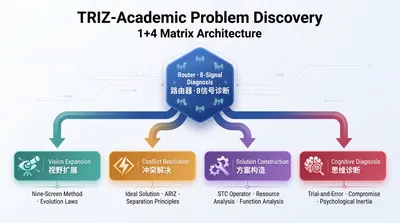
TRIZ-Academic Problem Discovery v2.0
14 TRIZ Core Tools · 1+4 Matrix Architecture
TRIZ-Academic Problem Discovery v2.0
14 TRIZ Core Tools · 1+4 Matrix Architecture
Showcase
Description
The core dilemma researchers face when selecting a topic is often not 'having no problems,' but 'not seeing the real problem.' TRIZ-Academic Problem Discovery v2.0 uses the AFP 3.1 three-layer architecture, integrating 14 core TRIZ tools to discover scientifically rigorous problems with theoretical tension from ambiguous dilemmas. Core Capabilities: 1. 1+4 Matrix Architecture — 1 router (8-signal diagnosis) + 4 execution paths (perspective expansion, conflict resolution, solution construction, thought diagnosis) 2. Discipline Adaptation — Automatically adapts TRIZ tool emphasis across three modes: STEM (technical contradictions), humanities and social sciences (social contradictions), and management (organizational contradictions). 3. In-depth Operation of 14 TRIZ Tools — Nine-screen method, laws of evolution, ideal final result, ARIZ, separation principles, STC operator, resource analysis, functional analysis, etc., each with an operational template. 4. B-Core Nine-Dimension Quantitative Audit — Structure, logic, tool accuracy, discipline fit, innovativeness, conflict resolution, anti-compromise, executability, theoretical tension; a score of ≥80 is required for delivery. 5. Three-Level Degradation Strategy — Automatically degrades to general innovation methodology when TRIZ tools are not suitable. Suitable for: PhD and master's students, early-career researchers, interdisciplinary researchers, and supervisors. Supports both Chinese and English.
Related Skills
View all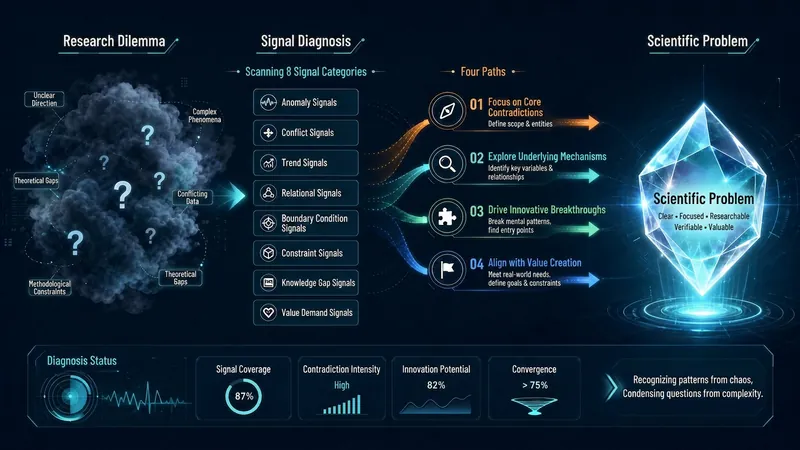
TRIZ Research Innovation Coach
TRIZ Research Innovation Coach is a system for discovering innovative research problems and generating research topics for academic work. Centered on TRIZ contradiction resolution, the nine-screen method, laws of evolution, resource analysis, and thinking-trap diagnosis, it uses a rigorous AFP-style step-by-step process to transform vague research challenges into clear scientific questions, actionable research plans, and theoretically compelling topic directions. The system also includes dual review by a thinking coach and an academic editor, assessing research subjects, theoretical mechanisms, evidence pathways, methodological fit, and degree of innovation. It helps users overcome common challenges such as “I can’t find an innovation,” “I can only compromise,” and “my methods are limiting me,” while building transferable and reusable innovative thinking skills.

Social Science Topic Master
Whether you are a novice researcher or an experienced scholar, whether you want to start from scratch to conceive a research direction or hope to optimize an existing topic, the 'Social Science Topic Master' can provide you with professional, systematic guidance. This tool is based on best practice methodologies for topic proposal writing, aiming to solve core challenges researchers face during topic selection: unclear direction, difficulty in refining research questions, ambiguous value judgment, and non-standard academic expression. Through step-by-step interactive guidance, this tool intelligently identifies your research needs and disciplinary background, providing customized theoretical perspective recommendations and policy clues. You will receive high-quality academic topic titles and undergo scientific diagnosis using the 'Five Criteria for a Good Question' to ensure the rigor and innovation of your topic. Ultimately, this tool outputs a structured complete topic proposal, including the academic title, topic element breakdown, results of the five-criteria test, key points for value argumentation, and policy and literature support. In addition, we provide two sets of detailed optimization suggestions: a 'Quick Fix' version and a 'Deep Optimization' version, helping you to improve key issues in a short time or to make systematic long-term enhancements, thereby significantly increasing the success rate of your topic proposal.
 Research
Academic Paper Writing v4.1
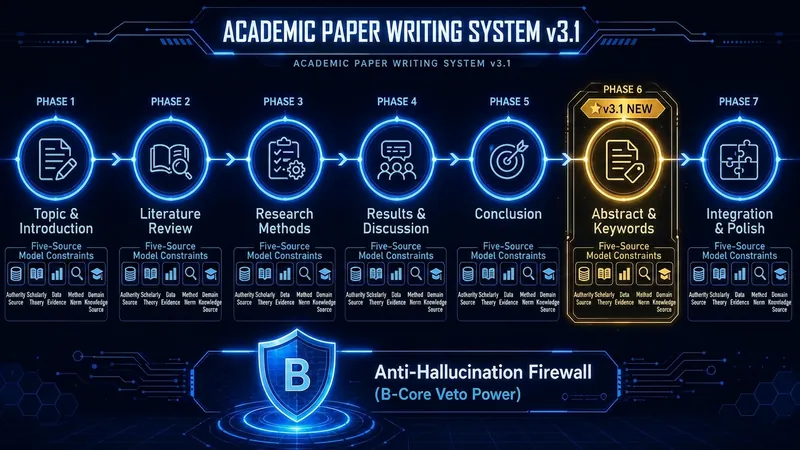
A full-process academic paper writing system that combines the Five Sources model with the AFP 3.1 three-layer architecture. Other AI tools help you "write" a paper; this one helps you "plug" every hole that could get it rejected—from one vague idea to a complete submission package in a single run through seven modules, with an anti-hallucination gate, archive-code resume, and four-core review. [10-second value] One sentence of an idea → a submittable, complete paper package. Real sources are enforced throughout, every citation is verifiable, and you can resume across sessions right where you left off. [Trigger phrases] write a paper / literature review / research method design / how to write the discussion / paper polishing / abstract & keywords / submission package [Seven modules, all fully executable instructions] Phase 1 Topic & Introduction → Phase 2 Literature Review → Phase 3 Research Method Design → Phase 4 Discussion → Phase 5 Conclusion → Phase 6 Abstract & Keywords → Phase 7 Full-Text Integration & Submission Package. Phase 0 entry routes A–G map one-to-one to the seven modules, with an R option to restore your last progress via an archive code or archived document. [v4.1 upgrades] 1. Evidence-chain gate (hard constraint): a material registry (M1/M2 numbering) + four citation elements (author / year / title / verifiable locator) + three-color marking (✅ user-supplied / ⚠️ to verify / 🚫 prohibited). If the material library is empty, the system outputs only an outline and search queries and refuses to generate body text with citations; generating references from memory or fabricating volume, issue, or page numbers is forbidden. 2. Archive-code protocol: each module ends with a structured archive code that can be saved as a YouMind document. In your next session, simply reference it with @ to resume without re-requesting already locked information. 3. Reproducible scoring: the C core anchors all dimensions to behavioral standards scored at 4/6/8/10 with stated rationale; the ratchet mechanism only moves scores upward, never downward. 4. Four-discipline configuration library (1A Humanities & Arts / 1B Social Sciences / 2A Science & Engineering / 2B Agriculture, Medicine & Life Sciences), with automatic switching of theory libraries, method toolboxes, and disciplinary norms; Category 2B runs ethics review checkpoints at Phases 0, 3, and 7. 5. Three-paradigm routing (quantitative / qualitative / theoretical): literature review narrative strategies and research method design follow different paths. 6. Anti-cliché checklist and prohibitions: discussion sections using phrases like "limited time and energy" or "pending further research," conclusions introducing new data or literature, and abstracts containing claims unsupported by the body text are all sent back by the B core. 7. Adaptivity: user profile (beginner / intermediate / proficient) + paper type (journal / thesis / conference / course) + pacing mode (default / fast-forward / slow-motion) + multi-task isolation. 8. Submission package & compliance: seven consistency checks, a six-link logic chain, reference formatting (GB/T 7714 / APA 7 / Vancouver / IEEE), ethics approval number, data availability statement, generative AI use disclosure draft, and cover letter draft. [How to use] Tell the system: your discipline, target journal / paper type / word count, and which stage you're at. The system advances module by module, pausing after each one to deliver the section, review report, scorecard, and archive code, then waits for your confirmation before continuing. [Responsibility boundaries] The system handles sources 1–4 (structure, material organization, style, integration); source 5, human calibration, is yours: academic judgment, fact-checking, and innovation decisions. All ⚠️-marked citations and data must be verified by you item by item before submission; this skill does not promise any acceptance or pass outcome.
Information
- Version
- v9
- Last updated
- Runtime credits
- Usage-based
- Models
- Auto
