
Thematic Analysis & Codebook Builder
Builds a codebook and theme map from your codes
Thematic Analysis & Codebook Builder
Builds a codebook and theme map from your codes
Showcase
Description
Builds a systematic codebook and theme map from your raw data excerpts or initial open codes; suggests a parent-child structure for use in MAXQDA/NVivo. Supports inductive, deductive, or hybrid analytic approaches. Who it's for: researchers conducting thematic analysis or content analysis.
Recommended by
Shuting@YouMind
Why we love this skill
An editor’s pick for turning scattered interview excerpts or open codes into a defensible analytic structure. It produces precise code definitions, inclusion criteria, evidence-backed themes, and MAXQDA/NVivo-ready hierarchies while respecting inductive, deductive, or hybrid approaches.
Related Skills
View all Research
Interview & Focus Group Protocol Writer
Prepares a complete semi-structured interview guide or focus group protocol, from warm-up questions to closing, based on your research question and participant profile. Produces non-leading, open-ended questions and suggests an a priori code list for MAXQDA/NVivo. Who it's for: researchers and graduate students conducting qualitative or mixed-methods research.
 Research
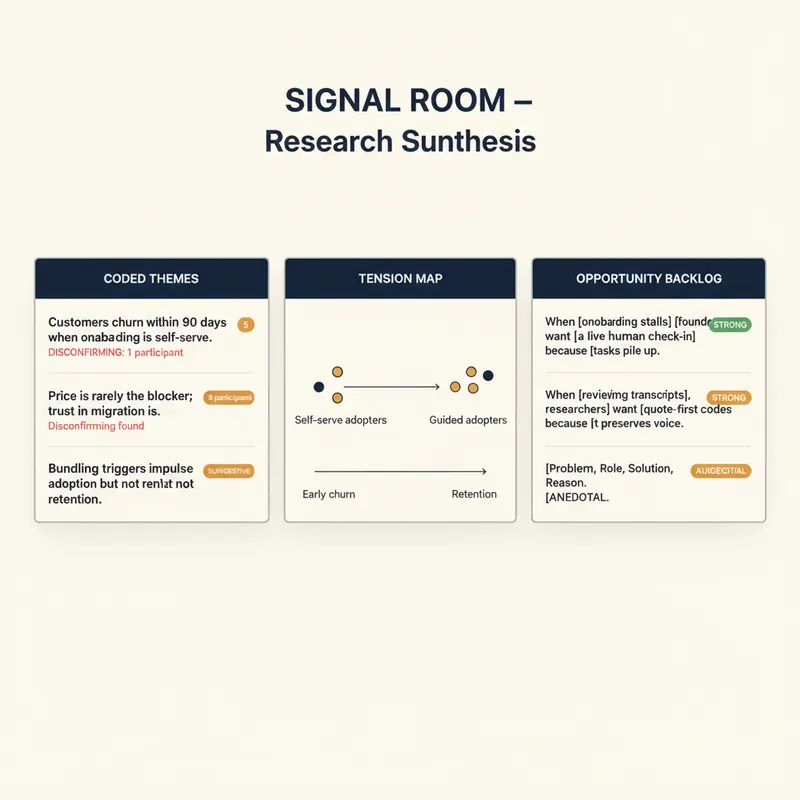
Signal Room: Interview Synthesis
YouMind already transcribes your calls, interviews and podcasts. Signal Room is what happens next. Drop in one transcript or twenty and get back a research synthesis an actual analyst would sign: coded themes, verbatim evidence with timestamps, the places people disagree, and a ranked answer to the decision you are trying to make. The method is real qualitative practice, not summarisation: • Open coding that works quote-first — no quote, no code — with codes named in the participant's own words rather than analyst jargon • Every code tagged Behaviour, Belief or Wish, because "I would definitely pay for that" is not the same class of evidence as "I paid for that last month" • Themes stated as falsifiable sentences, with strength counted in participants rather than quotes, and disconfirming evidence hunted for on purpose • A tension map showing where your participants genuinely split and what predicts which side they fall on • An opportunity backlog written as "when [situation], [who] wants [outcome] because [reason]", each rated Strong, Suggestive or Anecdotal • A direct answer to your decision question, with a stated confidence level and what would change it • The three questions this round could not answer, and who to interview next Guardrails that matter: it never invents or polishes a quote, it refuses to report percentages on fewer than twelve participants, it pseudonymises participants by default, and it will tell you to your face when n=1 means you have a hypothesis rather than a finding. For product managers, UX and market researchers, journalists, consultants, founders doing customer discovery, and anyone sitting on hours of recordings and no findings.
 Research
Thematic Analysis & Codebook
Creates a systematic codebook and thematic map from your raw data excerpts or initial open codes, recommending codes in a parent-child structure for use in MAXQDA/NVivo. Supports inductive, deductive, or hybrid analysis approaches. Who it's for: researchers conducting thematic or content analysis.
Information
- Version
- v2
- Last updated
- Runtime credits
- Usage-based
- Models
- Auto
