Social Sci Lit Review Coach V3
Social Sci Lit Review Coach V3
Showcase
Description
A literature review writing coach for social science graduate theses. Graduate students provide their literature, and the coach reviews the quality and timeliness of the materials. It deconstructs key information, including core arguments, research methods, and innovations, helping students deeply understand the core content. The coach then organizes, summarizes, and refines the literature, synthesizing it into a complete literature review of approximately 5,000 to 10,000 words that meets graduate academic standards.
Related Skills
View all
Social Science Lit Review
A staged guidance system for narrative literature reviews in the social sciences. It follows the AFP methodology—building the background → creating a classification framework → critical evaluation → deriving research gaps → integration audit—to gather information step by step, save intermediate results, and generate a review with traceable citations. Example: “Use the Social Science Literature Review Guide to help me write a literature review.” Scenario: undergraduate thesis proposal; topic example: mechanisms for improving organizational resilience in small and medium-sized enterprises undergoing digital transformation; literature: Zhang San (2022)… (provide 3–5 entries in the format author (year): one-sentence finding); length: 5,000–8,000 words, GB/T 7714 format.
Literature Review Assistant
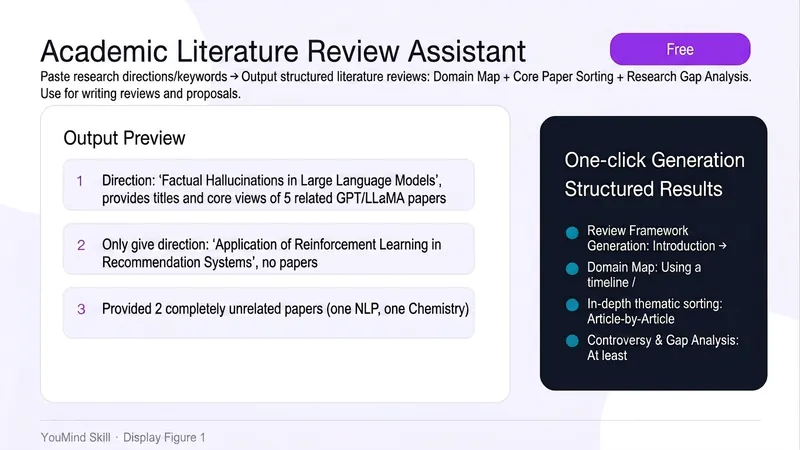
Writing a literature review is an inevitable challenge for graduate students—but turning information from 50 papers into a logically structured review, rather than a mere summary list, relies on methodology, not brute force. Tell it your research direction and the core papers you've already read. It first builds a framework—field map, thematic sorting, debates and gaps—then, after your confirmation, helps organize the language chapter by chapter. It doesn't write the paper for you, but helps you present the papers you've read with academic logic. ✨ Core Capabilities 1. Review framework generation: Introduction → Field map → Thematic sections → Debates and gaps → Outlook, standard academic structure 2. Field map: Sort domain development by timeline/school of thought, highlight milestone papers 3. In-depth thematic analysis: Individual paper introduction + intra-group comparison + overall contributions and limitations 4. Debate and gap analysis: At least 3 points of debate + 3 research gaps, with specific literature sources 5. Academic writing norms: Citation format, bilingual terminology, critical language rather than mere description 📱 Use Cases - Literature review chapter for graduate thesis/proposal writing - Related Work section of journal papers - Quick literature overview + structured notes when entering a new field - Used in combination with "论文速读笔记" and "论文双模研读" to form a "Read → Analyze → Synthesize" literature workflow ⚠️ Note: This skill does not perform real-time academic search. You need to provide information on papers you have already read (title/author/key points), and it helps you organize and write.
Research Paper Deconstruction Expert
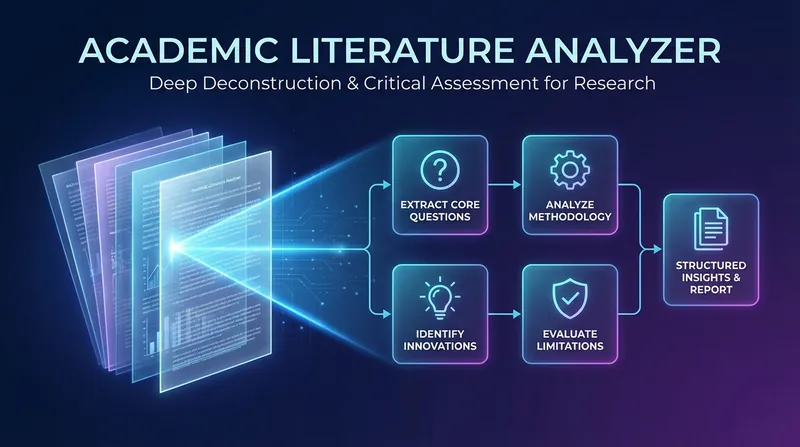
Read and structurally deconstruct academic papers like a top literature expert. Quickly extract core issues, methods, innovations, limitations, research quality, and future directions from one or multiple academic papers, helping you efficiently complete reviews and research topic selection.
Information
- Version
- v3
- Last updated
- Runtime credits
- Usage-based
- Models
- Auto