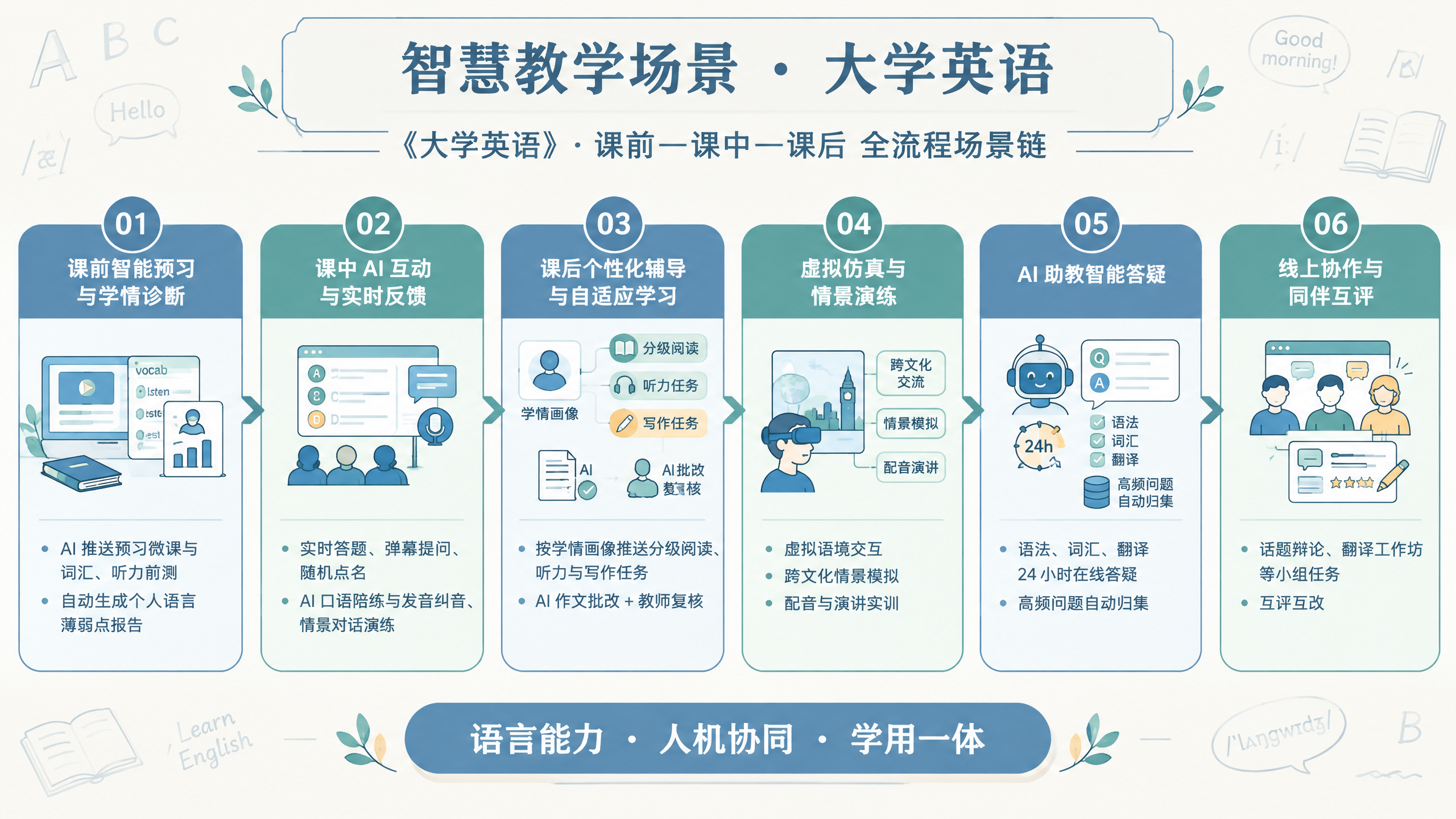
Smart Course Materials Expert
Create structured materials and supporting infographics
Smart Course Materials Expert
Create structured materials and supporting infographics
Showcase
Description
Transforms smart course development成果 in any discipline into “application / development / completion” materials tailored to provincial- or institution-level review, with professional infographics generated for each section. Uses the application template sections provided by the user; when no template is provided, it automatically applies a built-in six-module framework (development background and goals / features and innovation / smart resource development / smart teaching scenarios / smart assessment system / outcomes and promotion). Subject content, platform tools, and metric figures are fully parameterized; missing data is automatically marked with placeholders and never fabricated. The final deliverable combines a structured copy draft with 16:9 infographics in one integrated package, remaining discipline-agnostic and reusable across fields.
Related Skills
View all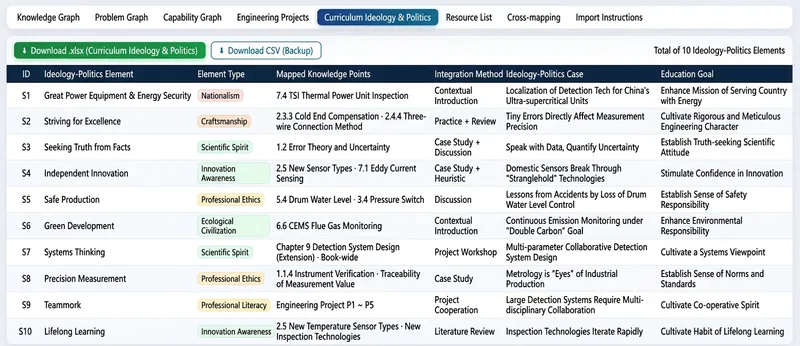
Smart Course Mapping Engine
Turn course webpages, Excel spreadsheets, or textbook text into multidimensional maps and supporting deliverables for smart course development. For both undergraduate and higher vocational courses, it organizes course content into knowledge systems, knowledge-point hierarchies, learning prerequisites and follow-up relationships, and cross-unit connections. The result is a clear, traceable course knowledge map, supplemented with resource, assessment, and teaching application information. Building on the knowledge map, it also creates problem maps, competency maps, engineering project maps, and curriculum-integrated values maps. These show the relationships among knowledge, skills, competencies, project tasks, and educational goals, helping instructors review content coverage, alignment with learning objectives, and the completeness of instructional design. For non-engineering courses, the structure can also be adapted into suitable integrated practice projects. The final deliverables can include interactive HTML visualizations, Excel import sheets compatible with Chaoxing Fanya, and documentation covering development metrics, standards alignment, and quality-check results. During generation, confirmed information is distinguished from items requiring verification to avoid fabricating textbooks, references, links, or platform fields. This makes it suitable for course development, smart course applications, teaching-resource organization, and course quality review.
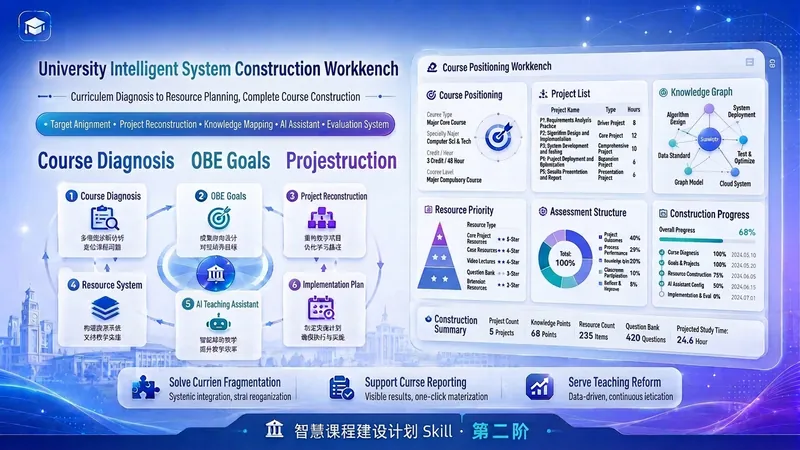
Smart Course Dev II Workbench
Systematically transform a traditional course into a smart course. This Skill is designed for college instructors who have already completed some lesson plans, syllabi, or unit designs and wish to further develop the entire course into a smart course. Teachers only need to provide the course name, target students, credit hours, course content, and existing materials, and a complete smart course construction plan will be generated, including: 1. Course positioning and construction problem diagnosis; 2. Knowledge, ability, and quality objective system; 3. OBE course objective mapping; 4. Project-based course content restructuring; 5. Course knowledge graph structure; 6. Smart teaching model for pre-class, in-class, and post-class; 7. Digital teaching resource development checklist; 8. Course AI assistant design plan; 9. Formative assessment and course evaluation system; 10. Construction tasks, implementation steps, and deliverable list. Applicable to courses in liberal arts, sciences, engineering, medicine, economics, management, arts, ideological and political education, etc. for undergraduate and vocational colleges. This Skill focuses on solving the problem of 'how to systematically build an entire course' and does not handle actual teaching data analysis, student early warning, or course operation diagnosis. Related tasks are completed by the third-level Skill.
 Research
Teaching Award App Auto Expert
Teaching Achievement Award Application · Full-Process Automation Advisor System 🎯 Adaptive Recognition of Coverage Levels: Education Type: Basic Education / Vocational Education / Higher Education → Automatically matches the application system Award Level: National / Provincial / School Level → Automatically identifies difficulty and focus of competition 📊 Four Delivery Phases (Staged Closed Loop): | Phase | Output | Core Value | |-------|--------|------------| | 1. Diagnosis & Profiling | 7-8 question smart survey + achievement positioning report | Identify the right application level to avoid over or under applying | | 2. Topic Selection | Topic direction matrix + 3-5 similar successful cases | Know which direction to adjust to be most visible | | 3. Title Incubation | 5-8 alternative titles (SCPAR naming) | If the title is right, half the application is done | | 4. Body Writing | Complete version of the application with strict word count | How many words for innovation, results, and dissemination value — precise to the paragraph | | 5. Diagnostic Scoring | Three-dimensional innovation assessment + expert checklist | Reviewing it yourself after editing is like having a professional review | 🔧 Built-in Standardized Tool Library: ✓ SCPAR Naming Rule — The invisible scoring table for teaching achievement titles ✓ Word Count Hard Constraint Check — Automatically enforces 5000-12000 word range ✓ Three-Dimensional Innovation Assessment Model — Full reproduction of the scoring logic used by award judges ✓ Title Template Library — Reference templates for national/provincial/school level achievements ✓ Expert Checklist — Item-by-item self-check for the finished application 📈 Expected Results: Application success rate from random 30% to precise 70%+ Application preparation time from 2-3 months to 2-3 weeks Higher first-submission hit rate (more accurate topic selection)
Information
- Version
- v3
- Last updated
- Runtime credits
- Usage-based
- Models
- Auto