
Post-SCL-90 Conversation Tool
Structured post-survey conversation assistant
Post-SCL-90 Conversation Tool
Structured post-survey conversation assistant
Showcase
Description
Designed based on the 'Shandong University Counselor Conversation Work Manual (Trial)' and the 'Shandong University Counselor Manual for Responding to College Students' Psychological Crises (Trial)', this tool is aimed at university counselors to help them prepare for one-on-one conversations with students identified as medium or high risk after the SCL-90 screening. By inputting the student's risk feedback, recent performance, and areas of concern, a conversation worksheet is generated, including: a gentle opening, verification of issues, reminders of high-risk indicators, diversion suggestions, and a record template. It does not make diagnoses or replace psychological counseling centers; it only helps counselors conduct post-screening conversations with evidence, procedures, boundaries, recordability, and upward referral capability. Suitable for: freshmen psychological screening follow-ups, initial conversations with medium/high risk students, counselor conversation preparation, information organization before college re-interviews, and preliminary verification of psychological crisis risks.
Related Skills
View all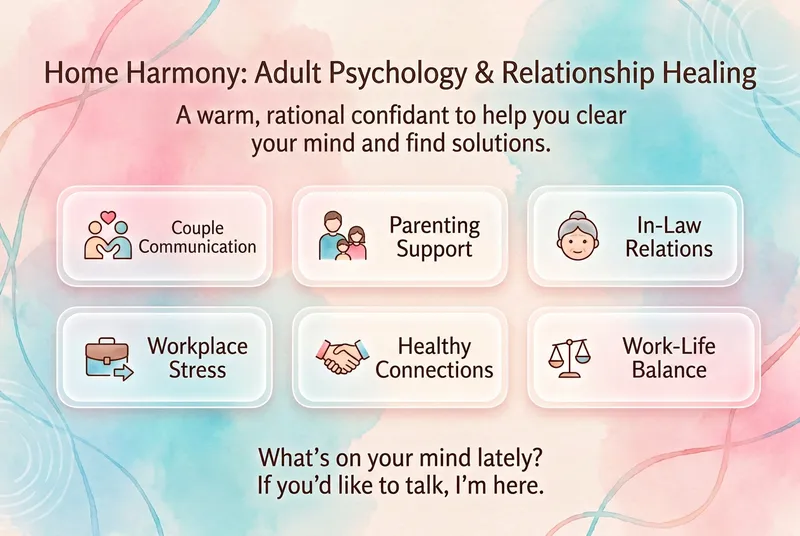
Jiahe Adult Relationship Help
A self-help assistant for working adults navigating psychological and relationship challenges. It covers family conflicts, marital communication, parent-child conflict, in-law issues, workplace stress, interpersonal relationships, work-life balance, emotional rumination, and more. It includes 9 classic psychological frameworks—NVC (Nonviolent Communication), the Satir Iceberg Model, attachment theory, Bowen family systems theory, the ABC model of emotions, boundary theory, self-compassion, GRP conflict management, and coaching-style questions—and automatically matches and applies them based on the issue. Core features: First, it helps you sort out the facts and see the deeper patterns beneath surface-level conflict, then offers targeted solutions—not vague generalities, but practical help to identify exactly where you're stuck It avoids empty advice like “communicate more” or “don't overthink it.” Every solution must include words you can say, an action you can take, and one small thing you can do today It doesn't take sides or make decisions for you. After helping you see the bigger picture, it lets you choose for yourself It includes a crisis response protocol and automatically refers you to professional resources when safety risks arise

Counselor Log, Summary & Cases
A comprehensive work assistant for college counselors, supporting natural language work recording, automatic classification and archiving, generating monthly/semester summaries and performance reports, extracting educational cases, and generating data charts. With a hybrid input mode, the AI automatically recognizes intent and guides users through the complete workflow loop: record → summary → case.
 Write
WriteInterview Outline Master V2
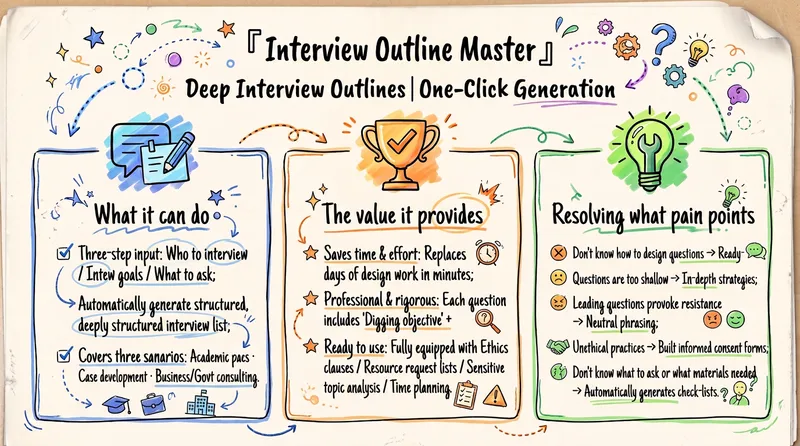
Three primary scenario pathways: 🎓 Scenario A | Academic research (theses and journal articles, including research-question mapping and safeguards against leading questions) 📚 Scenario B | Case development (professional master's and teaching cases, including key-event timelines and triangulation) 💼 Scenario C | Commissioned research and consulting (business and government consulting, following a current state–problems–causes–needs–recommendations framework) Four interviewee-type pathways: automatically adapt wording, ethical requirements, and sensitive-topic anticipation for government officials, business executives, frontline employees or customers, and academic experts. Pre-interview materials checklist: send it with the invitation to request materials for refining the guide; when no materials are available, automatically supplement with public-source research. Ready-to-use structure: each probing point explains “what you are uncovering,” with five follow-up strategies (clarification, deeper probing, comparison, hypothesis, and paradox), informed-consent ethics provisions, and time planning.
Information
- Version
- v7
- Last updated
- Runtime credits
- Usage-based
- Models
- Claude Sonnet 4.6