
Interview Outline Master V2
Research, case, and consulting interviews
Interview Outline Master V2
Research, case, and consulting interviews
Showcase
Description
Three primary scenario pathways: 🎓 Scenario A | Academic research (theses and journal articles, including research-question mapping and safeguards against leading questions) 📚 Scenario B | Case development (professional master's and teaching cases, including key-event timelines and triangulation) 💼 Scenario C | Commissioned research and consulting (business and government consulting, following a current state–problems–causes–needs–recommendations framework) Four interviewee-type pathways: automatically adapt wording, ethical requirements, and sensitive-topic anticipation for government officials, business executives, frontline employees or customers, and academic experts. Pre-interview materials checklist: send it with the invitation to request materials for refining the guide; when no materials are available, automatically supplement with public-source research. Ready-to-use structure: each probing point explains “what you are uncovering,” with five follow-up strategies (clarification, deeper probing, comparison, hypothesis, and paradox), informed-consent ethics provisions, and time planning.
Recommended by
Shuting@YouMind
Why we love this skill
Combines academic qualitative research, case reconstruction, and consulting diagnosis with scenario- and role-specific questions, plus materials requests, triangulation, probing labels, and sensitive-topic guidance.
Best for
Researchers, case developers, consultants, and project teams conducting in-depth interviews.
How to use this Skill
Provide your input
Provide the interviewee's identity, interview purpose, content scope, and any available research, case, or project background materials.
Run the Skill
Based on your scenario and interviewee, design a neutral, progressive, ethically sound question structure and organize key preparation points.
Review your result
Get a ready-to-use, structured interview guide covering question areas, follow-up directions, ethical notes, sensitive-topic prompts, and timing.
Related Skills
View all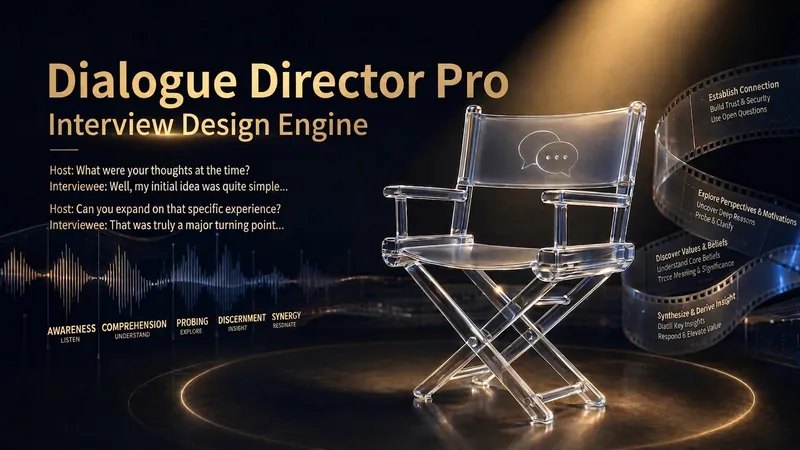
Dialogue Director Pro | Interview Design Engine
This isn't just a list of questions; it helps you design a memorable conversation. A 7-step process, from guest research to finalized materials: Guest Profile → Narrative Structure → Question Matrix → Process Layout → Interview Rehearsal → Material Conversion → Interview Debriefing 💡 Steps 1-3 form the core design process, delivering a complete interview plan independently; Steps 4-7 enhance the experience and can be used as needed. 🔍 Guest Profile | Online search of publicly available guest information generates a five-dimensional in-depth profile—factual skeleton, story vein, core conflict, communication style, and emotional entry point—telling you which direction to dig. Non-public figures automatically switch to interview-style information gathering. 🌿 Follow-up Question Branching Tree | When generating questions, the system pre-predicts the possible directions of the guest's answers for each key question and designs corresponding follow-up questions. You take this "decision tree" to the event, listen to the guest's answer, and then choose the corresponding branch to ask follow-up questions—no need for on-site AI, no need for real-time text transcription; all plans are designed during the preparation stage. It lets you be a chess player on-site, not an improvisational actor. No similar function exists on the market. 🎬 AI Rehearsal | Before the interview, AI plays the role of a guest, simulating three answering styles (in-depth/superficial/evasive), allowing you to practice follow-up questions and identify blind spots in the process. 📝 Five Outputs | Generates from a single interview: interview article/ podcast script/ oral history transcript/ social media content package/documentary script skeleton. 📊 Interview Debriefing | Plan vs. reality comparison, analysis of gold mines and regrets, five-dimensional capability radar chart, allowing you to grow with every interview. Suitable for: podcast interviews, interviews, student interviews, UX in-depth interviews, executive interviews.
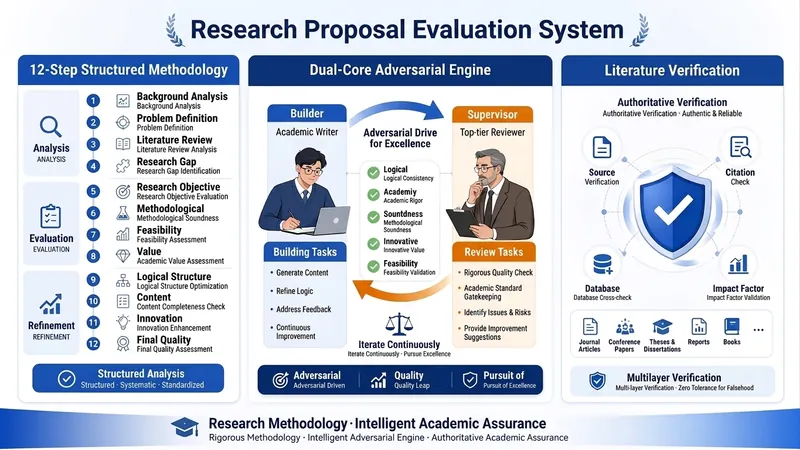
Grant Proposal Review PRO V2.0
🎯 Core Functionality Overview This is an intelligent review and optimization system specially designed for national social science, education ministry, and provincial grant applications. It simulates the thinking mode of a senior review expert with 15 years of experience, ensuring academic rigor and competitiveness through three core mechanisms. 🔧 Three Core Mechanisms 1️⃣ 12-Step Structured Methodology Covers the full lifecycle of grant proposal review: Phase 1-3: Basic Diagnosis - In-depth analysis of announcement (funding priorities, review criteria, application requirements) - Cross-disciplinary type judgment (precise identification of 8 types) - Research GAP five-dimension identification (theory/methodology/empirical/policy/technology) Phase 4-7: Core Element Review - Research question TMAQ model analysis (theory/methodology/approach/question four dimensions) - Research objective SMART principle test - Research content framework completeness assessment - Research approach type matching (6 types) Phase 8-10: Deep Quality Enhancement - Precise extraction of key difficulties (distinguish criteria + breakthrough paths) - Innovation point seven-dimension mining - Feasibility seven-dimension argumentation Phase 11-12: Overall Optimization - Nine-dimension quality check (academic rigor, innovativeness, feasibility, etc.) - Comprehensive optimization suggestions and final report 2️⃣ Dual-Core Adversarial Mechanism (Builder vs Supervisor) Working Principle: - Builder (academic writer): Generates optimization plans based on user materials - Supervisor (top journal reviewer): Challenges Builder's plans with the strictest standards - Adversarial iteration: 3 rounds of confrontation to ensure plans are robust Application Scenarios: - Innovation point mining: Builder proposes innovation points → Supervisor questions novelty → iterative optimization - Feasibility argumentation: Builder designs plan → Supervisor challenges feasibility → supplementary argumentation - Literature citation: Builder cites literature → Supervisor verifies authenticity → ensure academic standards 3️⃣ Literature Authenticity Verification Mechanism Two working modes: Mode A: Placeholder Mode (Default) - Use markers like [Literature Placeholder-001] in place of specific references - Output a Literature Requirement List specifying search requirements for each placeholder - User searches and fills in real references Mode B: Real-Time Verification Mode - Call Google Scholar to verify literature authenticity in real time - Generate Literature Verification Report (authenticity/relevance/authority scores) - Ensure every citation is traceable Preventing AI Hallucination: - Prohibits fabricating authors, journals, DOIs - All references must be verified or marked as placeholders - Guarantees academic integrity bottom line 💡 Core Value and Applicable Scenarios ✅ Key Pain Points Addressed 1. Academic sloppiness: AI-generated content often includes fake references, logical gaps 2. Insufficient innovation: Difficulty uncovering true academic innovation points 3. Weak feasibility: Research plans lack systematic argumentation 4. Cross-disciplinary difficulty: Interdisciplinary topics often fall between two stools 🎓 Target Users - University faculty (social sciences, education, humanities) - Researchers (applying for national and provincial grants) - Academic teams (needing systematic review processes) 📋 Typical Workflow 1. Input: Upload announcement + proposal draft 2. Review: System executes 12-step structured analysis 3. Adversarial: Dual-core mechanism iteratively optimizes key sections 4. Verification: Literature authenticity check 5. Output: Complete review report + optimization suggestions + literature list 🔍 Differences from Traditional Review | Dimension | Traditional Human Review | Expert Review System | |-----------|------------------------|----------------------| | Review depth | Depends on personal experience | 12-step structured + 9D QC | | Academic rigor | Hard to fully audit | Literature verification + dual-core adversarial | | Innovation mining | Subjective judgment | 7-dimension systematic analysis | | Feasibility argumentation | Experience-driven | 7-dimension item-by-item argumentation | | Consistency | Varies by individual | Standardized process | | Efficiency | Days to weeks | 1-2 hours for initial review | The core advantage of this system is: it makes the tacit knowledge of a 15-year senior review expert explicit, structured, and replicable, enabling every user to receive top-level expert review services.
 Research
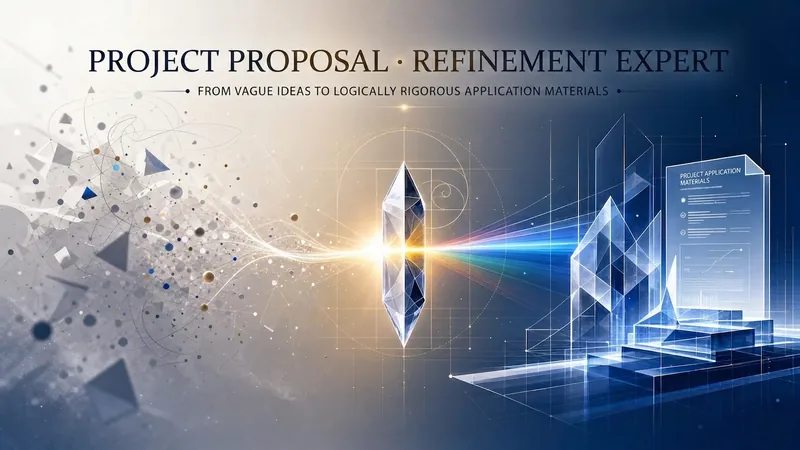
Project Proposal Expert v3.0
From vague ideas to logically rigorous application materials, even ordinary technical personnel can complete a 10,000-word argumentation report in 2 hours. Core Features: Eliminate empty language in applications: automatically strip out filler words like 'high-level' and 'significantly improved', use SCQA framework + Pyramid Principle to write quantified, logically rigorous arguments. Accurately identify innovation patterns: automatically analyze project characteristics, match three modes (autonomous originality, integrated innovation, iterative micro-innovation), give compatibility score and recommendation, avoid failure due to mispositioned innovation. Prevent logic gaps in argumentation: exclusive 'five elements + three chapters' structured output method, from project rationale to innovation points tightly linked, master 10,000-word deep report + high-definition technology roadmap. Zero experience required: no idea? Just input a one-sentence project idea (e.g., 'want to make a quantum sensor for gas leak detection'), system automatically completes 6 phases, outputs complete application materials. Usage: Open the dialogue box and directly input your project idea or upload existing materials; the system will guide you through the entire process: information collection → innovation mode selection → brief argumentation generation → full report generation → technology roadmap generation. Each phase has a confirmation mechanism, and you can flexibly exit and iterate. About V3.2: The new V3.2 version integrates five methodologies: SCQA framework, SMART principles, Pyramid Principle, Comparison-Difference-Advantage method, and Three-Dimensional Value method. It has been refined through real-world cases in quantum detection, smart elderly care, energy management, and other fields, locking in the underlying logic of research proposal success—an essential tool for successful project applications! Application scenarios: ✅ National Natural Science Foundation applications ✅ Provincial/municipal science and technology plan projects ✅ Enterprise technology innovation project initiation ✅ Graduate thesis proposal writing ✅ Technology achievement transformation plan design Core advantages: 🎯 Efficiency increase by 10x: from 2-3 weeks to 2-3 hours 📊 Quality professional guarantee: quantified indicators, rigorous logic, prominent innovation points 🔄 Flexible and controllable: each phase can be confirmed, modified, or exited 📈 Validated by real cases: successfully generated multiple 10,000-word deep reports Typical output examples: ✅ 10,000-word deep argumentation report ✅ High-definition technology roadmap ✅ Structured brief argumentation ✅ SCQA diagnostic analysis report ✅ Innovation mode compatibility assessment
Information
- Version
- v3
- Last updated
- Runtime credits
- Usage-based
- Models
- Auto
- Use cases
- Research & analysisLearning & educationBusiness & strategy
- What you get
- Document
