Roundtable Discussion
Roundtable Discussion
Showcase
Description
This skill is based on Li Jigang's ljg-roundtable. It builds a structured dialogue framework aimed at truth-seeking. A highly insightful moderator guides the conversation, inviting representative figures of different thoughts for intense, real-time deep dialogue. At the end of each round, the moderator generates a visual thinking framework (ASCII Chart). Through 'active questioning' and 'co-construction', it collaboratively explores the user's topic, ultimately producing profound, structured knowledge networks. Use cases: when the user says '圆桌讨论', '圆桌', 'roundtable', '辩论', or wants to explore a topic through multi-perspective structured debate.
Related Skills
View allCelebrity Chat Room
In the "Celebrity Chat Room," you can engage in deep conversations with top minds across various fields, whether seeking personal guidance or exploring complex issues. You can discuss first principles with Musk, learn strategic thinking from Mao, get decision-making insights from Munger, or talk about leverage with Naval—gaining multiple perspectives to avoid narrow thinking. This skill supports two core modes: one-on-one private conversations with a single figure to delve into their thought essence, or a roundtable discussion with multiple figures to provoke intellectual debate around your question, providing judgments, evidence, and even pointing out blind spots. Additionally, when you want to introduce new perspectives, the skill can "invite" more figures into the discussion on demand. It quickly extracts the core ideas and unique style of new participants, integrating them into the ongoing conversation to offer richer viewpoints and more comprehensive thinking. Finally, the host will summarize consensus, disagreements, blind spots, and action suggestions to help you clearly understand the issue and make informed decisions.
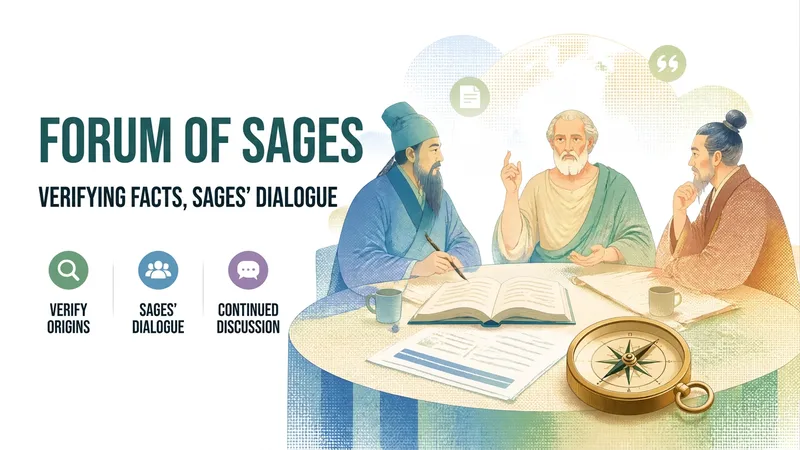
Fact-Checking & Philosopher Dialogue
Transform a piece of news, event description, or contemporary issue into a fact-based 'philosopher forum.' It begins by verifying key facts, timelines, and points of contention—distinguishing between verified information, unilateral claims, media reports, inferences, and unknowns—and organizes them into a public dossier with genuine sources, ensuring subsequent discussions are built on clear, traceable factual boundaries. Building on this, the forum can invite historical thinkers such as Confucius, Zhuangzi, Marx, and Nietzsche based on your specifications, or match thinker combinations to the topic. Each thinker analyzes the issue independently through a fictional thought experiment inspired by their philosophy, presenting their core concerns, reasoning paths, value conflicts, realistic costs, and potential counterarguments, all while integrating contemporary knowledge and life situations rather than simply quoting famous lines or using archaic tones. You can also call out and question a specific thinker, have them respond to points already raised by others, and conduct cross-examinations, position revisions, and continuous dialogue. When encountering the latest reports, you can update the facts before discussing their impact; subsequent exchanges default to appearing in the dialogue, and are only organized into a traceable discussion record when explicitly requested.
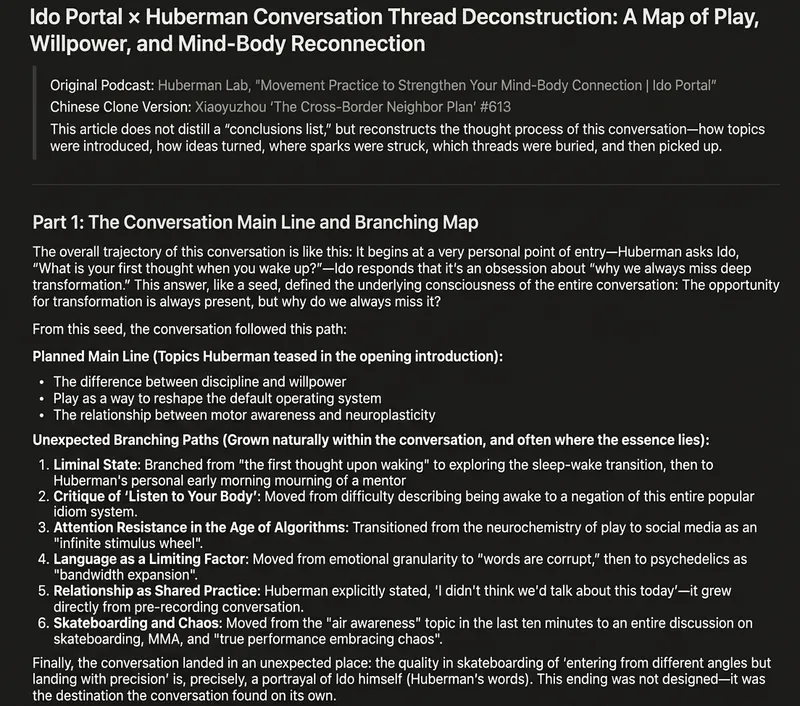
Conversation Podcast: Thinking
7/14 Update: Added content extraction and integration sections 1. Key information summary (Module 5) 2. Opinion integration and comparative analysis (Module 6): Groups scattered opinions by topic, distinguishes genuine divergence / surface divergence / consensus, and adds argument strength assessment. 3. Topic area tags (Module 7): Two-tier system of domain tags and concept tags, up to 15 tags, for future retrieval and cross-episode linking. 4. Key questions for further exploration (Module 8): Unresolved threads / logical extensions / assumptions to challenge. ———————————————— Deep analysis of conversational podcasts. This skill helps you capture the most compelling thought trajectories in conversations. It does not merely extract conclusions, but meticulously recreates collisions, generation, divergence, and extension of ideas, allowing you to see how podcast guests build their arguments step by step. You will receive a structurally clear podcast interpretation, including the main thread and unexpected "detour maps," accurately depicting the overall flow of the conversation. The skill presents the reasoning process in segments, from the origin of the topic, intermediate steps of argumentation, to the disagreements between guests and their fascinating chemistry, letting you understand the formation context of each viewpoint. Additionally, this skill highlights "sparkling moments" in the conversation, such as unexpected quotes, brilliant analogies, or 'aha' moments, along with the specific context in which they appear. You can also track the network of clues that are "laid earlier and echoed later," understanding how concepts evolve and how details mentioned early become key to later arguments. Finally, the skill lists unfinished topics and unresolved thoughts, providing inspiration for further exploration.
Information
- Version
- v1
- Last updated
- Runtime credits
- Usage-based
- Models
- Auto
