Research Question Refiner
Research Question Refiner
Showcase
Description
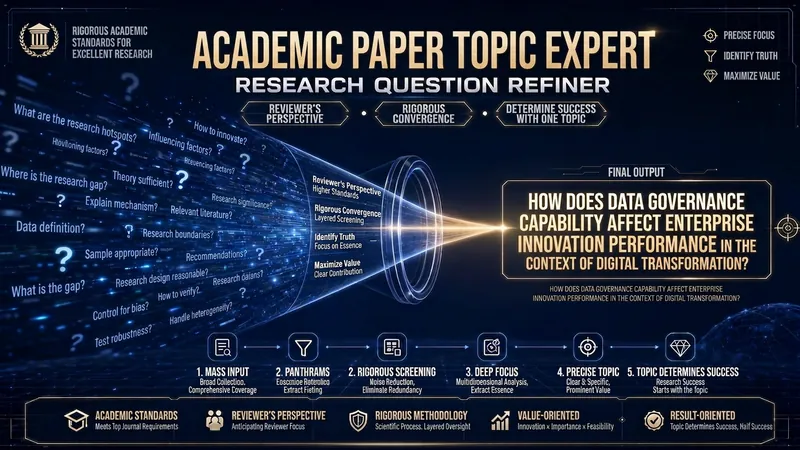
Gradually narrow broad interests, real-world phenomena, literature leads, or preliminary results into researchable, testable questions. Use an evidence ledger to identify gaps in data, mechanisms, boundaries, method comparisons, and contradiction synthesis; rank candidate questions through hard gates and sensitivity analysis; and develop a minimum viable research design for the top choice.
Related Skills
View all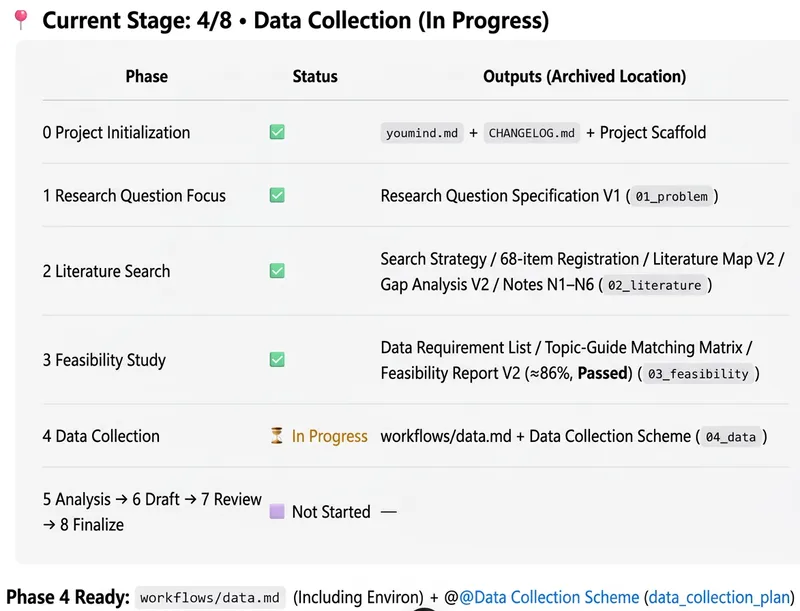
Research Proposal Assistant
Designed for university faculty and researchers, this assistant turns an initial research idea into an executable, fundable project plan. It covers national- and provincial-level humanities and social sciences projects, teaching reform projects, and other research project types. Provide the project type and application guidelines or template, research direction, existing成果, and personal and institutional information. The assistant helps clarify the topic, focus the research question, and build a complete foundation for the proposal around the research problem, application requirements, and review logic. As the project develops, the assistant can support academic searches, literature reviews, research gap analysis, feasibility assessments for data and methods, comparable project matching, and research design adjustments. It helps ensure that literature, data, and funding information are authentic and verifiable, while incorporating AI, contemporary relevance, and methodological innovation into the topic and innovation points. Once the research plan is mature, it can draft an initial proposal based on the application guidelines or blank template you provide, simulate different reviewer perspectives, and suggest revisions through to the final draft. The project retains stage outputs, version records, and the basis for changes. It can ultimately organize a proposal, technical roadmap, research framework diagram, innovation logic diagram, progress Gantt chart, and other research visuals. For tasks requiring an external environment, such as full-text PDF analysis, code execution, web scraping, or large-scale data processing, the assistant clearly identifies handoff tasks and supports filling in results and continuing the work, helping move the project from preparation through a properly formatted final proposal.
 Write
Academic Research Question
• Diagnose candidate topics: Identify overly broad topics, unclear subjects, uncontrolled boundaries, and false novelty before determining whether the topic is ready to be finalized. • Narrow the research scope: Remove nonessential subjects, variables, and objectives to reduce “trying to study everything” to one central question. • Derive the core question: Identify a single research direction based on subject clarity, question sharpness, scope control, and fit with available materials. • Generate a standardized title: Produce one Chinese title aligned with the research question, with an English title and a specific contribution statement when needed. After opening, say: “I have 3 candidate topics and want to submit to a CSSCI journal. Help me finalize the topic.” It will first check the research subject, core question, scope, and practical constraints, then provide a well-supported final research question. If information is insufficient, it will ask follow-up questions instead of forcing a polished title. Suitable for: Researchers with candidate topics who are struggling to choose one / scholars who need to focus quickly before submission / anyone who does not want to be rejected by a reviewer’s one-line criticism that the research question is unclear. ✅ This version has undergone two months of refinement, testing, and iteration.

Social Science Topic Master
Whether you are a novice researcher or an experienced scholar, whether you want to start from scratch to conceive a research direction or hope to optimize an existing topic, the 'Social Science Topic Master' can provide you with professional, systematic guidance. This tool is based on best practice methodologies for topic proposal writing, aiming to solve core challenges researchers face during topic selection: unclear direction, difficulty in refining research questions, ambiguous value judgment, and non-standard academic expression. Through step-by-step interactive guidance, this tool intelligently identifies your research needs and disciplinary background, providing customized theoretical perspective recommendations and policy clues. You will receive high-quality academic topic titles and undergo scientific diagnosis using the 'Five Criteria for a Good Question' to ensure the rigor and innovation of your topic. Ultimately, this tool outputs a structured complete topic proposal, including the academic title, topic element breakdown, results of the five-criteria test, key points for value argumentation, and policy and literature support. In addition, we provide two sets of detailed optimization suggestions: a 'Quick Fix' version and a 'Deep Optimization' version, helping you to improve key issues in a short time or to make systematic long-term enhancements, thereby significantly increasing the success rate of your topic proposal.
Information
- Version
- v3
- Last updated
- Runtime credits
- Usage-based
- Models
- Auto
