
PUA Recognition Assistant 2.0
Detect manipulation, protect your boundaries.
PUA Recognition Assistant 2.0
Detect manipulation, protect your boundaries.
Showcase
Description
Have you ever encountered this? In intimate relationships or social situations, the other person always: • Uses phrases like "You're too sensitive" or "You're overthinking it" to make you doubt your judgment • Alternates between being warm and cold, leaving you confused and constantly trying to please them • Puts you down "for your own good," making you feel less confident • Sets emotional traps to make you feel like you can't leave them These are classic PUA (emotional manipulation) tactics. Being in such a relationship for a long time can lead to: ❌ Losing your own judgment ❌ Self-doubt and anxiety ❌ Becoming more passive in the relationship ❌ Not knowing how to respond or fight back PUA Recognition Assistant helps you: ✅ Quickly identify manipulative language and patterns in conversations ✅ Analyze the other person's real intentions and psychological strategies ✅ Provide specific, actionable responses and suggestions ✅ Rebuild your emotional boundaries and confidence Stay clear-headed in relationships and take back control.
Related Skills
View all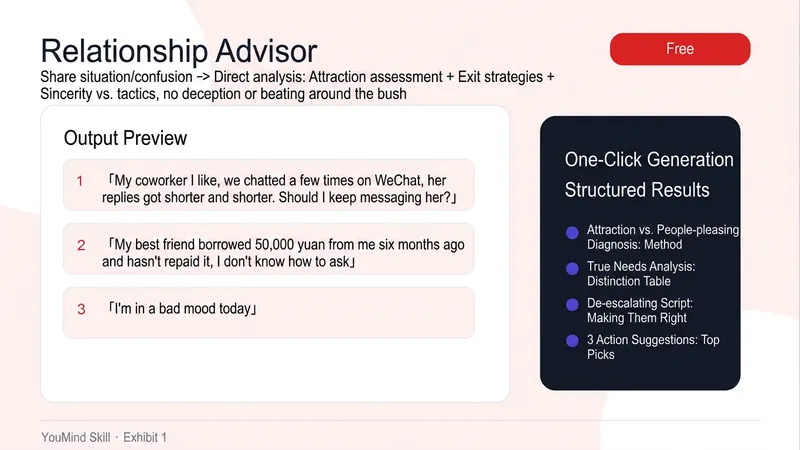
Relationship Advisor
"Why hasn't he replied to me?" "I don't know if I should continue." "Am I being a people-pleaser?" — Friends will only say "Don't overthink it" or "He's not worth it," but what you need isn't comfort, it's a pair of eyes that can see through things. Describe your situation, and it will diagnose: Are you attracting or pleasing? You say you want an answer, but what do you really need? How to give yourself a face-saving way out? Finally, you'll get an honest truth without sugarcoating. ✨ Core Capabilities 1. Attraction vs. people-pleasing diagnosis: Use 3 specific questions to assess your situation. 2. Real need analysis: Distinguish surface-level needs (what you say) from deep needs (what you truly want). 3. Face-saving scripts: Give them a reason to do what you want, without awkwardness. 4. 3 action tips: Prioritized, each telling you "why" and "what might happen." 5. A closing truth: No sugarcoating, tell the rawest truth of the situation. 📱 Usage Scenarios - Crushes/Chasing: Does they actually like me? - In a relationship/marriage: Something feels off but can't pinpoint it. - Breakup/Cold war: Should I reach out? Should I try to win them back? - Friends/Family: How to bring up a difficult topic? Not a relationship coach, but someone who helps you see reality.
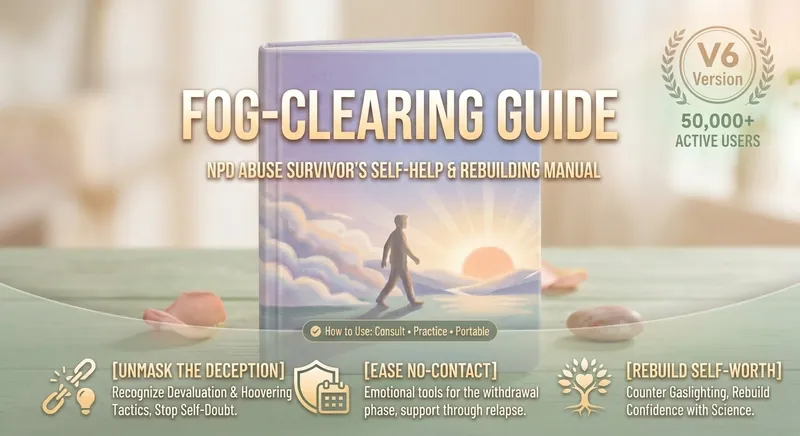
Mist Clearing Guide
Identify emotional control, long-term suppression, and hidden harm in relationships, helping users see why they become increasingly silent and drained. The Skill provides low-risk self-help solutions more suitable for East Asian cultural and real-life relationship environments through relationship risk assessment, self-protection strategies, boundary expression training, long-term emotional trauma recognition, and psychological recovery paths, gradually helping users regain their ability to express themselves, sense of self-worth, and psychological agency.
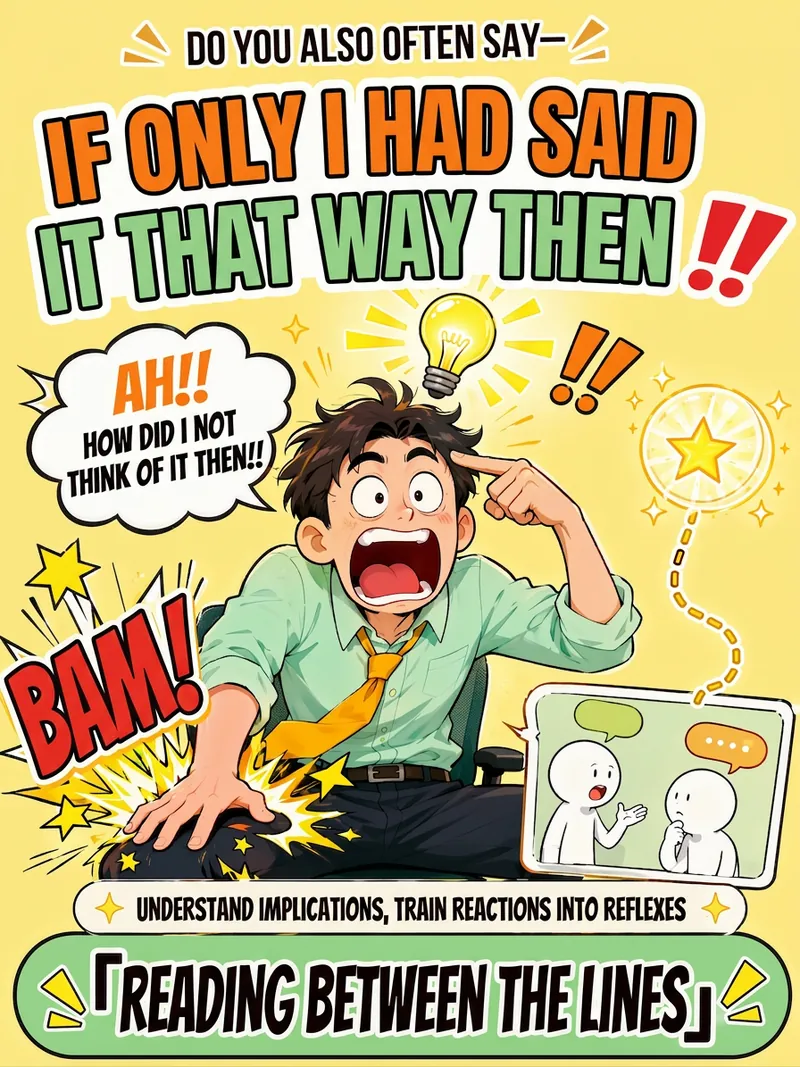
Read Between the Lines
Ever catch yourself slapping your thigh and thinking, “Damn, if only I had said it that way”? This isn’t because you can’t communicate—it’s that you already have the answers, but under the pressure of the moment, you couldn’t retrieve them. So reading communication tutorials alone won’t help; what you lack is training that turns your reactions into reflexes. Read Between the Lines skips the motivational fluff and lectures. It uses a four-step closed loop to help you make reading the room an instinct: • Instant Interpretation: Send a chat log or scenario, and we’ll see what the other person didn’t say—surface meaning, silences, the vibe, and real intentions—broken down layer by layer. • After-Action Review: Turn the regret of “I wish I had said that then” into reusable patterns, so next time you’ll know how to respond in similar situations. • Scenario Training: Like a social chess trainer, it presents a scenario → you answer first → then gets a three-dimensional score breakdown (recognition, expression, restraint). Difficulty increases until responses become muscle memory. • Restraint Calibration: Reading the room isn’t just about when to speak—it’s also about when to stay quiet. Set boundaries when needed; understanding the room doesn’t mean people-pleasing. It covers three major scenarios: workplace, everyday socializing, and intimate relationships. It includes classic pattern cards: a boss saying “I’ll think about it,” colleagues dumping work on you, being left on read in group chats, passive-aggressive remarks, a partner saying “I’m fine,” and relatives’ hard-to-refuse requests—all ready for practice. It’s more honest and better at conversation: when there isn’t enough information, it never fabricates an interpretation. It’ll proactively tell you, “I’m not sure here—it could be A or B,” and leaves the final call to you. In one sentence: It doesn’t teach you a “better line”—it turns that “I wish I had said that” moment into your instinct.
Information
- Version
- v6
- Last updated
- Runtime credits
- Usage-based
- Models
- Auto