
PRD Specification
Organize ideas into a PRD
PRD Specification
Organize ideas into a PRD
Showcase
Description
Used to organize vague ideas, business rules, or research conclusions into a developable product requirements document. It outputs background, goals, scope, user flow, functional requirements, business rules, acceptance criteria, risks, and open issues. Suitable for product requirements review and pre-development use.
Related Skills
View all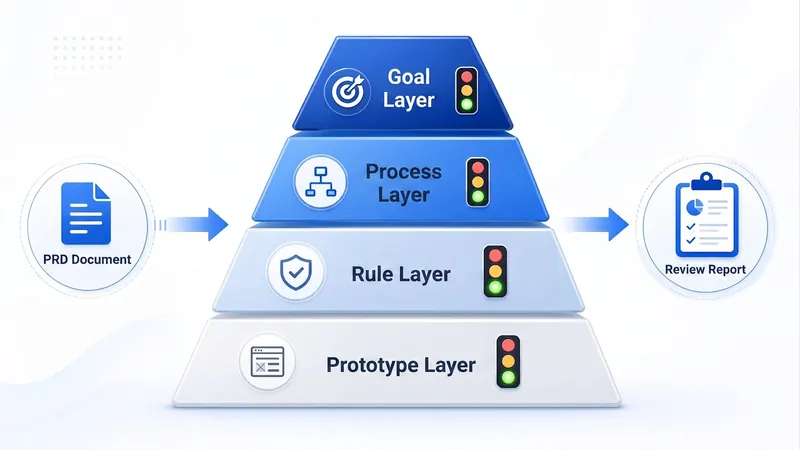
PRD Review Agent
Submit a structured PRD to automatically retrieve product context as the review benchmark. It then conducts a four-layer review—“goals → flows → rules → prototype”—covering five key dimensions: requirements completeness, clarity, technical feasibility, business rationale, and alignment with product goals. The result is a comprehensive red-yellow-green review report. Supports two modes: self-review for team members and review for managers.
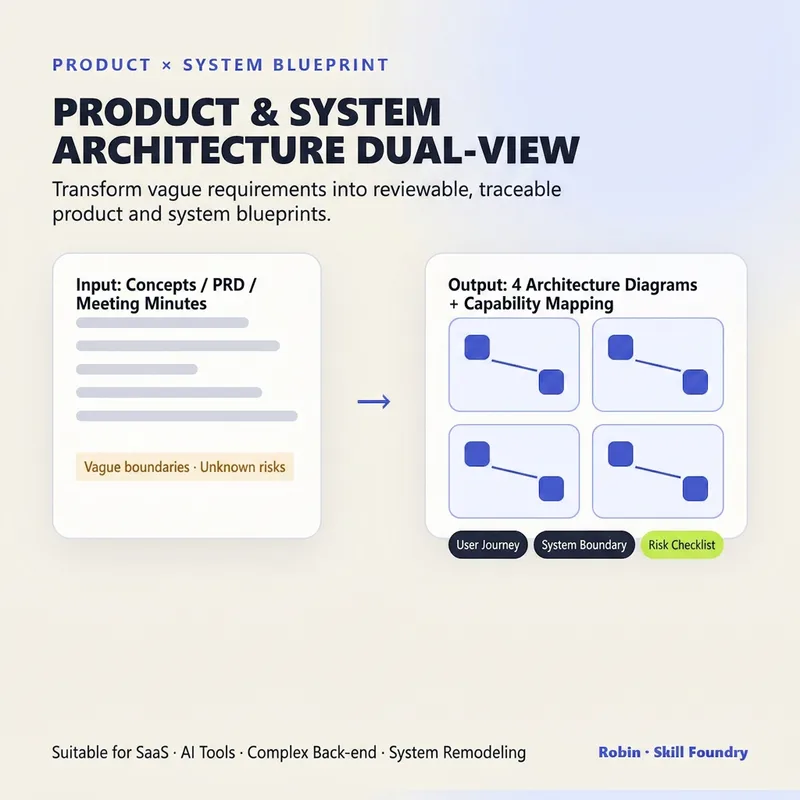
Product Blueprint | Dual Maps
Turn product ideas, PRDs, meeting notes, or documentation of an existing system into cross-validated product information architecture, core user flows, system context, and data flow diagrams. It also produces a product-to-system capability map, key risks, and open decisions. Ideal for product managers, founders, solution architects, and engineering teams conducting requirements reviews, planning SaaS/AI products, designing complex back-office systems, and modernizing existing systems. Supports Chinese and English input, prioritizes generating shareable responsive web pages, and preserves editable Mermaid source code.

Product Logic Architect
This skill helps product managers and business analysts reverse engineer detailed product requirements document (PRD) logic from front-end page descriptions or interaction descriptions. It converts visual front-end information into structured backend business logic, focusing on data flow, business rules, and state changes. As a senior product logic architect, this skill deeply explores the business essence behind the page. It helps you sort out the page's commercial positioning in the product chain, user entry prerequisites, and derives backend data field structures based on front-end elements. It also clearly defines how user interactions trigger business state transitions and elaborates on core business rules such as data validation, calculation distribution, concurrent processing, and anti-fraud. To ensure rigorous product logic, this skill exhaustively considers the invisible "underwater logic" on front-end pages, including exception handling, network delay handling, and permission checks. The final output PRD logic section covers exception boundaries and degradation strategies, such as empty state handling, boundary limits, and responses to extreme exceptions. You only need to provide a front-end page description, interaction flow, or screenshot, and this skill generates a clear, logically rigorous PRD core content, greatly improving product documentation efficiency.
Information
- Version
- v4
- Last updated
- Runtime credits
- Usage-based
- Models
- Auto