Product Logic Architect
Big company ops for top product logic prompts
Product Logic Architect
Big company ops for top product logic prompts
Showcase
Description
This skill helps product managers and business analysts reverse engineer detailed product requirements document (PRD) logic from front-end page descriptions or interaction descriptions. It converts visual front-end information into structured backend business logic, focusing on data flow, business rules, and state changes. As a senior product logic architect, this skill deeply explores the business essence behind the page. It helps you sort out the page's commercial positioning in the product chain, user entry prerequisites, and derives backend data field structures based on front-end elements. It also clearly defines how user interactions trigger business state transitions and elaborates on core business rules such as data validation, calculation distribution, concurrent processing, and anti-fraud. To ensure rigorous product logic, this skill exhaustively considers the invisible "underwater logic" on front-end pages, including exception handling, network delay handling, and permission checks. The final output PRD logic section covers exception boundaries and degradation strategies, such as empty state handling, boundary limits, and responses to extreme exceptions. You only need to provide a front-end page description, interaction flow, or screenshot, and this skill generates a clear, logically rigorous PRD core content, greatly improving product documentation efficiency.
Related Skills
View all Write
WriteCourse Monetization Strategist
Do you have professional knowledge and unique experience but struggle to turn them into valuable course products? The 'Course Monetization Strategist' offers you a one-stop solution to systematically plan a hit course that can successfully generate revenue from scratch. This skill will guide you to deeply explore your strengths, precisely target market needs, and tailor a course development strategy based on your actual situation. Through dialogue-based co-creation with AI, you will progressively complete course positioning, content system construction, instructional design, and commercial monetization planning. We not only help you organize your knowledge framework and design engaging teaching sessions, but also refine core selling points, build a product matrix of 'traffic—trust—profit—premium', and plan feasible monetization paths. Whether you are a trainer, knowledge blogger, or corporate internal trainer, this skill can become your right-hand assistant to transform your professional accumulation into tangible market value. Ultimately, you will receive a complete course development plan covering everything from user personas and course outlines to teaching methods, PPT framework suggestions, and monetization strategies. This detailed plan will provide clear guidance for your subsequent course production and promotion, ensuring that your knowledge product is not only solid in content but also competitive and commercially successful.

Competitive Intel Analyst
Start with a broad view to build a persuasive competitor database, then focus the output on the company’s core business and decision-making needs. This elevates competitor research from “case hunting” to a decision basis that can be verified, compared, and acted on. This is not a prompt that merely lists a few competitors and stitches together webpage screenshots, nor one that crams every database detail into a PPT. “Competitive Intel Analyst” is suitable for consumer goods, technology products, software services, healthcare, education, retail, manufacturing, and other industries. It first defines the research scope and builds a multidimensional search framework covering markets, companies, products/services, user value, technology paths, business models, pricing and channels, intellectual property, partners, and evidence sources. It then creates a continuously updateable, deduplicated, traceable competitor database. Finally, based on the company’s core business, intended use cases, and leadership’s decision questions, it selects a small number of highly relevant benchmarks and produces a conclusion-first leadership briefing PPT, opportunity gaps, and an action roadmap. Suitable for: Panoramic scans of new markets or product categories Product planning, technology planning, and annual strategy research Tracking key competitors, patents, suppliers, or partner ecosystems Adding to, cleaning, and updating evidence in existing competitor databases or PPTs Investment, business development, and management decision briefings Condensing large volumes of material into conclusions that leaders can understand and teams can act on Typical deliverables include a complete competitor database, a shortlist of core competitors, a leadership briefing PPT, technology/patent/ecosystem maps (as needed), an opportunity and risk list, 90/180/365-day action roadmaps, and a source index.
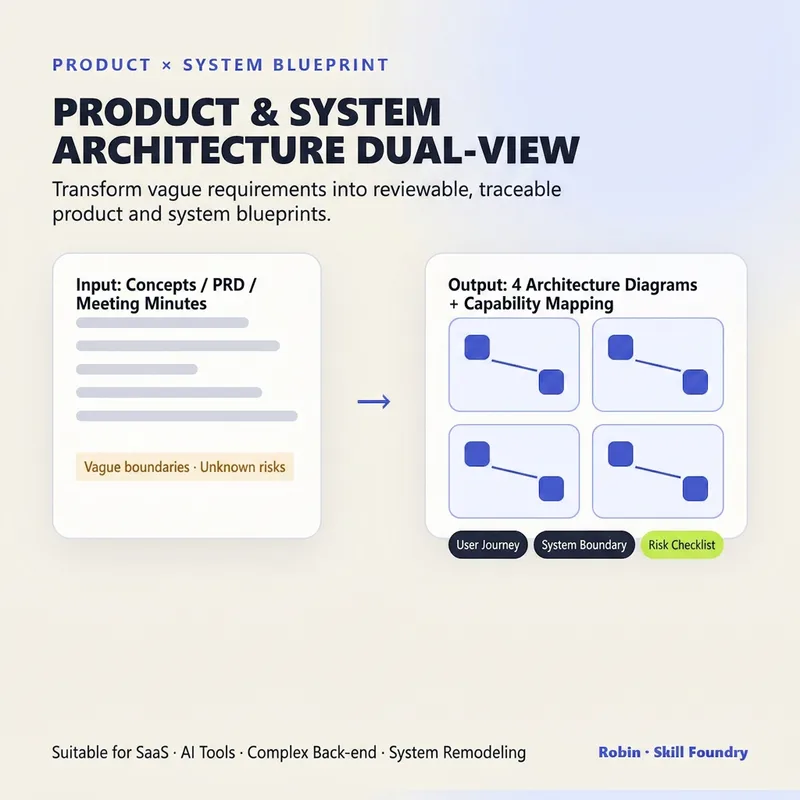
Product Blueprint | Dual Maps
Turn product ideas, PRDs, meeting notes, or documentation of an existing system into cross-validated product information architecture, core user flows, system context, and data flow diagrams. It also produces a product-to-system capability map, key risks, and open decisions. Ideal for product managers, founders, solution architects, and engineering teams conducting requirements reviews, planning SaaS/AI products, designing complex back-office systems, and modernizing existing systems. Supports Chinese and English input, prioritizes generating shareable responsive web pages, and preserves editable Mermaid source code.
Information
- Version
- v3
- Last updated
- Runtime credits
- Usage-based
- Models
- Auto