Paper-Folded Realms
Create paper art blending photos with real cues
Paper-Folded Realms
Create paper art blending photos with real cues
Showcase
Description
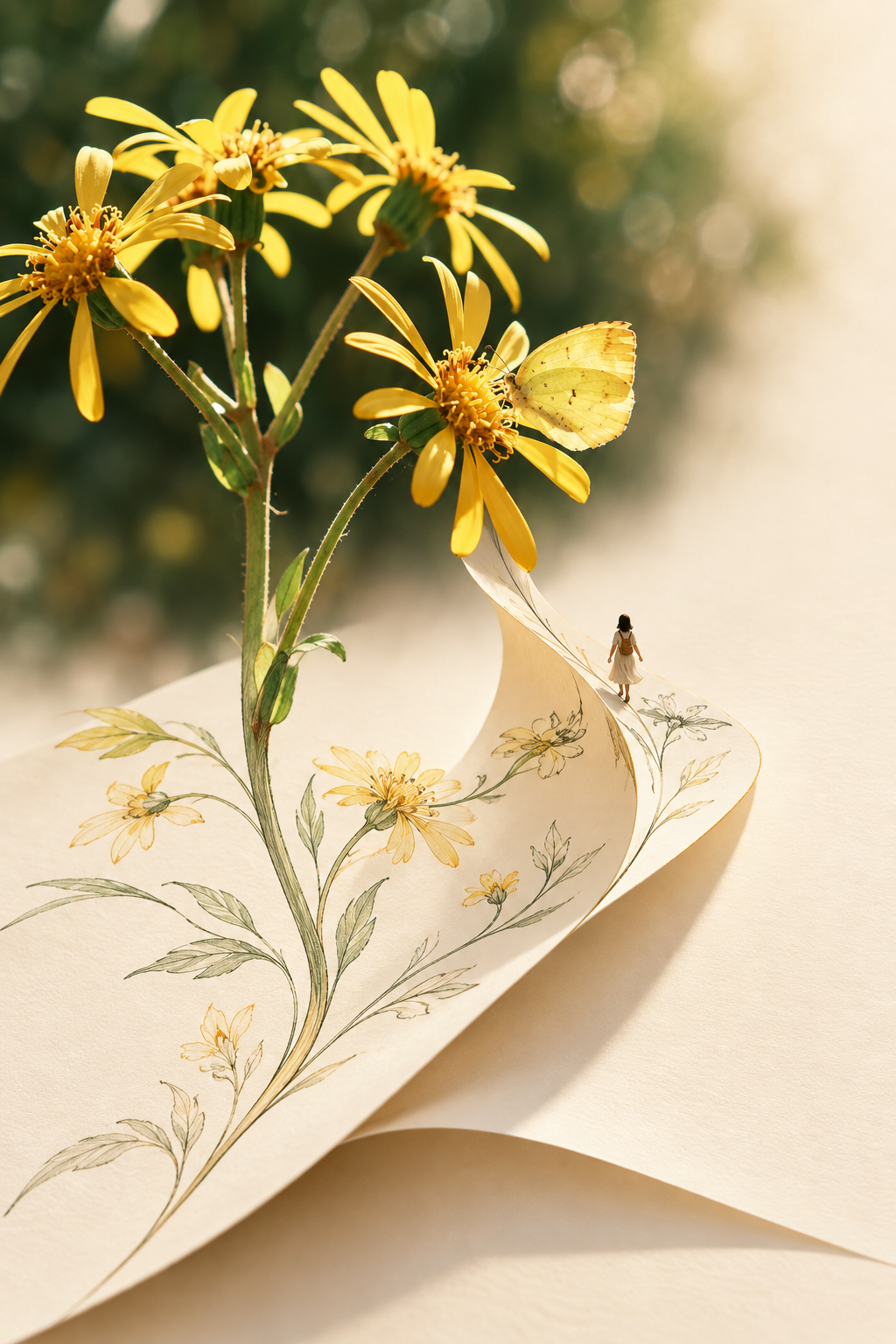
Transform a real photo into a piece of photographic art where the image seamlessly connects with folded paper. Natural lines like roads, riverbanks, eaves, branches, shadows, or object contours extend into believable paper lifts, bends, bridges, or turns, creating new paths and spatial variations. The artwork preserves the original scene's subjects, orientations, positional relationships, and primary colors so viewers can easily recognize the source while feeling a moderately surreal paper-based space. The imagery features a warm off-white paper tone with generous whitespace, restrained colors sampled from the photo, and delicate line work, focusing visual details at the connection points between the photo and the folds. The paper has realistic thickness, lighting, and soft shadows rather than looking like simple layered cutouts or decorations. The artwork also includes a tiny, guiding human figure placed on a logical surface. It is ideal for turning landscapes, architecture, urban spaces, or everyday scenes into paper-fold scapes with a sense of journey and dimensionality. It defaults to a vertical composition, which can be adjusted based on the photo and your needs. Generative inpainting may alter original pixels; for strict pixel preservation, explicitly use real image compositing and check the seams.
Why we love this skill
Seamlessly turns roads, shorelines, eaves, or outlines from photos into believable paper lifts, bends, and paths, creating a surreal space where photography and 3D paper art meet. Every fold stems from the scene, enhanced by restrained negative space and a miniature figure.
Best for
Content creators and photography enthusiasts looking to turn personal photos into visual works with a sense of pathway, depth, and paper-crafted space.
How to use this Skill
Provide your input
Provide a photo of a landscape, architecture, urban space, or everyday scene, along with any special requests such as aspect ratio or pixel fidelity.
Run the Skill
Translates real-world cues in the photo into paper lifts, folds, bridges, or turns that seamlessly connect with the scene, while preserving core subjects and primary colors.
Review your result
Generates a three-dimensional art image blending the photo with warm off-white paper folds, featuring clear pathways, spatial changes, and a moderately surreal feel.
Related Skills
View all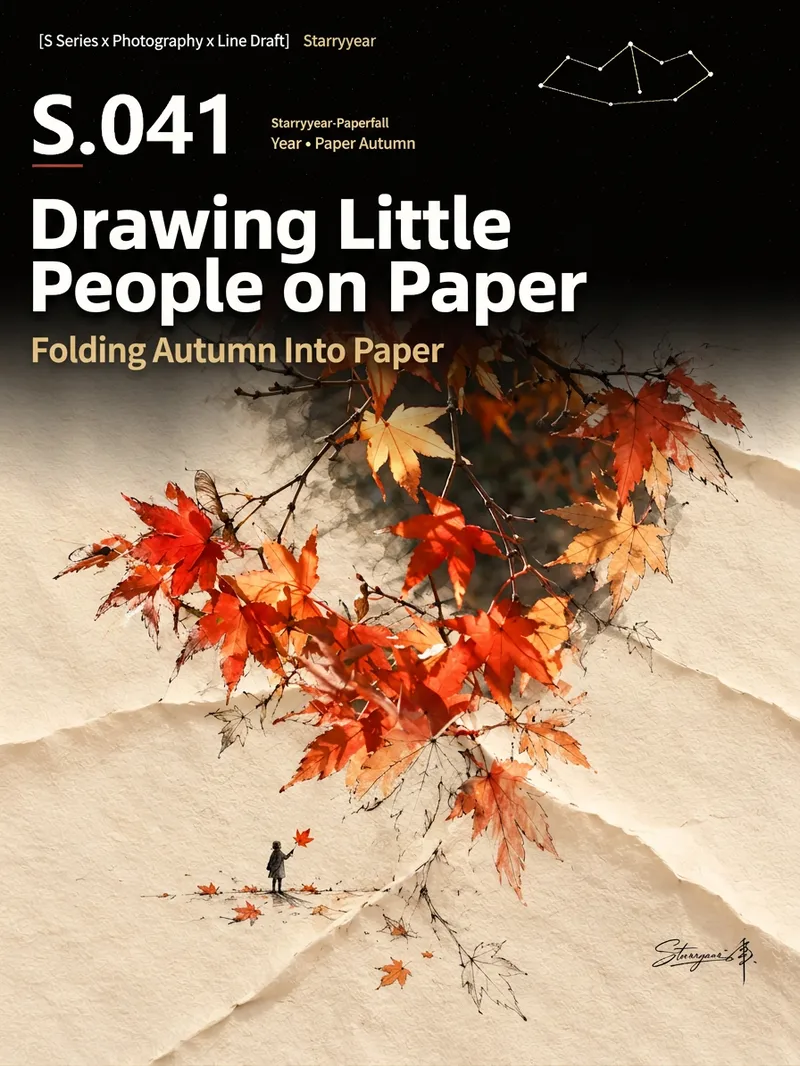 Image
Cardboard Photo Art Starryear
Transform a photo into a spatial folded cardboard artwork with a photographic narrative feel, allowing the original scene to naturally extend across generous, warm negative space. The piece preserves the true relationships and visual characteristics of the primary subjects, people, or animals, while blending the top and bottom edges into sparse charcoal line work and hints of source colors, avoiding rigid stitching, excessive decoration, or irrelevant autumn clichés. The artwork uses a vertical composition centered on a clearly identifiable photographic area, combining continuous thick fiber cardboard, wide folds, raised paper ridges, and soft shadows to deliver a spatial paper art installation effect. Negative space acts as a visual breathing room for the original lines, light, and textures, making it well-suited for autumn-themed cardboard art, photographic extensions, and handcrafted artistic images. The scene also incorporates a tiny hand-drawn figure whose actions naturally interact with the environment, without replacing or shrinking real people from the photo, and without adding titles, signatures, or watermarks. This is designed for creators and photography lovers who want to translate travel photos, documentary snapshots, natural landscapes, or everyday scenes into unique papercraft visual pieces.
 Image
S.031 Year-Vein · Starryear
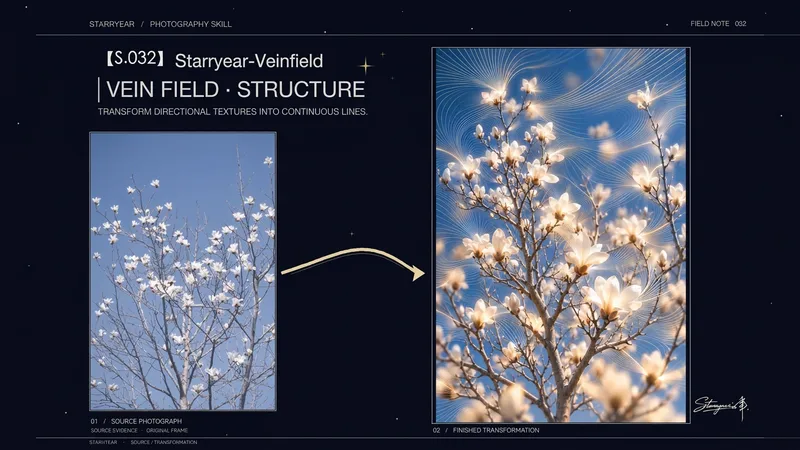
Reconstruct a photo into a distinctive 2:3 portrait artwork that naturally blends photographic details, the subject’s form, and continuous colorful line fields. The work is based on the original subject identity, composition, perspective, lighting, and color relationships, preserving key photographic details as recognition anchors while extending structured line fields from real textures such as radiating patterns, branches, folds, twigs, flowing water, architectural lines, or directions of movement found in the photo. Colorful lines grow along the original forms, spatial relationships, and lighting, creating gradient transitions within the subject, along its edges, and between the subject and background—not simply adding decorative lines or collaging abstract areas. The original image’s dark foundation, subject colors, lit colors, and environmental colors carry through the photographic anchors, reconstructed forms, and line fields, preserving the source image’s warm-cool relationships and spatial depth. This is suited to translating photos of nature, people, architecture, cities, or other subjects with directional textures into portrait artworks that combine photographic texture with a linear visual language. By default, no text, logos, watermarks, or promotional elements are added.
 Image
【S.005】Photo Ink · Starryear
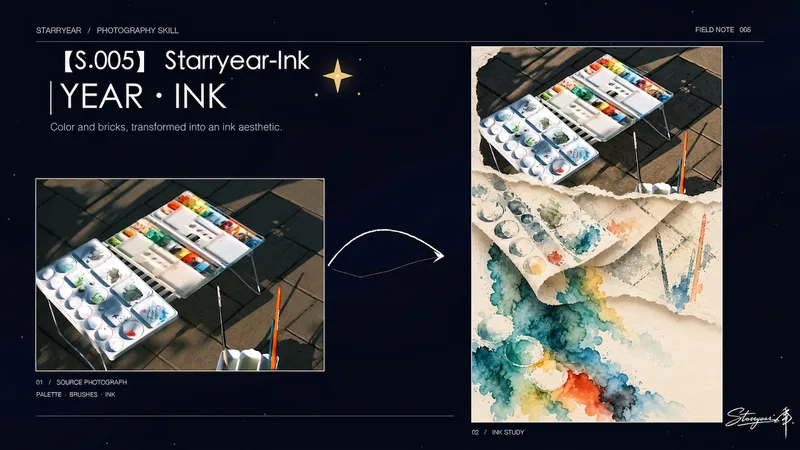
Transform a single photo into a vertical artwork with tactile quality and narrative depth: the top preserves the source photo as real visual evidence, the middle presents a three-dimensional memory of the photo through lifted, curled, and layered warm ivory handmade paper, and the bottom releases a moist, translucent, diffused afterimage in colored ink. It is suited to creating Starryear ink, torn-paper photo ink, and three-dimensional turning-page ink works with the “original image above, flowing ink released below” structure. It is especially suitable for photos of people, animals, buildings, or landscapes where the original identity, number, direction, and spatial relationships need to remain intact. The finished piece emphasizes one complete vertical composition rather than a simple filter or evenly divided collage. The photo area remains clear and recognizable, while the paper layers carry the rhythm, contours, reflections, or negative space of the scene, using natural paper thickness, deckled fibers, overlaps, and soft shadows to create a convincing page-turning effect. The lower ink section uses a small number of related color families to show water-driven blooming, layered color, backflow, pooling, and seepage, creating a clear spatial transformation as the image moves between materials. The overall design centers on matte warm ivory paper and negative space, avoiding a second complete person, unrelated fantasy elements, decorative paper strips, imitation traditional Chinese painting, or overly saturated visual noise. The final output is a polished vertical artwork.
Information
- Version
- v4
- Last updated
- Runtime credits
- Usage-based
- Models
- Auto
- Use cases
- Images & design
- What you get
- Image
- Visual styles
- MinimalistSurrealistPaper art
