
PatentForge - Patent Analysis
Search · Analyze · Layout · Defend · Deliver
PatentForge - Patent Analysis
Search · Analyze · Layout · Defend · Deliver
Showcase
Description
PatentForge is a 6-stage full-process patent intelligence analysis engine (technical problem decoupling → structured patent deconstruction → clustering and white-space analysis → patentability analysis and layout strategy → FTO initial screening → technical solution generation). It integrates a hybrid model of Perplexity patent semantic search + googleSearch exact search, with 3 plugins enabled by default (TRIZ contradiction analysis + three-level patent tree + FTO initial screening), a multi-core adversarial engine (Executor A + Auditor B + TRIZ Expert C + Layout Architect D), 8 core red lines, and dynamic dashboard tracking. Designed for R&D engineers, patent analysts, and IP managers. Trigger words: patent analysis, patent layout, patent search, FTO, patentability, technical solution, PatentForge. Operation Manual: Method 1: Quick Start (One-Sentence Version) Help me analyze the patent layout for this technical problem: [describe your technical problem in one sentence], and the technical field is [your field]. Example: Help me analyze the patent layout for this technical problem: automatic removal of slag from the inner wall of metal pipes after laser cutting, technical field: laser processing + automated cleaning. Method 2: Standard Start (Recommended) Please conduct patent intelligence analysis and layout for the following technical problem: 1. Technical problem: [the core technical problem you want to solve, be as specific as possible] 2. Technical field: [the field involved, e.g., mechanical/electronics/materials/testing/control/AI, etc.] 3. Constraints: [limitations such as volume/cost/material/working conditions, e.g., "cost ≤ 500 RMB, must adapt to existing production line"] 4. Exclusions: [approaches explicitly not to be used, e.g., "do not use chemical cleaning"] 5. Known competitors or patents (optional): [names of known competitors or patent numbers] 6. Existing search results: No (AI will perform Perplexity + googleSearch hybrid search) Example: Please conduct patent intelligence analysis and layout for the following technical problem: 1. Technical problem: automatic detection and defect localization of deep-sea pipeline welds under high-pressure environments; the existing ROV-mounted ultrasonic testing probe has unstable coupling under turbulent flow conditions, causing signal loss 2. Technical field: underwater robotics + ultrasonic testing + signal processing 3. Constraints: working water depth ≤ 3000m, pressure-resistant sealing, must fit existing ROV mechanical interface, single inspection speed ≥ 2m/min 4. Exclusions: do not use radiographic testing (radiation safety restrictions), do not use magnetic particle testing (non-ferromagnetic material pipes) 5. Known competitors or patents: CNXXXXXXXXXX (an underwater ultrasonic testing device) 6. Existing search results: No Method 3: Start with Search Results (When Patent Data Already Exists) Please conduct patent intelligence analysis and layout for the following technical problem. I have provided search results: 1. Technical problem: [core technical problem] 2. Technical field: [field] 3. Constraints: [constraints] 4. Exclusions: [approaches not to be used] 5. Known competitors or patents: [patent number or competitor name] 6. Existing search results: Yes Below is the list of patents I found: [Paste patent numbers, titles, applicants, etc., one per line] Example: Please conduct patent intelligence analysis and layout for the following technical problem. I have provided search results: 1. Technical problem: stiffness degradation and abnormal noise of foldable screen hinges under frequent folding 2. Technical field: precision machinery + material mechanics 3. Constraints: folding life ≥ 300,000 cycles, hinge thickness ≤ 2.5mm, torque decay ≤ 10% 4. Exclusions: do not use liquid metal damping 5. Known competitors or patents: None 6. Existing search results: Yes Below is the list of patents I found: CNXXXXXXXXXX A flexible screen hinge mechanism Company X US2021XXXXXXXXX Hinge mechanism for foldable display Samsung CNXXXXXXXXXX Hinge stiffness adjustment device Company X WO2022/XXXXXXXX Foldable hinge with variable stiffness LG
Related Skills
View all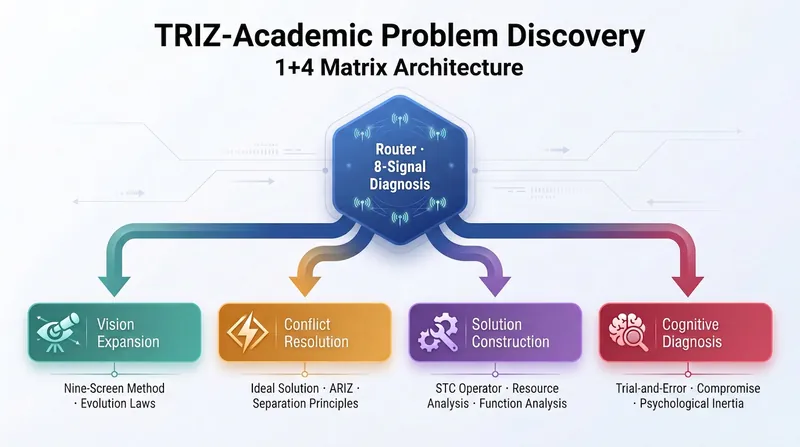
TRIZ-Academic Problem Discovery v2.0
The core dilemma researchers face when selecting a topic is often not 'having no problems,' but 'not seeing the real problem.' TRIZ-Academic Problem Discovery v2.0 uses the AFP 3.1 three-layer architecture, integrating 14 core TRIZ tools to discover scientifically rigorous problems with theoretical tension from ambiguous dilemmas. Core Capabilities: 1. 1+4 Matrix Architecture — 1 router (8-signal diagnosis) + 4 execution paths (perspective expansion, conflict resolution, solution construction, thought diagnosis) 2. Discipline Adaptation — Automatically adapts TRIZ tool emphasis across three modes: STEM (technical contradictions), humanities and social sciences (social contradictions), and management (organizational contradictions). 3. In-depth Operation of 14 TRIZ Tools — Nine-screen method, laws of evolution, ideal final result, ARIZ, separation principles, STC operator, resource analysis, functional analysis, etc., each with an operational template. 4. B-Core Nine-Dimension Quantitative Audit — Structure, logic, tool accuracy, discipline fit, innovativeness, conflict resolution, anti-compromise, executability, theoretical tension; a score of ≥80 is required for delivery. 5. Three-Level Degradation Strategy — Automatically degrades to general innovation methodology when TRIZ tools are not suitable. Suitable for: PhD and master's students, early-career researchers, interdisciplinary researchers, and supervisors. Supports both Chinese and English.
 Research
Project Proposal Expert v3.0
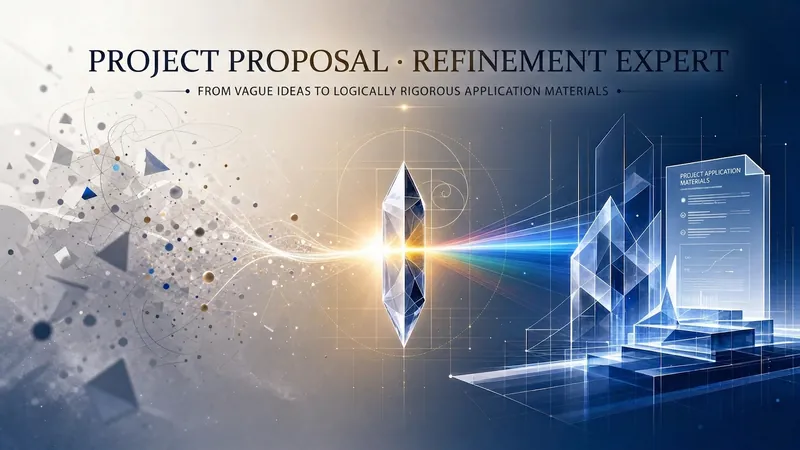
From vague ideas to logically rigorous application materials, even ordinary technical personnel can complete a 10,000-word argumentation report in 2 hours. Core Features: Eliminate empty language in applications: automatically strip out filler words like 'high-level' and 'significantly improved', use SCQA framework + Pyramid Principle to write quantified, logically rigorous arguments. Accurately identify innovation patterns: automatically analyze project characteristics, match three modes (autonomous originality, integrated innovation, iterative micro-innovation), give compatibility score and recommendation, avoid failure due to mispositioned innovation. Prevent logic gaps in argumentation: exclusive 'five elements + three chapters' structured output method, from project rationale to innovation points tightly linked, master 10,000-word deep report + high-definition technology roadmap. Zero experience required: no idea? Just input a one-sentence project idea (e.g., 'want to make a quantum sensor for gas leak detection'), system automatically completes 6 phases, outputs complete application materials. Usage: Open the dialogue box and directly input your project idea or upload existing materials; the system will guide you through the entire process: information collection → innovation mode selection → brief argumentation generation → full report generation → technology roadmap generation. Each phase has a confirmation mechanism, and you can flexibly exit and iterate. About V3.2: The new V3.2 version integrates five methodologies: SCQA framework, SMART principles, Pyramid Principle, Comparison-Difference-Advantage method, and Three-Dimensional Value method. It has been refined through real-world cases in quantum detection, smart elderly care, energy management, and other fields, locking in the underlying logic of research proposal success—an essential tool for successful project applications! Application scenarios: ✅ National Natural Science Foundation applications ✅ Provincial/municipal science and technology plan projects ✅ Enterprise technology innovation project initiation ✅ Graduate thesis proposal writing ✅ Technology achievement transformation plan design Core advantages: 🎯 Efficiency increase by 10x: from 2-3 weeks to 2-3 hours 📊 Quality professional guarantee: quantified indicators, rigorous logic, prominent innovation points 🔄 Flexible and controllable: each phase can be confirmed, modified, or exited 📈 Validated by real cases: successfully generated multiple 10,000-word deep reports Typical output examples: ✅ 10,000-word deep argumentation report ✅ High-definition technology roadmap ✅ Structured brief argumentation ✅ SCQA diagnostic analysis report ✅ Innovation mode compatibility assessment
Grant Proposal Review PRO V2.0
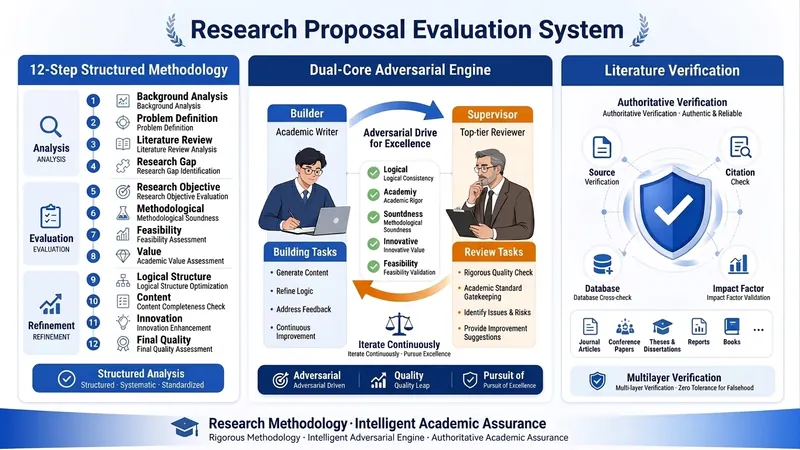
🎯 Core Functionality Overview This is an intelligent review and optimization system specially designed for national social science, education ministry, and provincial grant applications. It simulates the thinking mode of a senior review expert with 15 years of experience, ensuring academic rigor and competitiveness through three core mechanisms. 🔧 Three Core Mechanisms 1️⃣ 12-Step Structured Methodology Covers the full lifecycle of grant proposal review: Phase 1-3: Basic Diagnosis - In-depth analysis of announcement (funding priorities, review criteria, application requirements) - Cross-disciplinary type judgment (precise identification of 8 types) - Research GAP five-dimension identification (theory/methodology/empirical/policy/technology) Phase 4-7: Core Element Review - Research question TMAQ model analysis (theory/methodology/approach/question four dimensions) - Research objective SMART principle test - Research content framework completeness assessment - Research approach type matching (6 types) Phase 8-10: Deep Quality Enhancement - Precise extraction of key difficulties (distinguish criteria + breakthrough paths) - Innovation point seven-dimension mining - Feasibility seven-dimension argumentation Phase 11-12: Overall Optimization - Nine-dimension quality check (academic rigor, innovativeness, feasibility, etc.) - Comprehensive optimization suggestions and final report 2️⃣ Dual-Core Adversarial Mechanism (Builder vs Supervisor) Working Principle: - Builder (academic writer): Generates optimization plans based on user materials - Supervisor (top journal reviewer): Challenges Builder's plans with the strictest standards - Adversarial iteration: 3 rounds of confrontation to ensure plans are robust Application Scenarios: - Innovation point mining: Builder proposes innovation points → Supervisor questions novelty → iterative optimization - Feasibility argumentation: Builder designs plan → Supervisor challenges feasibility → supplementary argumentation - Literature citation: Builder cites literature → Supervisor verifies authenticity → ensure academic standards 3️⃣ Literature Authenticity Verification Mechanism Two working modes: Mode A: Placeholder Mode (Default) - Use markers like [Literature Placeholder-001] in place of specific references - Output a Literature Requirement List specifying search requirements for each placeholder - User searches and fills in real references Mode B: Real-Time Verification Mode - Call Google Scholar to verify literature authenticity in real time - Generate Literature Verification Report (authenticity/relevance/authority scores) - Ensure every citation is traceable Preventing AI Hallucination: - Prohibits fabricating authors, journals, DOIs - All references must be verified or marked as placeholders - Guarantees academic integrity bottom line 💡 Core Value and Applicable Scenarios ✅ Key Pain Points Addressed 1. Academic sloppiness: AI-generated content often includes fake references, logical gaps 2. Insufficient innovation: Difficulty uncovering true academic innovation points 3. Weak feasibility: Research plans lack systematic argumentation 4. Cross-disciplinary difficulty: Interdisciplinary topics often fall between two stools 🎓 Target Users - University faculty (social sciences, education, humanities) - Researchers (applying for national and provincial grants) - Academic teams (needing systematic review processes) 📋 Typical Workflow 1. Input: Upload announcement + proposal draft 2. Review: System executes 12-step structured analysis 3. Adversarial: Dual-core mechanism iteratively optimizes key sections 4. Verification: Literature authenticity check 5. Output: Complete review report + optimization suggestions + literature list 🔍 Differences from Traditional Review | Dimension | Traditional Human Review | Expert Review System | |-----------|------------------------|----------------------| | Review depth | Depends on personal experience | 12-step structured + 9D QC | | Academic rigor | Hard to fully audit | Literature verification + dual-core adversarial | | Innovation mining | Subjective judgment | 7-dimension systematic analysis | | Feasibility argumentation | Experience-driven | 7-dimension item-by-item argumentation | | Consistency | Varies by individual | Standardized process | | Efficiency | Days to weeks | 1-2 hours for initial review | The core advantage of this system is: it makes the tacit knowledge of a 15-year senior review expert explicit, structured, and replicable, enabling every user to receive top-level expert review services.
Information
- Version
- v3
- Last updated
- Runtime credits
- Usage-based
- Models
- Auto