
OPC Contract Guardrails
Pre-signing risk check for solo entrepreneurs
OPC Contract Guardrails
Pre-signing risk check for solo entrepreneurs
Showcase
Description
A contract guardrail tool for OPCs, solo companies, and AI service providers. It automatically identifies 12 red-line risks, offering ready-to-use clauses and negotiation scripts. This helps individual entrepreneurs without legal expertise decide: 'Can I sign this? What are the risks? How to change it? How to negotiate? Do I need a lawyer?' It provides business risk assessment, not legal advice.
Why we love this skill
This skill is designed for solo entrepreneurs, intelligently identifying potential contract risks and providing replicable modification clauses and negotiation scripts to help you sign with confidence and protect your rights.
Related Skills
View all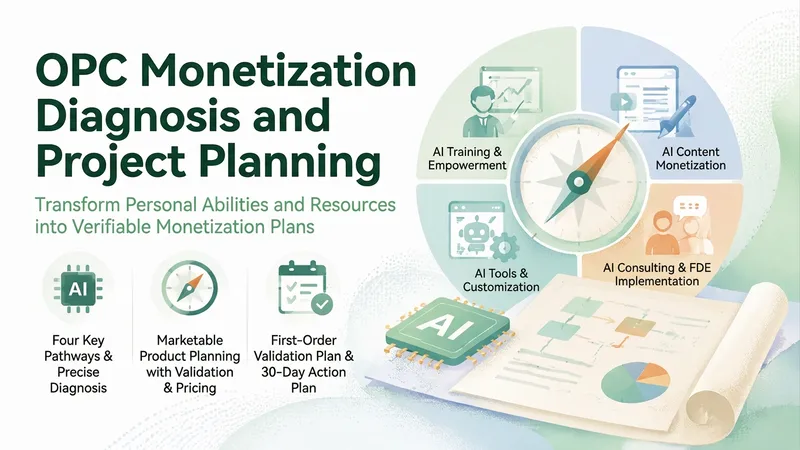 Research
OPC Monetization Planner
A monetization diagnosis and planning assistant for solo entrepreneurs (OPCs) in the AI era. Enter your professional experience, skills, reachable customer resources, available time, and budget; if you already have a project, add its current status and validation results. The Skill first reviews your existing strengths and key gaps, asking only the critical questions that affect the assessment when information is missing. It then compares four monetization paths: AI training and enablement, AI content monetization, custom AI tools and agents, and AI consulting and FDE implementation services. You’ll receive a concise diagnosis with one primary recommendation, one alternative, the biggest obstacle, and the core assumption to validate first. After you choose a direction, it designs a minimum sellable product—including target customers, deliverables and acceptance criteria, service boundaries, trial pricing and cost assumptions, and a repeat-purchase strategy—then provides a first-customer validation plan covering channels, interview questions, outreach scripts, and criteria for assessing willingness to pay, along with a 30-day action plan. The result is a complete, saveable plan. Suitable for beginners exploring from scratch, career changers with industry experience, and entrepreneurs with existing projects. No income guarantees are made, market data is never fabricated, and all policy, market, and salary information must be verified.
 Research
Company Background Checker
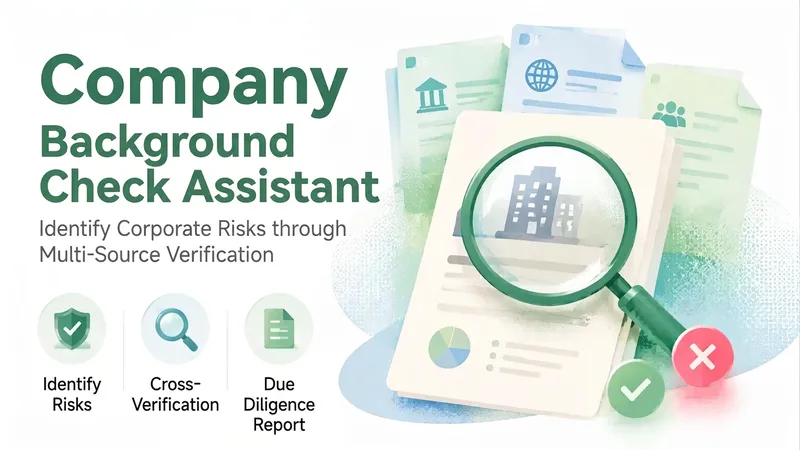
The Company Background Checker uses a tiered evidence verification method to check the authenticity of partners, suppliers, bidders, and internship providers. It identifies risks such as qualification grafting, data inflation, time anomalies, entity mismatches, metric mixing, performance misattribution, disguised dispatching, and omitted negative facts, producing due diligence conclusions that can be directly reported to leadership and written into contracts. Each conclusion is tagged across two dimensions: evidence nature (A-G: statutory registration, official lists, judicial supervision, annual reports, commercial databases, public web, inference) and source status (original official, official reference, commercially processed, self-reported), strictly distinguishing between disproven, unverified, and lacking evidence. It includes a built-in data source accessibility table and integration tiers. For listed or bond-issuing entities, it first reads disclosures from Cninfo and stock exchanges; for unlisted micro-enterprises, it provides alternative pathways for login walls and an industry metrics exception table. It enforces strict group-to-legal-entity attribution and includes 13 omission checks. Version 2.4 adds a bidding and supplier admission module: distinguishing bidding from winning, verifying performance entity attribution, grading licenses and certifications across four levels, checking three discredited lists according to regulatory standards with one-vote veto, and delivering a one-page conclusion card, evidence request letter, and contract risk clause package, complete with 18 regression self-checks. Version 2.5 adds an educational scenario module for reviewing school-enterprise partners, internship providers, and employment agencies, incorporating admission criteria and red lines based on vocational school internship regulations, using five criteria to identify disguised dispatching, prohibiting intermediary involvement and proxy fee collection, mandating tripartite agreements and internship liability insurance, and noting that these regulations serve as references for general undergraduate institutions. Version 2.5.1 introduces a final delivery gate with six-item skip-step consistency checks, an evidence chain self-verification table, a single-screen five-piece delivery set, anti-patterns, and a channel fact cold-start table. It disables commercial database inferred fields like enterprise scale or ratings. It supports four modes: basic risk overview from company name alone, targeted verification with company name and claims, page-level verification of uploaded materials, and integration consulting. It triggers when users mention background checks, due diligence, partner or supplier reviews, bidding qualifications, internship provider checks, school-enterprise reliability, cross-validation, or requests to verify specific companies. It is not suitable for legally binding due diligence requiring a law firm or classified military qualification reviews.

Startup Opportunity Radar
Turn “I think this could make money” into “What evidence is worth testing?” Discover and screen early-stage business opportunities suited to solo businesses, micro-SaaS, AI tools, digital products, data products, physical goods based on supply chains, and transaction services. It starts with real user friction, substitute behaviors, payment actions, and industry changes, helping you avoid mistaking popular trends, search volume, or scattered complaints for genuine demand. You can ask it to scan for new startup directions, or submit a product idea, market, link, screenshot, plan, sales feedback, or historical opportunity list for an individual health check, validation design, or periodic review. The analysis distinguishes facts, inferences, assumptions, and opposing evidence. It examines buyers, use cases, competitive gaps, data and supply chain legality, customer acquisition channels, standardization potential, maintenance costs, and related liability risks. When evidence is insufficient, it states that clearly instead of inventing market size or purchase intent. You will receive a clear opportunity assessment, an evaluation of opportunity quality and user adoption readiness, and a minimum validation plan focused on the riskiest assumptions. This includes validation actions, a stage budget, the maximum acceptable loss, and criteria for proceeding or stopping. It helps you decide which opportunities are worth investigating further while allowing conclusions such as “monitor,” “gather more evidence,” or “do not pursue this cycle,” making startup investment more manageable and gradually building repeatably sellable products and long-term assets.
Information
- Version
- v2
- Last updated
- Runtime credits
- Usage-based
- Models
- Auto
