Doc Writer: Red Lines & Format
Red line & format review, first-pass approval
Doc Writer: Red Lines & Format
Red line & format review, first-pass approval
Showcase
Description
Solve the problem of 'revise endlessly but never pass review'. Strictly aligned with national standard GB/T 9704-2012, it uses a closed-loop three-step party discipline review (political red lines, writing style, format standards) to ensure official documents pass on the first attempt.
Why we love this skill
This skill's unique 'political red line' review mechanism ensures document compliance and significantly boosts approval rates, making it an essential writing assistant.
Related Skills
View all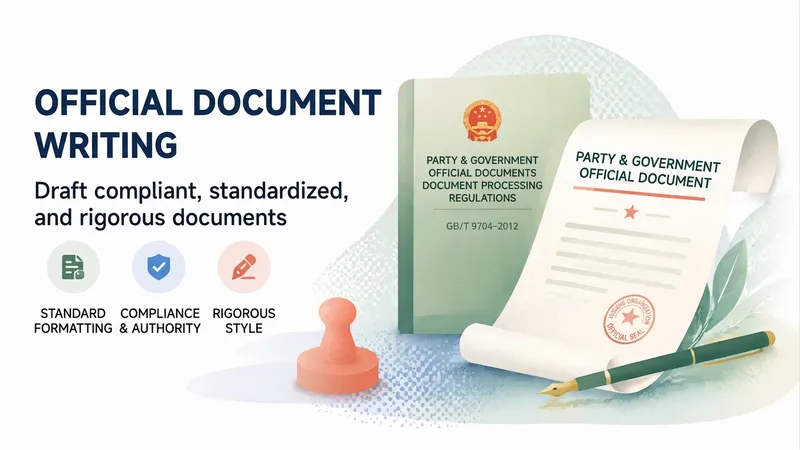
Official Document Writing
Act as a senior official document writing specialist at a Party and public service center. Based on the Regulations on the Handling of Official Documents by Party and Government Organs and GB/T 9704-2012, Format of Official Documents of Party and Government Organs, quickly draft official documents that follow required formats, use standardized layouts, and maintain a formal, rigorous style. Ask about the issuing organization, document type, length, and specific context. Covers statutory document types such as notices, requests for instructions, reports, replies, opinions, circulars, letters, minutes, decisions, public announcements, and notices, as well as common administrative documents including speech scripts, work summaries, work plans, implementation plans, research reports, performance reports, and rules and regulations. Also includes Word and print layout standards for direct export and use.

SOE Official Document Writing
This skill is specifically designed for state-owned enterprises, strictly following the 'Regulations on the Handling of Official Documents of Party and Government Organs', the 'Official Document Format of Party and Government Organs' (GB/T 9704), and the prevailing requirements of state-owned assets regulatory authorities. It integrates the 'Three Major and One Large' decision-making system and corporate governance structures such as the Party Committee, Board of Directors, and General Manager's Office Meeting to write, polish, and review various statutory official documents and internal corporate documents. The output is politically compliant with standardized wording and formatting, tailored to the actual management needs of state-owned enterprises. Applicable document types: Requests, Reports, Notices, Letters, Meeting Minutes, Decisions, Opinions, Leadership Speeches, Inspection Rectification Reports, etc.
 Write
NSSF Proposal Review & Audit
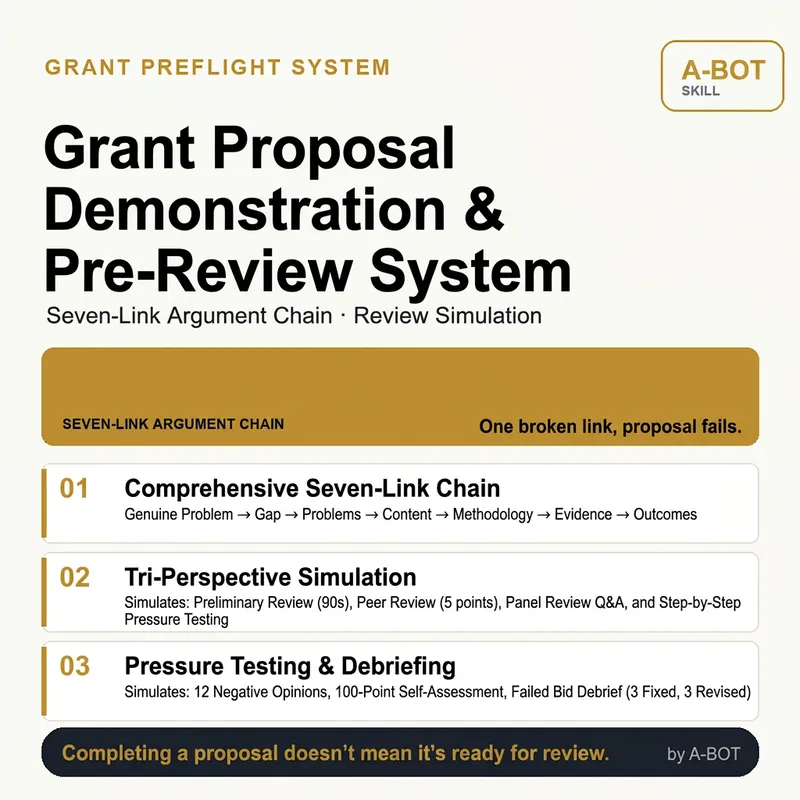
Does your proposal hold up under scrutiny? This skill compresses your National Social Science Fund or Ministry of Education humanities proposal into a one-page 7-ring logic chain, previews it from three review perspectives, and stress-tests it against 12 negative review opinions. With execution upgrades, it organizes your materials into a 7-ring argument table, a negative opinion comparison table, and a self-assessment form after authorization. It never ghostwrites text, fabricates facts, or guarantees approval. Key selling point: It doesn't just point out flaws—after authorization, it directly generates the 7-ring argument table, negative opinion comparison table, dual-track framework, and self-assessment form for you. Announcements for the current year apply; no preliminary results are fabricated. Best for: Applicants for National Social Science Fund or Ministry of Education humanities projects, early-career researchers looking to review rejected submissions, or anyone whose content resembles a textbook table of contents, whose innovations sound like slogans, whose main thread is broken, or who worries about identity disclosure in blind reviews. What to input: Discipline + category + batch (subject to the current year's announcement) + research direction + your actual completed work + draft (optional). What is delivered: 8 content items (identity card / rejection review / restriction checklist / three-perspective card / 7-ring one-pager / dual-track framework / 12 negative opinions / 100-point self-assessment / authoritative anchor check) + 5 finished items (authorization record / 7-ring argument table / negative opinion comparison + dual-track framework / self-assessment form / rejection review & acceptance sheet). If tools are unavailable, a copy-pasteable finished content package is provided with notes. ## Exclusive Methodology: The 7-Ring Logic Chain Most rejections aren't due to formatting, but fragile arguments. Before writing a single word of text, this method compresses your logic onto a single page: 1. 7-ring thread: True problem → literature gap → research question → content → methods → evidence → outcomes. Any broken ring is highlighted in red with a fix, and rings 3→4→5→7 must connect. 2. Three-perspective preview: 90-second initial review, five-item desk review, and panel review skepticism—each step highlights "who is being defended against," helping you understand why the check matters. 3. Stress testing and review: Check off 12 negative opinions one by one, take a 100-point self-assessment (submissions under 70 points are not recommended), and conduct a rejection review for secondary submissions adhering to "three unchanged, three must-change" principles to block skin-deep rejections. Remember this: Break one ring, and the proposal fails. ## Evidence-Based: Parameter Rules Follow Current Announcements Anchored strictly to authentic public guidelines: current year's NSSF application announcement / Ministry of Education humanities notification / institutional research office template (highest priority), historical approval libraries, and CNKI/Wanfang novelty checks (self-checked), plus standard publishing ethics (background only). Age limits, word counts, restrictions, columns, and deadlines that cannot be confirmed are marked as "pending verification"; numbers are never filled in from memory. Unrelated guidelines (PRISMA, ICMJE, etc.) are explicitly marked as not applicable. ## v1 Update: From Tables to Finished Files Older versions provided modifiable intermediates, but this version turns content into usable files: it first tests your current session's tool capabilities, tells you what will be generated and resource consumption, and only proceeds upon your confirmation. - One-page 7-ring argument table: 7 rows of arguments with broken rings highlighted in red and connectivity conclusions, ready for Excel. - Negative opinion preview comparison table: 12 rows checked one by one, hit location + one-sentence fix. - Dual-track framework + self-assessment form + rejection review table: Frameworks based on Type A blind review 8 sections / Type B form 5 columns, complete with self-assessment scores and secondary submission revision lists. No generation tool in the session? Delivered as a "ready-to-paste finished content package"—all five tables written in Markdown, ready to copy into Word or Excel. Never pretends to generate or fabricates file paths. ## Detail Page Text ### Proposal AIGC is a hard red line. How does this skill safeguard it? Its scope is narrow: it only organizes the authentic materials you provide into tables and frameworks. If you lack data, interviews, samples, preliminary results, literature, or approved entries, they remain "pending supplement / pending verification." The skill will not fabricate them just to make a table look good; the 7,000-word text is written by you. ### Five Steps 1. Identity card + rejection review (secondary submissions prioritize three unchanged, three must-change rules); 2. Track gate + restrictions + three perspectives (mutually exclusive blocking, age verification, current year parameters); 3. 7-ring one-pager (broken rings highlighted in red, connectivity must pass); 4. Dual-track framework (no ghostwriting of text); 5. Negative opinions + removing AI tone + formal review + 100-point self-assessment. + Authoritative anchoring layer + execution delivery layer (detect → authorize → generate finished file → accept/downgrade).
Information
- Version
- v3
- Last updated
- Runtime credits
- Usage-based
- Models
- Auto
