
Nalanda Capital Framework
Nalanda Capital stock valuation
Nalanda Capital Framework
Nalanda Capital stock valuation
Showcase
Description
Based on the investment philosophy of Nalanda Capital from Prakash Prasad's book 'Investment Lessons I Learned from Darwin', it performs a systematic in-depth analysis of any stock. Input a stock ticker, and receive a complete report using Nalanda's 7-dimension framework: Six No-Invest Exclusions, ROCE Quality Screener, Proximal vs Ultimate Factors, Signaling Theory Test, Valuation Margin of Safety, and Presumption of Guilt Judgment.
Recommended by
Dancang
Why we love this skill
This skill applies Nalanda Capital's rigorous investment framework, using a 'presumption of guilt' and data-driven seven-step analysis to deeply evaluate stock value. Unique and highly insightful.
Related Skills
View all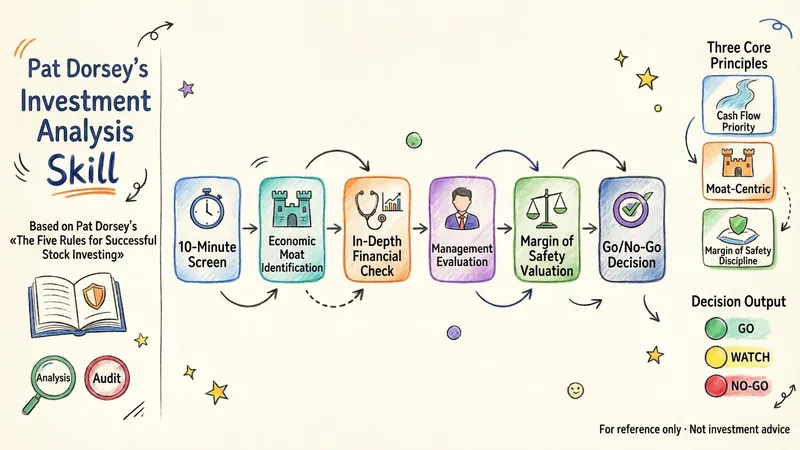
Dorsey Investment Analyzer V2
A structured investment analysis Skill based on Pat Dorsey's 'The Little Book That Builds Wealth' methodology. It provides users with Go/No-Go investment decision assistance through a six-phase workflow (Fast Screening → Moat → Financial Health Check → Management Assessment → Valuation → Decision). Core features: Cash Flow Priority, Moat Centricity, Margin of Safety Discipline, Dual-Core Adversarial Engine (Analysis Executor + Quality Auditor), Strict Step-by-Step Mechanism. Suitable for individual stock investment analysis, quick screening, complete investment report generation, and other scenarios.
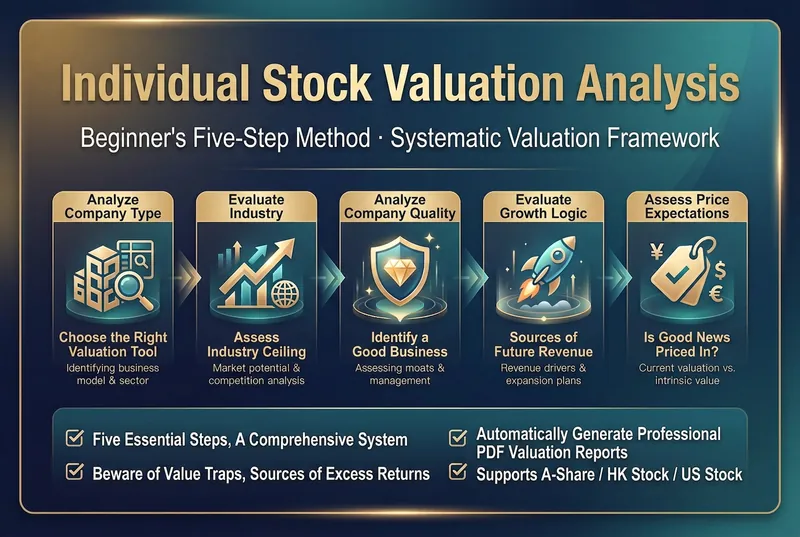
Stock Valuation Analysis
The two biggest fears in stock investing are buying a bad company and overpaying for a good one. Many investors, when they get a stock, first check its PE and PB ratios, compare them with peers, and draw conclusions—this is the biggest misconception in valuation. • 📝 Focusing only on numbers, not the company: Is a low PE always cheap? A low PE for a cyclical stock at the peak of its cycle can actually be a trap; for a growth stock, a high PE isn't necessarily expensive. With the wrong yardstick, you can't measure correctly. • 🤔 Discussing valuation without considering the industry: A contract manufacturer and a tech platform may both have a PE of 20, but their meanings are vastly different. Without first understanding the industry ceiling and business model, any valuation number is a castle in the air. • 📉 Ignoring value traps: A low valuation could be a sign of fundamental deterioration, not an investment opportunity. If the company quality is poor, no matter how 'cheap' it looks, it could still be a trap. • 🎯 Overlooking expectation gaps: Stock price movements don't depend on the absolute level of performance, but on the relative difference between performance and market expectations. If profits rise 30% but the market expected 50%, the stock can still fall. • 📊 Being too precise in valuation can itself be a mistake: Valuation is a range, not an exact number. Better to be roughly right than precisely wrong. This skill is designed to solve these problems. It is based on the 'Five-Step Valuation Method' framework and uses a systematic five-step process that cannot be skipped. It guides you from company type, industry ceiling, company quality, growth logic, and price expectations, progressing step by step to complete a full, professional individual stock valuation analysis. Finally, it outputs a structured valuation report and a downloadable PDF file. It applies to A-shares, Hong Kong stocks, and U.S. stocks.
 Research
Investment Direction Deep Dive
A standardized investment direction analysis framework based on Niu Da's six-layer progressive verification and Ma Chao's five-step industry chain timing. Input any investment-related article or information to automatically output a six-tier rating (A/B/C), industry chain beneficiary ranking, and participation strategy recommendations. Differentiates between demand-driven and technology-substitution industry logic.
Information
- Version
- v5
- Last updated
- Runtime credits
- Usage-based
- Models
- Auto
