Minimalist Entrepreneur
Minimalist Entrepreneur
Showcase
Description
Transform any business decision into minimalist entrepreneurial wisdom. Quickly assess options to ensure profitability and sustainable growth, avoid unnecessary risks, and progress steadily.
Related Skills
View all
Startup Opportunity Radar
Turn “I think this could make money” into “What evidence is worth testing?” Discover and screen early-stage business opportunities suited to solo businesses, micro-SaaS, AI tools, digital products, data products, physical goods based on supply chains, and transaction services. It starts with real user friction, substitute behaviors, payment actions, and industry changes, helping you avoid mistaking popular trends, search volume, or scattered complaints for genuine demand. You can ask it to scan for new startup directions, or submit a product idea, market, link, screenshot, plan, sales feedback, or historical opportunity list for an individual health check, validation design, or periodic review. The analysis distinguishes facts, inferences, assumptions, and opposing evidence. It examines buyers, use cases, competitive gaps, data and supply chain legality, customer acquisition channels, standardization potential, maintenance costs, and related liability risks. When evidence is insufficient, it states that clearly instead of inventing market size or purchase intent. You will receive a clear opportunity assessment, an evaluation of opportunity quality and user adoption readiness, and a minimum validation plan focused on the riskiest assumptions. This includes validation actions, a stage budget, the maximum acceptable loss, and criteria for proceeding or stopping. It helps you decide which opportunities are worth investigating further while allowing conclusions such as “monitor,” “gather more evidence,” or “do not pursue this cycle,” making startup investment more manageable and gradually building repeatably sellable products and long-term assets.
 Research
Selected Works of Mao
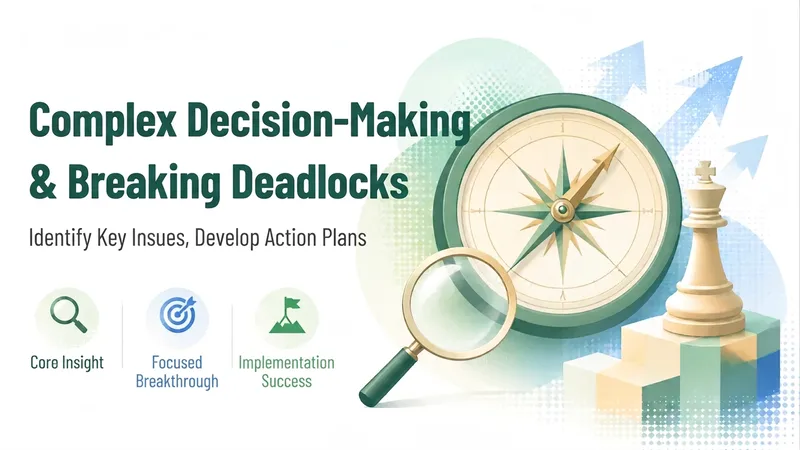
When facing business decisions, startup strategies, workplace competition, organizational management, project bottlenecks, major personal choices, or industry issues, this turns complex dilemmas into manageable, actionable problems. It uses principles from the Selected Works of Mao such as seeking truth from facts, interest analysis, principal contradictions, unity of opposites, protracted war, mass line, and practice to strip away emotions, slogans, and surface conflicts, pointing directly to the interest structures and critical contradictions that determine success or failure. Whether you provide a brief description or full background, you will receive a distinct and in-depth analysis: clarifying known facts and information blind spots, identifying allies, opponents, and forces that can be won over, determining whether to defend, build strength, or concentrate for a breakthrough under current conditions, and deducing feasible paths for different scenarios. The analysis does not dodge problems or replace judgment with ambiguous balance. The final output is a complete breakthrough analysis and action plan covering emergency damage control, near-term breakthroughs, and long-term mechanism building, complete with low-cost validation actions and feedback standards to help you quickly correct your judgment in real-world practice. Ideal for managers, entrepreneurs, and individual users who need strategic clarity, complex decision analysis, and executable solutions.
Should I Do It? Analysis
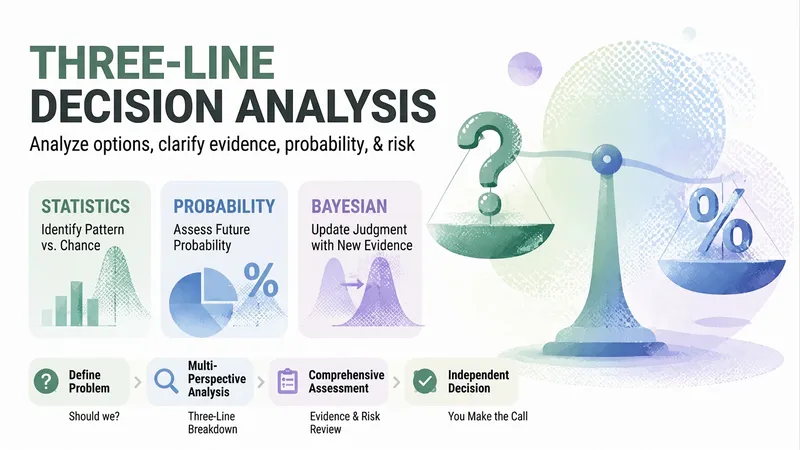
Turn the vague uncertainty of “Should I do X?” into a clearly bounded decision analysis that can be checked and updated over time. Whether you’re considering leaving your job to start a business, investing in a project, buying an asset, or making a career or life choice, you can provide text, tables, documents, or screenshots to organize your options, time horizon, major costs, how much risk you’re willing to accept, and how much confidence you need before acting. The analysis examines the question through statistics, probability theory, and Bayesian reasoning: checking whether samples are reliable and whether an observed pattern is more likely a real trend or a coincidence; breaking down possible future scenarios and comparing probabilities, expected returns, and tail risks; then combining prior beliefs with new evidence to determine which information is truly discriminating and how your judgment should be updated. User-provided facts, public information, and analytical assumptions are clearly separated. When reliable data is lacking, uncertainty is not concealed behind false precision. You’ll receive a replayable decision framework that includes new information worth verifying, actionable next steps, triggers for reassessment, and key evidence still needed. It won’t make the decision for you or present assumptions as facts. Instead, it helps you see the evidence, probabilities, costs, and risks clearly, leaving the decision in your hands.
Information
- Version
- v1
- Last updated
- Runtime credits
- Usage-based
- Models
- Auto
