Meeting/Interview Gold Summary
Meeting/Interview Gold Summary
Showcase
Description
Specializes in processing messy audio transcripts. Automatically filters out filler talk, directly extracts "decision conclusions", "to-do list", and "contentious points", making meetings twice as efficient.
Related Skills
View all
Recording Transcript to Minutes
Quickly convert lengthy meetings into precise minutes. Intelligent error correction, core extraction, decisions and tasks at a glance.

Meeting Minutes Expert
Organize meeting recordings, speech transcripts, or rough notes into structured meeting minutes with one click: automatically extract key decisions, action items (responsible person + deadline), pending issues, and risks. Supports converting spoken language to written language, relative date conversion, and sensitive phrase warnings. First produces a detailed master version, then generates on demand: a concise version for WeChat/email, a task tracking table version, follow-up message templates grouped by responsible person, or a PPT presentation version.
 Research
Interview-to-Insights V3
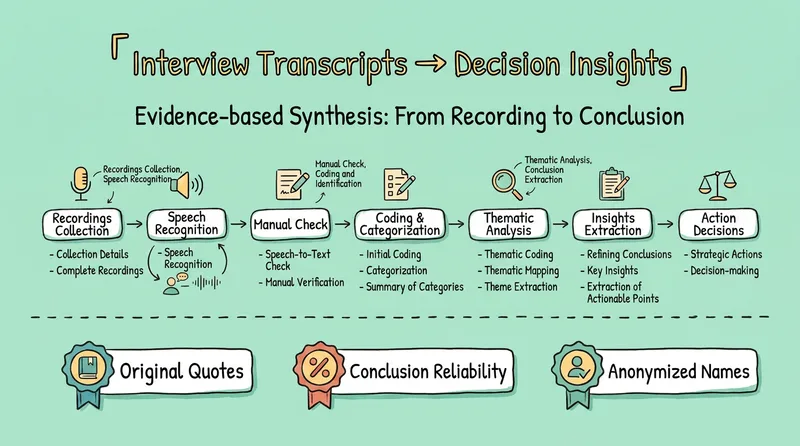
Turn interview, user research, or focus-group transcripts into an evidence-based research synthesis where every conclusion is traceable to a supporting quote. From one transcript to twenty, get coded themes, a tension map, an opportunity backlog, and direct answers to your decision questions—no more hours of recordings with zero findings. For businesses and product teams: save days of analyst time spent organizing and coding. Every claim is anchored to participants’ exact words and timestamps, making it auditable and traceable while reducing the risk of AI-fabricated insights. Opportunities are presented as “when [situation], [who] wants [outcome] because [reason]”, ready to connect with product roadmaps and market decisions. For researchers and academics: follow rigorous qualitative research practice rather than simple summarization—quote-first open coding, Behaviour/Belief/Wish evidence categories, falsifiable themes, and deliberate searches for disconfirming evidence. The method is rigorous enough for a research paper. Sample discipline is strict: percentages are not reported with fewer than 12 participants, n=1 is identified as a hypothesis rather than a finding, and conclusion strength is based on participant counts. Ideal for product managers, UX and market researchers, journalists, consultants, founders, and anyone with hours of recordings but no research findings yet. English: Turn interview, user research, or focus-group transcripts into an evidence-led research synthesis where every conclusion is traceable to a verbatim quote. Feed it one transcript or twenty, and get coded themes, a tension map, an opportunity backlog, and a direct answer to your decision question—no more hours of recordings with zero findings. For businesses & product teams: skip days of manual coding; every claim is anchored to participant quotes with timestamps, auditable and traceable, eliminating the risk of AI-fabricated insights; opportunities are framed as "when [situation], [who] wants [outcome] because [reason]", ready to feed product roadmaps and market decisions. For researchers & academics: real qualitative practice, not summarisation—quote-first open coding, Behaviour/Belief/Wish evidence tagging, falsifiable themes, deliberate disconfirming-evidence hunting, rigorous enough for a methods section; strict sample discipline: no percentages under 12 participants, n=1 flagged as hypothesis rather than finding, theme strength counted in participants. For product managers, UX & market researchers, journalists, consultants, founders doing customer discovery—and anyone sitting on hours of recordings with no findings.
Information
- Version
- v2
- Last updated
- Runtime credits
- Usage-based
- Models
- Auto