
Interview-to-Insights V3
Evidence-led analysis from interview data
Interview-to-Insights V3
Evidence-led analysis from interview data
Showcase
Description
Turn interview, user research, or focus-group transcripts into an evidence-based research synthesis where every conclusion is traceable to a supporting quote. From one transcript to twenty, get coded themes, a tension map, an opportunity backlog, and direct answers to your decision questions—no more hours of recordings with zero findings. For businesses and product teams: save days of analyst time spent organizing and coding. Every claim is anchored to participants’ exact words and timestamps, making it auditable and traceable while reducing the risk of AI-fabricated insights. Opportunities are presented as “when [situation], [who] wants [outcome] because [reason]”, ready to connect with product roadmaps and market decisions. For researchers and academics: follow rigorous qualitative research practice rather than simple summarization—quote-first open coding, Behaviour/Belief/Wish evidence categories, falsifiable themes, and deliberate searches for disconfirming evidence. The method is rigorous enough for a research paper. Sample discipline is strict: percentages are not reported with fewer than 12 participants, n=1 is identified as a hypothesis rather than a finding, and conclusion strength is based on participant counts. Ideal for product managers, UX and market researchers, journalists, consultants, founders, and anyone with hours of recordings but no research findings yet. English: Turn interview, user research, or focus-group transcripts into an evidence-led research synthesis where every conclusion is traceable to a verbatim quote. Feed it one transcript or twenty, and get coded themes, a tension map, an opportunity backlog, and a direct answer to your decision question—no more hours of recordings with zero findings. For businesses & product teams: skip days of manual coding; every claim is anchored to participant quotes with timestamps, auditable and traceable, eliminating the risk of AI-fabricated insights; opportunities are framed as "when [situation], [who] wants [outcome] because [reason]", ready to feed product roadmaps and market decisions. For researchers & academics: real qualitative practice, not summarisation—quote-first open coding, Behaviour/Belief/Wish evidence tagging, falsifiable themes, deliberate disconfirming-evidence hunting, rigorous enough for a methods section; strict sample discipline: no percentages under 12 participants, n=1 flagged as hypothesis rather than finding, theme strength counted in participants. For product managers, UX & market researchers, journalists, consultants, founders doing customer discovery—and anyone sitting on hours of recordings with no findings.
Recommended by
Shuting@YouMind
Why we love this skill
Quote- and timestamp-grounded analysis with disconfirming-evidence checks, clear Behavior/Belief/Wish distinctions, and disciplined limits on conclusion strength.
Best for
Research, product, and strategy teams turning interview or user research materials into auditable insights.
How to use this Skill
Provide your input
Provide one or more interview, user research, or focus-group transcripts and describe the decision question you want answered. You may include participant backgrounds, IDs, and timestamps.
Run the Skill
The system organizes evidence from the transcripts, identifies themes, surfaces disagreements and opportunities, and flags anything the material cannot support.
Review your result
Receive a traceable research synthesis with themes, supporting and disconfirming evidence, a tension map, opportunity items, and a direct answer to the decision question.
Related Skills
View all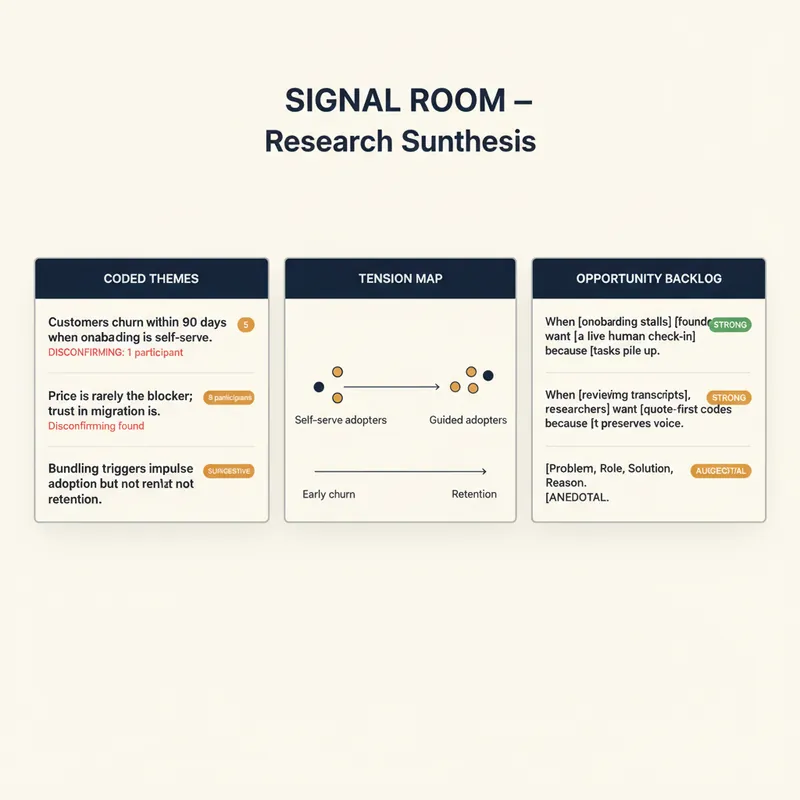 Research
Signal Room: Interview Synthesis
YouMind already transcribes your calls, interviews and podcasts. Signal Room is what happens next. Drop in one transcript or twenty and get back a research synthesis an actual analyst would sign: coded themes, verbatim evidence with timestamps, the places people disagree, and a ranked answer to the decision you are trying to make. The method is real qualitative practice, not summarisation: • Open coding that works quote-first — no quote, no code — with codes named in the participant's own words rather than analyst jargon • Every code tagged Behaviour, Belief or Wish, because "I would definitely pay for that" is not the same class of evidence as "I paid for that last month" • Themes stated as falsifiable sentences, with strength counted in participants rather than quotes, and disconfirming evidence hunted for on purpose • A tension map showing where your participants genuinely split and what predicts which side they fall on • An opportunity backlog written as "when [situation], [who] wants [outcome] because [reason]", each rated Strong, Suggestive or Anecdotal • A direct answer to your decision question, with a stated confidence level and what would change it • The three questions this round could not answer, and who to interview next Guardrails that matter: it never invents or polishes a quote, it refuses to report percentages on fewer than twelve participants, it pseudonymises participants by default, and it will tell you to your face when n=1 means you have a hypothesis rather than a finding. For product managers, UX and market researchers, journalists, consultants, founders doing customer discovery, and anyone sitting on hours of recordings and no findings.

Research & Implementation
For a specified topic, this Skill produces a focused research report that combines expert judgment with practical execution. It helps beginners understand the problem, compare options, and complete their first hands-on project. The report first defines the research scope, intended audience, and time-sensitivity boundaries. It then reviews mainstream options by cost, barriers to entry, maturity, suitable use cases, and risks, providing a clear, evidence-based recommendation instead of a vague comparison that simply says “each has its pros and cons.” The report also explains the recommended option’s basic principles, capability boundaries, and common pitfalls. For information that may change easily—such as pricing, policies, and versions—it identifies the supporting evidence, validity period, and verification method. When information is insufficient, it clearly points out the gaps rather than making things up. All technical terms are explained in plain language, and key facts are accompanied by verifiable sources or reproducible steps whenever possible. You’ll also receive a beginner-focused, from-scratch implementation guide covering the tools, accounts, budget, and time needed in advance, along with specific actions, decision criteria, and common troubleshooting steps for each stage. After your first hands-on experience, the guide provides 30-day and 90-day progression plans and highlights the steps people are most likely to abandon. It’s suitable for individuals and teams conducting focused research, selecting among options, or putting a plan into practice.
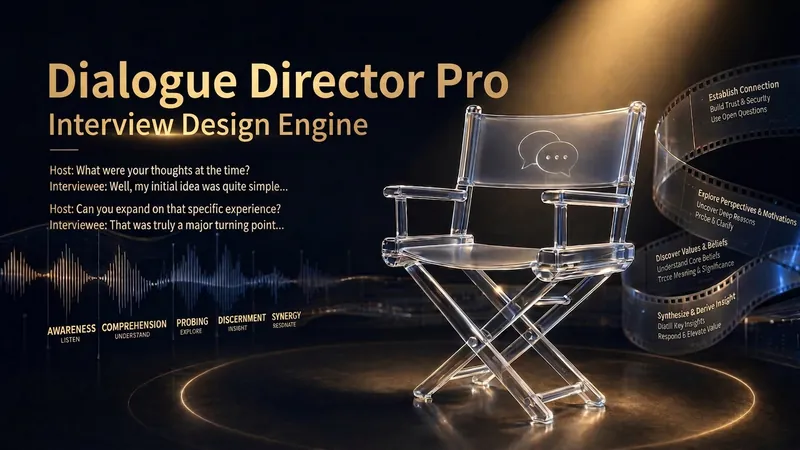
Dialogue Director Pro | Interview Design Engine
This isn't just a list of questions; it helps you design a memorable conversation. A 7-step process, from guest research to finalized materials: Guest Profile → Narrative Structure → Question Matrix → Process Layout → Interview Rehearsal → Material Conversion → Interview Debriefing 💡 Steps 1-3 form the core design process, delivering a complete interview plan independently; Steps 4-7 enhance the experience and can be used as needed. 🔍 Guest Profile | Online search of publicly available guest information generates a five-dimensional in-depth profile—factual skeleton, story vein, core conflict, communication style, and emotional entry point—telling you which direction to dig. Non-public figures automatically switch to interview-style information gathering. 🌿 Follow-up Question Branching Tree | When generating questions, the system pre-predicts the possible directions of the guest's answers for each key question and designs corresponding follow-up questions. You take this "decision tree" to the event, listen to the guest's answer, and then choose the corresponding branch to ask follow-up questions—no need for on-site AI, no need for real-time text transcription; all plans are designed during the preparation stage. It lets you be a chess player on-site, not an improvisational actor. No similar function exists on the market. 🎬 AI Rehearsal | Before the interview, AI plays the role of a guest, simulating three answering styles (in-depth/superficial/evasive), allowing you to practice follow-up questions and identify blind spots in the process. 📝 Five Outputs | Generates from a single interview: interview article/ podcast script/ oral history transcript/ social media content package/documentary script skeleton. 📊 Interview Debriefing | Plan vs. reality comparison, analysis of gold mines and regrets, five-dimensional capability radar chart, allowing you to grow with every interview. Suitable for: podcast interviews, interviews, student interviews, UX in-depth interviews, executive interviews.
Information
- Version
- v5
- Last updated
- Runtime credits
- Usage-based
- Models
- Auto
- Use cases
- Research & analysisBusiness & strategy
- What you get
- Report