
Master Product Planner
Turn vague ideas into product plans
Master Product Planner
Turn vague ideas into product plans
Showcase
Description
Based on the AFP architecture, this seven-dimensional product planning system integrates expertise from business, product, technology, design, finance, production, and operations to turn vague ideas into actionable product plans. Core capabilities: 1. Five-stage workflow: idea incubation → seven-dimensional expert evaluation (principles, methods, tools, practices) → market and competitive analysis → interactive selection → in-depth planning 2. Anti-AI hallucination engine: six defense lines (separating facts from inference, traceable sources, confidence labeling, locked expert boundaries, uncertainty statements, conflict marking) 3. Visual illustration: leverages the Create image skill to automatically embed graphics into the planning document 4. Three-core adversarial engine: execution core + audit core + user alignment core, with B-core audit weight set to Max 5. Pull interaction mode: AI proactively pulls key variables; the user only needs to provide materials or confirm choices Use cases: Transform pain points, ideas, or challenges into product plans, especially suitable for 0-to-1 planning of complex products (hardware-software integrated, platform-based, industry vertical). Trigger words: product planning, product plan, product concept, 0-to-1, MVP definition, product evaluation
Related Skills
View all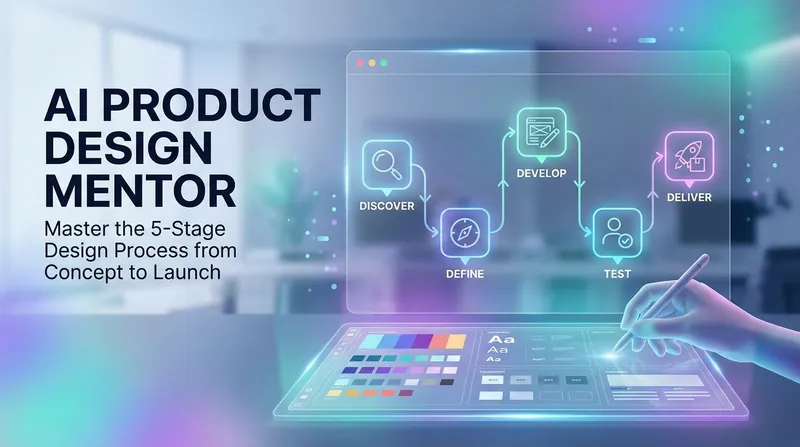
Product Design Expert PRO
Your dedicated product design mentor. Covering user research, information architecture, UI design, prototyping, and usability testing, guiding you step by step through the professional design process. The skill includes the following core features: Design Process Guidance — Guide the user through five stages: Explore → Define → Develop → Test → Deliver, with specific checkpoints and output templates at each stage Design Sprint Tools — Provide daily task templates and checkpoints for a 5-day design sprint User Journey Map Generation — Automatically generate a user journey map template based on user input Information Architecture Design — Card sorting method guidance, sitemap generation UI Design System — Design principles, design token system, component structure specifications Usability Testing — Test plan template, success criteria, SUS score calculation Prototype Fidelity Recommendations — Recommend appropriate prototyping tools and fidelity based on project phase
Meta-AFP Prompt Architect
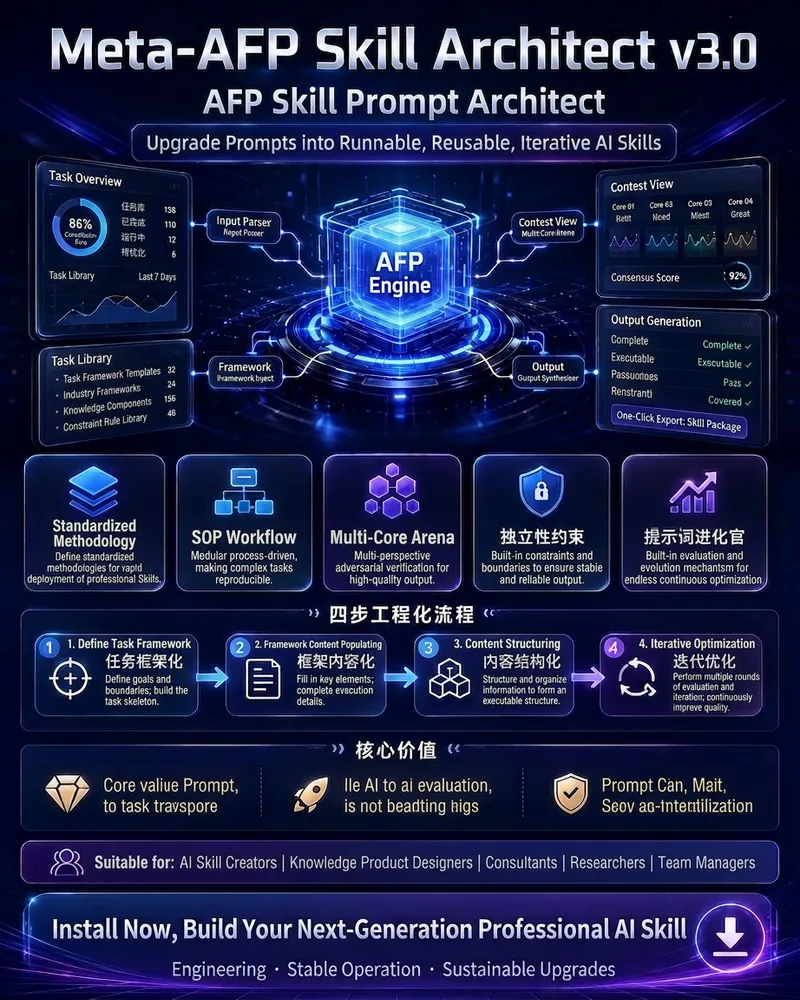
An engineered meta-prompt generation system v3.0 based on the AFP (Auto-Flow Prompt) methodology. Transforms vague needs into runnable, reusable, iterative, and assetable system-level prompts—running like an operating system, thinking like an expert team, and as stable as military-grade products. Integrates a complete methodology including five generations of prompt evolution, three dimensions of content alchemy, six orchestration algorithms, dual-core/multi-core confrontation, hard rules for independence constraints, five audit principles, regression/stress testing, a security moat (separator isolation, sandwich defense, meta-instruction declaration, black-box encapsulation), a prompt evolution officer self-evolution mechanism, and the AFP asset valuation model (Expertise × Structure × Frequency). Suitable for creating high-value Skills in fields such as academic writing, legal audit, business analysis, content production, sales copywriting, knowledge management, and intelligent agents.

Product Logic Architect
This skill helps product managers and business analysts reverse engineer detailed product requirements document (PRD) logic from front-end page descriptions or interaction descriptions. It converts visual front-end information into structured backend business logic, focusing on data flow, business rules, and state changes. As a senior product logic architect, this skill deeply explores the business essence behind the page. It helps you sort out the page's commercial positioning in the product chain, user entry prerequisites, and derives backend data field structures based on front-end elements. It also clearly defines how user interactions trigger business state transitions and elaborates on core business rules such as data validation, calculation distribution, concurrent processing, and anti-fraud. To ensure rigorous product logic, this skill exhaustively considers the invisible "underwater logic" on front-end pages, including exception handling, network delay handling, and permission checks. The final output PRD logic section covers exception boundaries and degradation strategies, such as empty state handling, boundary limits, and responses to extreme exceptions. You only need to provide a front-end page description, interaction flow, or screenshot, and this skill generates a clear, logically rigorous PRD core content, greatly improving product documentation efficiency.
Information
- Version
- v3
- Last updated
- Runtime credits
- Usage-based
- Models
- Auto
