
Lesson Prep Script V1.0
Lesson Prep Script V1.0
Showcase
Description
Helps instructors/knowledge IPs directly turn lesson preparation topics into a ready-to-use 30-minute spoken-word script—just pick it up and read, not secondary prompts. What it solves Traditional lesson preparation requires instructors to go through "ideation → break into modules → write script → mark pacing → design interactions", which is time-consuming and easy to miss details. This Skill compresses this process into a 5-step interaction. Instructors only need to provide the topic and key knowledge points, and the rest is automated. Core capabilities ① Five-step structured interaction: Select lesson type → Receive preparation content → Deep analysis with option presentation → Ask for style preference → Directly generate a complete spoken-word script. Each step waits for user confirmation before proceeding. ② CXO three-dimensional teaching verification: Each module is annotated with teaching dimensions — C (Content/Knowledge), X (Experience/Practice), O (Objective/Output), ensuring full coverage throughout. ③ Spoken-word script template: Each segment follows the framework of Hook → Key Point → Structure → Call to Action. The structure supports four modes: reason, method, situation/reaction, and chronological order. ④ Complete output includes: 7 modules totaling approximately 7,900 words of spoken text + tone cues (【Pause 2 seconds】【Emphasis】) + audience interaction instructions + CXO paragraph annotations + full statistics. ⑤ Seven-dimensional quality check: Word count deviation / Spoken style / Template completeness / CXO coverage / Logical coherence / Pacing / Reusability — each dimension is checked, and if any fails, it is corrected and regenerated.
Related Skills
View all
Automated Course Lesson Plans
One-line summary: Generate all lesson plans for an entire course in one go — not just one lesson, but a whole system of logically connected lesson plans. Detailed description: Still writing lesson plans one by one? This skill directly helps you batch-output all lesson plans for a full course (16 weeks/32 class hours or more) in your school's template format. 🔥 Core Capabilities 1. Cascading design for the entire course, not isolated pieces Each lesson plan is not standalone — the skill has a built-in OBE (Outcome-Based Education) logic engine that works backward from course objectives to each lesson's teaching goals, key/difficult points, activities, and assessment methods. Knowledge progression, ability scaffolding, and method rotation across units are all auto-planned. The result is a systematic set of lesson plans, not 16 unrelated documents. 2. Fully automated pipeline From template parsing → content source confirmation → first unit deep polishing → style locking → subsequent unit auto-generation → course summary matrix → batch file output — the entire pipeline runs automatically. You only need to confirm at key nodes; the repetitive work is all done by AI. 3. Two content sources, flexible adaptation With a textbook: Upload textbook/handouts/PPT, AI automatically extracts knowledge points and chapter structure to generate lesson plans directly. Without a textbook: Just provide the topic and outline, AI searches online for materials, organizes them into structured material packages, and generates after confirmation. Mixed mode: Some units have materials, others need to be gathered — switch flexibly per unit. 4. Template adaptation + style learning No matter what your school's lesson plan template looks like, upload it and AI automatically parses the fields. For the first unit, confirm field by field and edit until satisfied; then AI locks in your writing style (word choice, level of detail, formatting preferences) and automatically generates subsequent units in your style. 5. Professional quality assurance Teaching goals strictly use Bloom's action verbs, avoiding vague expressions like "understand" or "master." Each lesson plan undergoes automatic consistency checks (goals ↔ methods ↔ activities ↔ assessment fully aligned). Every 3 units, an automatic quality inspection (method diversity, knowledge progression, style consistency). Finally outputs a course objective coverage matrix, providing a clear view of the entire course's design logic. 📦 Final Deliverables 📁 A folder containing individual lesson plan documents for all units 📊 A course overview document (unit progression table + objective coverage matrix + method distribution statistics) 🎯 Each lesson plan strictly output in your school's template format, ready to submit 💡 Who Should Use It College/vocational teachers who need to write a full course's lesson plans for a new semester Teaching teams that need to batch-produce lesson plans for multiple courses Teachers preparing for teaching inspections or course evaluations who need to quickly complete a full set of lesson plans Teachers who want to write professional, standardized lesson plans that can pass OBE accreditation review One skill, complete lesson plans for an entire course. It doesn't just help you write one — it helps you design a complete course teaching system, then automatically outputs each one.
 Research
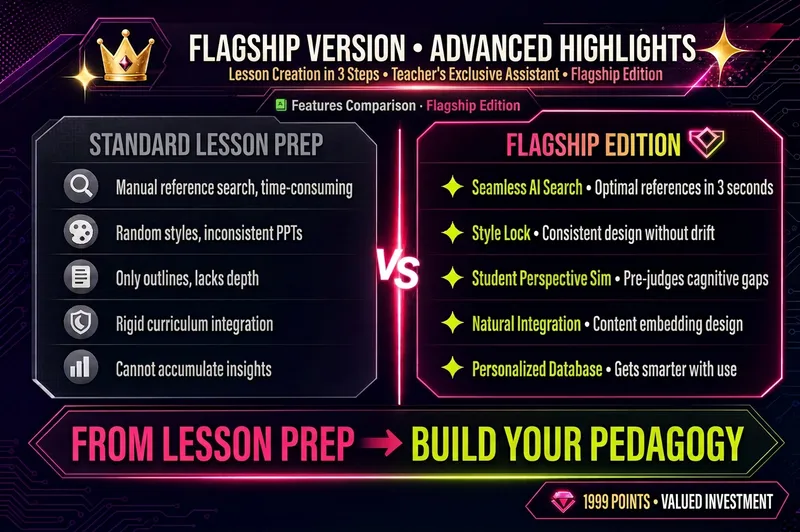
Premium 3-Step Teacher Prep v4
🔥 Start the new term with a contest-grade lesson planning workflow. [All-in-One Generation · 5-Piece Lesson Bundle] 🖥 Slides (Contest-refined or daily lightweight) · 📝 Verbatim lesson plan (includes complete guided scripts for easy delivery) · 🎯 Activity design · Board writing · In-class exercises [Why Contest-Grade?] This skill incorporates a teaching design model library from top-tier national demonstration classes, covering mainstream contest strategies such as situational introduction, task-driven learning, question chains, and flipped classrooms, while integrating professional frameworks like Bloom's Taxonomy, the ADDIE model, and UbD backward design. Every lesson is methodologically verified rather than simply piling up content. [Flagship Core Upgrades] — Built from the ground up for superior teaching design ✨ Mixed questionnaire collection: Clickable options plus free text entry, complete information collection in 30 seconds ✨ Parameter locking mechanism: Lesson info and Slide styles are locked in step one with zero drift in subsequent generation ✨ Real interactive confirmation: Outline confirmation and 5-piece selection use clickable options for personalized customization ✨ Dual-mode Slides: Intelligent switching between contest-display and daily teaching types ✨ Post-lesson reflection loop: Questionnaire collection → AI-generated reflection → Board Memory building your exclusive teaching archive ✨ Controlled costs: Cost expectations stated beforehand, choice between fully detailed and lightweight outline versions, no over-issuance or unexpected upgrades [Three-Step Workflow] ① Information Collection → Two rounds of interactive questionnaires + parameter locking ② Outline Confirmation → AI provides the teaching framework first, generated after your approval ③ Visual Delivery → One-stop output of the 5-piece bundle, including Slides + verbatim/contest-standard lesson plans + activity designs + board writing + exercises, ready to mix and match [Pricing Note] 1999 = The price of a coffee for daily lesson planning freedom. · Single-use generation of the complete 5-piece bundle · Lesson prep time reduced from ~4 hours to ~1 hour · Contest lesson plans ready to generate · Daily courseware ready to teach · Iterated with feedback from 45 teachers, saving over 200 cumulative prep hours 💡 Applicable Scenarios: Suitable for all grade levels from kindergarten to university, across all subjects, for daily teaching, contest defense, or public demonstration classes. ⚠️ Please review and modify AI-generated content in combination with your textbook version, school requirements, and actual student performance, relying ultimately on professional teacher judgment. 📩 Feedback/Suggestions: 593975647@qq.com, helpful feedback comes with a pleasant surprise 🎁!
 Write
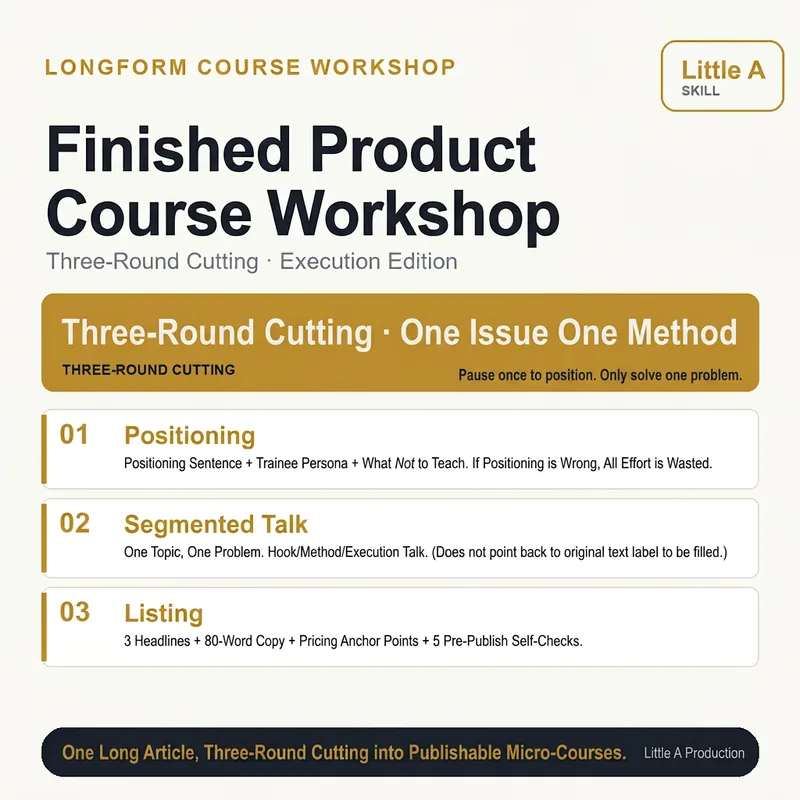
Micro-Course Rescuer
Turn a long text into a breakdown table, lecture handouts, and publishing copy for a 3-part mini-course through three rounds of segmentation. Uses only the source text without inventing anything. **Core Selling Point**: Beyond planning tips—directly generates your course profile, 3-part breakdown table, lecture handouts, and publishing kit. Each lecture solves one real problem, and every point links back to the source text. **Best For**: Content creators and knowledge bloggers looking to quickly test the waters; anyone with a long text, notes, or book excerpt who doesn't know how to structure it into a course. **Input**: A source text (1,800+ words of long text, notes, book excerpt, or draft) + goal (free lead-magnet course or low-priced entry-level course). **Output**: 8 content pieces + 4 finished pieces (12 total). Course profile, breakdown table, lecture handouts, and publishing kit are generated one by one. If tools are unavailable, a copy-pasteable package is provided with unproduced items marked. ## [Exclusive Methodology] Three-Round Segmentation · One Problem Per Lecture If your positioning is wrong, the next two rounds are wasted—so the first round must pause to confirm the course profile, which is the most efficient step in the entire workflow. 1. **Anchor**: Positioning formula "Help [who] achieve [result] in [scenario] using [method]" + 3 student persona questions + clarify what "not to teach" (cut anything the source text cannot support or exceeds capacity). 2. **Segment**: Each lecture solves one real problem (lecture titles written as questions); default hook lecture -> method lecture -> practical lecture; each point maps to a source paragraph, unmapped items marked as [To Be Added], no fluff. 3. **Publish**: 3 titles from result/pain-point/scenario angles + 80-word short copy (pain point -> what you get -> who it's for -> call to action) + pricing anchor + 5 pre-release self-checks. Remember it in one sentence: **Pause to anchor first, solve one problem per lecture.** ## [Grounded in Rules] Standards Based on Current Official Guidelines Anchored only in real public standards: target platform skill package guidelines, copyright duplication and fair use, AI-generated content labeling requirements, and restrictions on absolute terms and earnings promises in publishing copy. **Any fields, clauses, or rules that are unclear will be marked as "To Be Verified"—never filled from memory**; rules unrelated to this scenario are explicitly marked as not applicable. ## [v1 New · From Intermediates to Finished Files] Older versions provided editable intermediates; this version turns content **into ready-to-use files**: first detects your current session's tool capabilities, tells you what is about to be generated and the consumption cost, and only acts after your confirmation— - **Breakdown Table + Course Profile File**: Positioning sentence, what not to teach, 3 lecture problem titles, and corresponding source paragraphs in one table; - **Lecture Handout Drafts**: Five-section format per lecture (hook/explanation/demonstration/practice/summary) + take-away checklist, written as an editable draft; - **Publishing Kit + Checklist**: 3 titles, 80-word short copy, pricing anchor, and 5 pre-release self-checks. **No generation tools in the session?** Delivers a "ready-to-paste finished content package"—formatted entirely in Markdown, ready to use when copied into Word or tables. **Never pretends to generate, never invents file paths.** ## [Details Page Body] ### What Boundaries Are Maintained The service scope is clear: **only arranges your provided real material into a breakdown table / lecture handout drafts / publishing kit**. If you lack workflows, course content, cases, qualifications, data, or student reviews, they remain [To Be Added]; the skill will not invent them just to make the table look nice. It does not copy others' works, cites sources, and does not promise platform review or publishing results. ### Core Architecture 1. Anchor: Positioning sentence + student personas + what not to teach, pause to confirm; 2. Segment: One problem per lecture + five-section handout + take-away checklist; 3. Publish: 3 titles + 80-word short copy + pricing anchor + 5 self-checks. + Authoritative anchoring layer + execution delivery layer (detect -> authorize -> output finished product -> accept/fallback).
Information
- Version
- v4
- Last updated
- Runtime credits
- Usage-based
- Models
- Auto
