
Kaplan-Meier Report Writer
Turn survival results into a full report
Kaplan-Meier Report Writer
Turn survival results into a full report
Showcase
Description
Generates a complete Methods + Results section from your Kaplan-Meier survival curves, log-rank tests, and Cox regression outputs. Correctly interprets hazard ratios, clearly notes when the censoring rate is high, and reminds you to check the proportional hazards assumption for the Cox model. Suitable for researchers working with clinical or epidemiological survival data.
Recommended by
Shuting@YouMind
Why we love this skill
Turns Kaplan-Meier, log-rank, and Cox outputs into complete Methods and Results text while addressing censoring, hazard ratio direction, and proportional hazards assumptions.
Related Skills
View all Research
Validity & Reliability Writer
Generates a complete, publication-ready Methods + Results section from your EFA or CFA analysis outputs, including KMO, Bartlett’s test, factor loadings, fit indices, and Cronbach’s alpha/CR/AVE. Correctly classifies fit index thresholds (CFI/TLI ≥ .90, RMSEA ≤ .08, etc.) and reports validity concerns such as AVE < .50 without hiding them. Suitable for academics and graduate students conducting scale development or adaptation studies.
 Research
Group Comparison Test Writer
Generates APA 7-compliant, publication-ready Results text from your t-test, ANOVA, or chi-square test outputs. Uses the correct statistical reporting format (t(df) = ..., p = ..., d = ...) and interprets effect sizes according to Cohen’s criteria. Reminds you to report a multiple-comparison correction when comparing three or more groups. Suitable for researchers and graduate students conducting experimental or comparative studies.
 Research
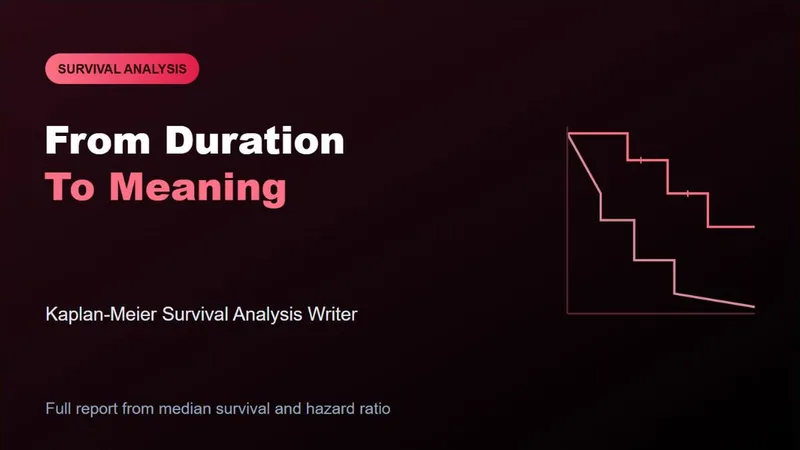
Kaplan-Meier Survival Analysis Writer
Produces a complete Methods + Results text from your Kaplan-Meier survival curve, log-rank test, and Cox regression output. Correctly interprets hazard ratios, explicitly flags a high censoring rate, and reminds you to check the proportional hazards assumption for Cox models. Who it's for: researchers working with clinical/epidemiological survival data.
Information
- Version
- v2
- Last updated
- Runtime credits
- Usage-based
- Models
- Auto
