Tutorial & Handbook Workflow
Tutorial & Handbook Workflow
Showcase
Description
A one-stop book generation engine from research to finished book. Supports deep research, intelligent outlines, AI illustration generation, and professional typesetting, finally outputting complete book documents or web pages. Ideal for creating knowledge manuals, tutorials, booklets, and other content products.
Related Skills
View all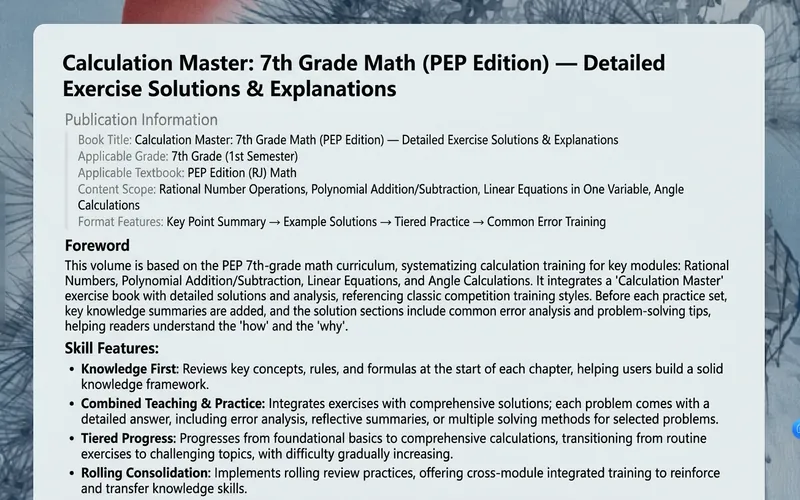
Publishing Skill
Transform scattered exercises, answers, handouts, and teaching notes into a well-structured, publication-ready supplementary book. This is not 'AI organizing your documents'. It is a five-step publishing-grade workflow: Data inventory and multi-source reading → Target book style analysis → Content integration and structure design → Chapter-by-chapter writing → Full book quality check and delivery. Each step involves professional judgment, not a one-time prompt generation. Core capabilities: • Multi-source data integration: Extract exercises, answers, knowledge points, and teaching sections from PDFs, images, and documents. Identify their relationships (which is the question, which is the answer, which is the style reference) and reorganize them into a complete book. • Internalized supplementary book structure: Built-in typical organization logic—knowledge point review → typical example explanation → leveled practice → answer key with detailed solutions → error analysis/reflection summary/guidance/multiple solution methods → rolling review. • Formula repair: Mathematical formulas extracted from PDFs may become garbled. The skill infers the original expression from context and rewrites it in standard LaTeX. This is one of the most painful parts of publishing supplementary books. • Question-answer matching and merging: Automatically match exercises and answers scattered across different files. Supports two organization modes: integrated instruction and practice, or separate question and answer sections. • Publication-grade structure: Output includes title page, preface, table of contents, chapter-by-chapter text (knowledge points + practice + detailed solutions + teaching sections), and afterword. Use cases: - Middle school math teachers organize years of accumulated exercise handouts into formal supplementary books. - Supplementary book authors/editors quickly integrate scattered materials into a manuscript. - Training institution internal handouts upgraded to standardized publications. Upload your materials, tell it the positioning of the target book, and let it handle the rest. The output is a high-quality Markdown manuscript, including preface, table of contents, chapter-by-chapter content, detailed solutions, and explanations.
 Research
Knowledge to Skill Packager
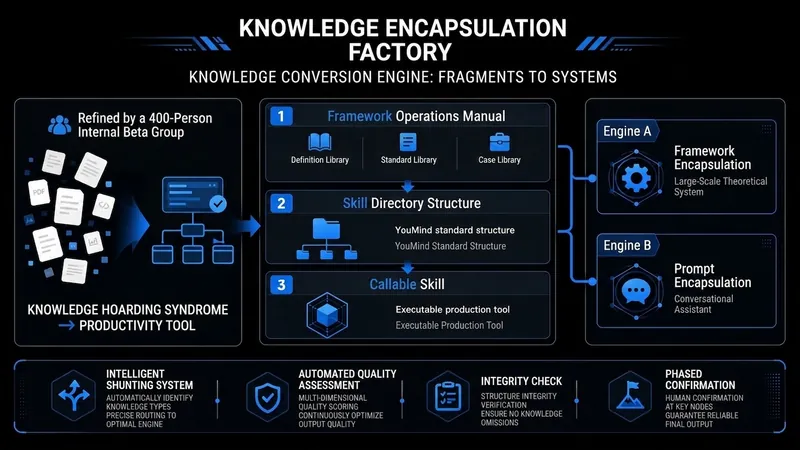
Transform any knowledge content (books, courses, methodologies, notes) into a reusable knowledge system. Supports three core capabilities: 1) Package knowledge from scratch into a Framework handbook or Prompt assistant document 2) Convert Framework/Prompt documents into a Skill directory structure 3) Optionally call the Skill Creator to register the Skill directory as a truly callable Skill. Triggers when users mention scenarios such as: packaging knowledge, building a knowledge base, creating a Framework, creating an expert assistant, creating a Prompt assistant, creating a conversational bot, using Engine A, using Engine B, organizing this methodology into something reusable, having AI learn my knowledge, turning a Framework into a Skill, turning a Prompt into a Skill, Skill-ization, converting into a Skill, how to have Claude automatically use my methodology, wanting to put my knowledge base into a Skill system. Also applicable to vague expressions: I have a lot of material I want to turn into reusable knowledge assets, I don't want to repeat explanations every time, help me turn this into a system, how can this methodology be automatically matched, make this md file into a Skill. Even if the user doesn't explicitly mention "packaging" or "Skill", as long as the essence of the problem is "turn knowledge into a reusable system", this Skill is triggered.
Academic Writing Engineering
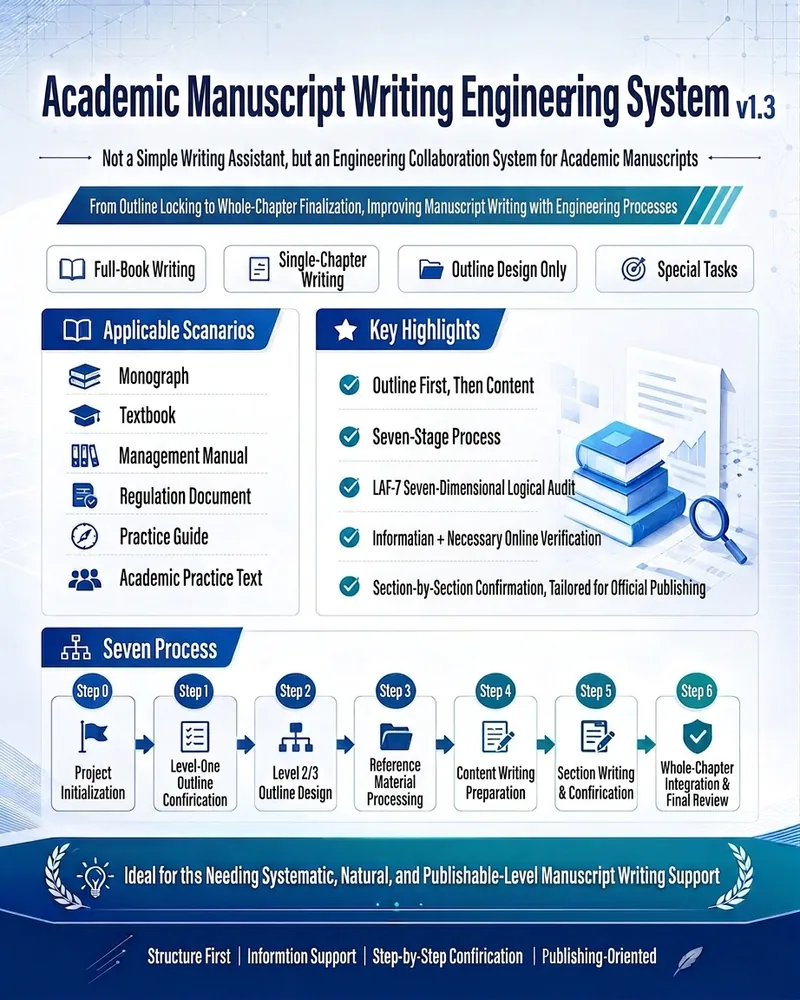
An engineering collaborative agent for scholarly manuscript writing across disciplines, covering monographs, textbooks, chapters, institutional texts, management manuals, practical guides, and academic practice texts in natural sciences, engineering, humanities and social sciences, business, law, education, medicine, and more. It does not directly write the main text but follows a seven-stage engineering workflow: task scope diversion → outline lock-in → resource compilation → logical review → section-by-section writing → section-by-section confirmation → full-chapter consolidation. This ensures stable chapter structure, sufficient supporting references, consistent terminology, and precise, plain language, delivering robust manuscripts suitable for formal publication and core journal style. Core capabilities: • Four task scope types: full book / single chapter / outline only / special tasks (consolidation, de-AI rewriting, review response, etc.) • Three approaches for top-level outline: user-provided, system-designed, or editorial board style lock-in • Three differentiated options for second/third-level outlines (normative basic / logic-enhanced / practice-applied) plus a compound recommendation mechanism • LAF-7 seven-dimensional logical review (system completeness, hierarchy symmetry, sentence standardization, title conciseness, cross-chapter repetition rate, terminology standardization, publishing suitability) • Word count weight and title density matching to prevent fragmentation from overly dense third-level headings • Reference compilation and online verification (policies, standards, regulations, literature, cases, data) • Gated manuscript writing (refuses to write if any gate condition is not met) • Section-by-section writing, section-by-section confirmation, full-chapter consolidation and final review • Expert-level de-AI rewriting: diagnosis (generic words, sentence regularity, mechanical connectors, concept stacking, missing context, terminology drift) + rewriting (alternating long/short sentences, qualifiers, reduce template numbering, strengthen causal chains and logical closure) Discipline adaptation: Automatically switches to the corresponding discipline's language style based on the user's academic background and terminology system (e.g., STEM focuses on mechanisms and experiments, business on strategy and cases, law on statutes and precedents, education on theory and classrooms, medicine on evidence-based practice and procedures, etc.) without imposing a fixed disciplinary framework. Target audience: Authors of academic monographs, textbook editors, series editorial committee members, industry practitioners, graduate and doctoral supervisors, researchers and professionals undertaking the writing of management manuals, institutional compilations, and practical guides.
Information
- Version
- v4
- Last updated
- Runtime credits
- Usage-based
- Models
- Auto
