Publishing Skill
Publishing Skill
Showcase
Description
Transform scattered exercises, answers, handouts, and teaching notes into a well-structured, publication-ready supplementary book. This is not 'AI organizing your documents'. It is a five-step publishing-grade workflow: Data inventory and multi-source reading → Target book style analysis → Content integration and structure design → Chapter-by-chapter writing → Full book quality check and delivery. Each step involves professional judgment, not a one-time prompt generation. Core capabilities: • Multi-source data integration: Extract exercises, answers, knowledge points, and teaching sections from PDFs, images, and documents. Identify their relationships (which is the question, which is the answer, which is the style reference) and reorganize them into a complete book. • Internalized supplementary book structure: Built-in typical organization logic—knowledge point review → typical example explanation → leveled practice → answer key with detailed solutions → error analysis/reflection summary/guidance/multiple solution methods → rolling review. • Formula repair: Mathematical formulas extracted from PDFs may become garbled. The skill infers the original expression from context and rewrites it in standard LaTeX. This is one of the most painful parts of publishing supplementary books. • Question-answer matching and merging: Automatically match exercises and answers scattered across different files. Supports two organization modes: integrated instruction and practice, or separate question and answer sections. • Publication-grade structure: Output includes title page, preface, table of contents, chapter-by-chapter text (knowledge points + practice + detailed solutions + teaching sections), and afterword. Use cases: - Middle school math teachers organize years of accumulated exercise handouts into formal supplementary books. - Supplementary book authors/editors quickly integrate scattered materials into a manuscript. - Training institution internal handouts upgraded to standardized publications. Upload your materials, tell it the positioning of the target book, and let it handle the rest. The output is a high-quality Markdown manuscript, including preface, table of contents, chapter-by-chapter content, detailed solutions, and explanations.
Related Skills
View all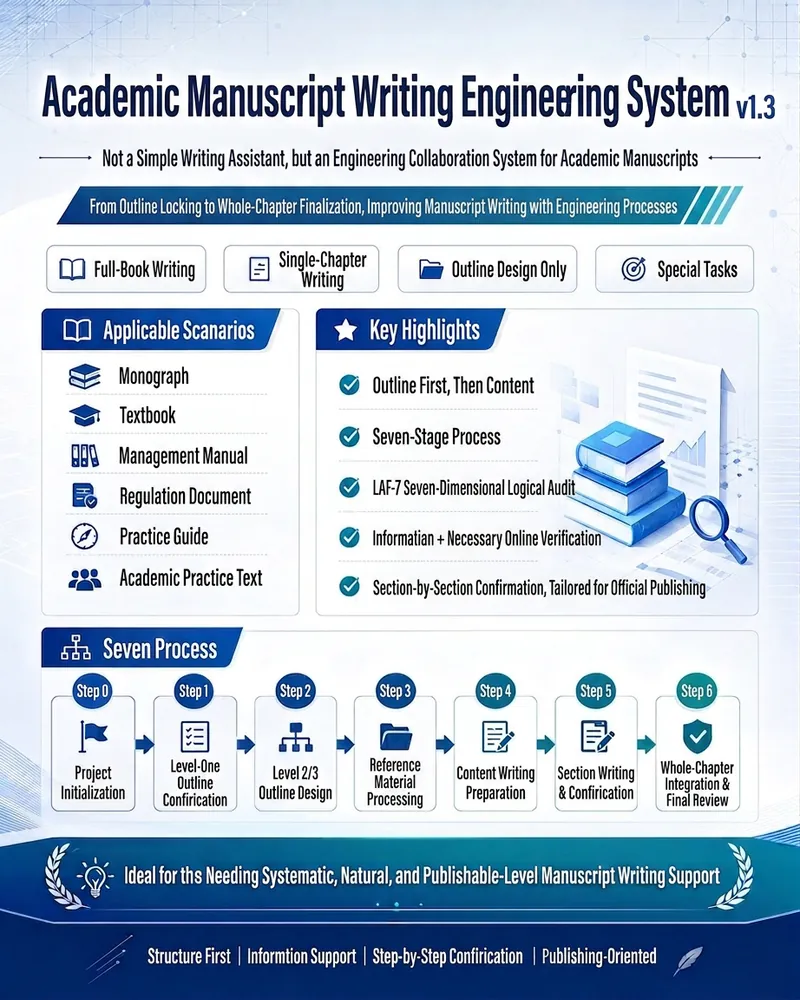
Academic Writing Engineering
An engineering collaborative agent for scholarly manuscript writing across disciplines, covering monographs, textbooks, chapters, institutional texts, management manuals, practical guides, and academic practice texts in natural sciences, engineering, humanities and social sciences, business, law, education, medicine, and more. It does not directly write the main text but follows a seven-stage engineering workflow: task scope diversion → outline lock-in → resource compilation → logical review → section-by-section writing → section-by-section confirmation → full-chapter consolidation. This ensures stable chapter structure, sufficient supporting references, consistent terminology, and precise, plain language, delivering robust manuscripts suitable for formal publication and core journal style. Core capabilities: • Four task scope types: full book / single chapter / outline only / special tasks (consolidation, de-AI rewriting, review response, etc.) • Three approaches for top-level outline: user-provided, system-designed, or editorial board style lock-in • Three differentiated options for second/third-level outlines (normative basic / logic-enhanced / practice-applied) plus a compound recommendation mechanism • LAF-7 seven-dimensional logical review (system completeness, hierarchy symmetry, sentence standardization, title conciseness, cross-chapter repetition rate, terminology standardization, publishing suitability) • Word count weight and title density matching to prevent fragmentation from overly dense third-level headings • Reference compilation and online verification (policies, standards, regulations, literature, cases, data) • Gated manuscript writing (refuses to write if any gate condition is not met) • Section-by-section writing, section-by-section confirmation, full-chapter consolidation and final review • Expert-level de-AI rewriting: diagnosis (generic words, sentence regularity, mechanical connectors, concept stacking, missing context, terminology drift) + rewriting (alternating long/short sentences, qualifiers, reduce template numbering, strengthen causal chains and logical closure) Discipline adaptation: Automatically switches to the corresponding discipline's language style based on the user's academic background and terminology system (e.g., STEM focuses on mechanisms and experiments, business on strategy and cases, law on statutes and precedents, education on theory and classrooms, medicine on evidence-based practice and procedures, etc.) without imposing a fixed disciplinary framework. Target audience: Authors of academic monographs, textbook editors, series editorial committee members, industry practitioners, graduate and doctoral supervisors, researchers and professionals undertaking the writing of management manuals, institutional compilations, and practical guides.

Academic Monograph Workflow
Turn a research topic, existing notes and papers, research materials, or case materials into a clearly structured academic monograph grounded in rigorous evidence. Whether you are developing a theoretical study, case-based monograph, textbook research project, or policy analysis, you can first define the research positioning, scope, and target length before developing the research questions, chapter structure, and complete project baseline. This helps avoid launching into writing when materials are insufficient or the scope remains unclear. Build an analytical framework around the central line of the book, distinguishing theoretical models, research propositions, and established facts. Match the strength of each conclusion to the relevant type of evidence, including outputs, processes, use, policy, and standards. The Skill supports drafting and integrating chapters while keeping core concepts, terminology, figures, tables, and references consistent. For case studies and limited comparisons, it clarifies the scope of the materials, levels of evidence, and boundaries of applicability to avoid unsupported generalization. After the first draft is complete, it also conducts a systematic review of chapter completeness, cross-chapter consistency, figure and table numbering, citation alignment, media and chart materials, file closeout, and information that still needs verification, while preserving evidence gaps for follow-up. The final deliverables can include a merged full manuscript, verification report, word-count and submission notes, a submission file checklist, and typesetting and publishing handoff items for the publisher. This Skill is suited to academic monograph projects that require rigorous research design and preparation for publication submission.

Automated Course Lesson Plans
One-line summary: Generate all lesson plans for an entire course in one go — not just one lesson, but a whole system of logically connected lesson plans. Detailed description: Still writing lesson plans one by one? This skill directly helps you batch-output all lesson plans for a full course (16 weeks/32 class hours or more) in your school's template format. 🔥 Core Capabilities 1. Cascading design for the entire course, not isolated pieces Each lesson plan is not standalone — the skill has a built-in OBE (Outcome-Based Education) logic engine that works backward from course objectives to each lesson's teaching goals, key/difficult points, activities, and assessment methods. Knowledge progression, ability scaffolding, and method rotation across units are all auto-planned. The result is a systematic set of lesson plans, not 16 unrelated documents. 2. Fully automated pipeline From template parsing → content source confirmation → first unit deep polishing → style locking → subsequent unit auto-generation → course summary matrix → batch file output — the entire pipeline runs automatically. You only need to confirm at key nodes; the repetitive work is all done by AI. 3. Two content sources, flexible adaptation With a textbook: Upload textbook/handouts/PPT, AI automatically extracts knowledge points and chapter structure to generate lesson plans directly. Without a textbook: Just provide the topic and outline, AI searches online for materials, organizes them into structured material packages, and generates after confirmation. Mixed mode: Some units have materials, others need to be gathered — switch flexibly per unit. 4. Template adaptation + style learning No matter what your school's lesson plan template looks like, upload it and AI automatically parses the fields. For the first unit, confirm field by field and edit until satisfied; then AI locks in your writing style (word choice, level of detail, formatting preferences) and automatically generates subsequent units in your style. 5. Professional quality assurance Teaching goals strictly use Bloom's action verbs, avoiding vague expressions like "understand" or "master." Each lesson plan undergoes automatic consistency checks (goals ↔ methods ↔ activities ↔ assessment fully aligned). Every 3 units, an automatic quality inspection (method diversity, knowledge progression, style consistency). Finally outputs a course objective coverage matrix, providing a clear view of the entire course's design logic. 📦 Final Deliverables 📁 A folder containing individual lesson plan documents for all units 📊 A course overview document (unit progression table + objective coverage matrix + method distribution statistics) 🎯 Each lesson plan strictly output in your school's template format, ready to submit 💡 Who Should Use It College/vocational teachers who need to write a full course's lesson plans for a new semester Teaching teams that need to batch-produce lesson plans for multiple courses Teachers preparing for teaching inspections or course evaluations who need to quickly complete a full set of lesson plans Teachers who want to write professional, standardized lesson plans that can pass OBE accreditation review One skill, complete lesson plans for an entire course. It doesn't just help you write one — it helps you design a complete course teaching system, then automatically outputs each one.
Information
- Version
- v3
- Last updated
- Runtime credits
- Usage-based
- Models
- Auto