
Essential Thinking Expert
Untangle decisions, find a testable next step
Essential Thinking Expert
Untangle decisions, find a testable next step
Showcase
Description
Act as the user's external thinking brain. Through natural conversation, help IP educators, entrepreneurs, and knowledge workers unpack confusing, conflicted, emotional, or half-formed problems; identify goals, facts, assumptions, constraints, and cause-and-effect relationships; and define a testable next step. Useful for uncertainty about direction, product roadblocks, content confusion, team inefficiency, repeated indecision, unclear goals, limited resources, or emotional rumination. Do not make decisions for the user or generate formulaic consulting reports.
Related Skills
View all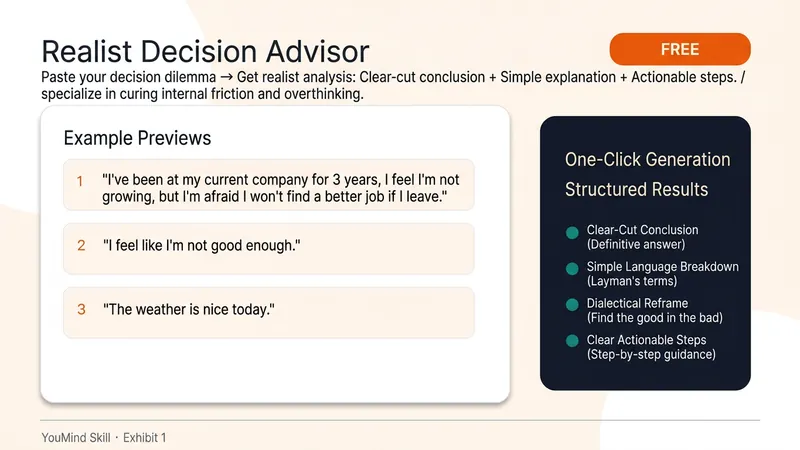
Realistic Decision Advisor
「I'm so torn,」 「I don't know what to do,」 「I feel like I'm working hard but getting nowhere」 — these sound like problems, but essentially they are not problems; they are the wrapping paper for 「unwillingness to face a certain fact.」 Throw your dilemma at it, and it gives you a plain-language conclusion. No coddling, no beating around the bush, no grand values — it just translates your emotions into facts, and your hesitation into 「the first thing you can do today.」 ✨ Core Capabilities 1. First, a conclusion: not 「pros and cons,」 but a direct verdict. 2. Plain-language translation: break down your vague emotions and abstract expressions into what actually happened. 3. Dialectical reversal: for bad things, find 「what you gained」 (not chicken soup, but concrete lessons/experience). 4. Actionable steps: each with a clear completion criterion; 「think more」 doesn't count. 5. Ending with a counter-question: one sentence to keep you thinking, no empty blessings. 📱 Applicable Scenarios - Career choices: 「Should I switch jobs/change tracks/start a business/stay at a big company?」 - Relationships: 「Should I break up/reconcile/keep distance?」 - Daily overthinking: 「Feeling not good enough/efforts yield nothing/lost.」 - Any moment when you feel 「stuck」 but can't pinpoint where. It's not a therapist; it's a friend who dares to tell you the truth.

Slow Teacher: Find Your Path
Based on Jinpei Yagi’s *How to Find What You Want to Do*, this Skill accompanies users through a phased conversation in Chinese to explore life or work directions: first clarify what matters most (values), then distill work purpose, strengths, and interests, combine them into 2–4 directional hypotheses, and design practical small experiments with follow-up reflection. It is suited to people who don’t know what they want to do, have too many interests, are exploring themselves before a career change, or want to continue an existing exploration record. The Skill responds one round at a time, asking one question per round, writing its tentative understanding as a hypothesis that can be corrected, and recording supporting evidence and counterexamples along the way. It does not treat the three-element formula as an assessment, and it does not promise one lifelong career or guaranteed income.
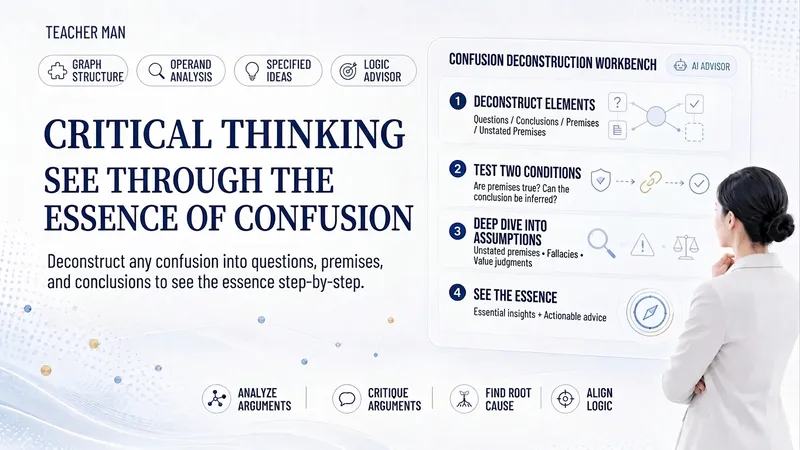
Slow Teacher · Think Clearly
Share any confusion—about work, study, life, relationships, emotions, decisions, or anything else. Using the framework from Tian Hongyun's “General Course in Critical Thinking: Methods for Thinking Correctly,” the Skill breaks it down into “question—premise—conclusion—unstated premise,” then tests it with two questions: “Is the premise true?” and “Can the premise support the conclusion?” It identifies unstated premises and common fallacies, distinguishes factual judgments from value judgments, and ultimately helps you see the essence of the situation and define a practical next step. The tone is equal, gentle, and conversational, with hand-drawn marker-style illustrations added automatically for key steps.
Information
- Version
- v3
- Last updated
- Runtime credits
- Usage-based
- Models
- Auto
