
Cronbach Alpha Writer
Turn reliability stats into academic text
Cronbach Alpha Writer
Turn reliability stats into academic text
Showcase
Description
Converts the reliability statistics entered by the user (Cronbach's alpha, item count, and subdimensions) into an academic “Reliability Analysis” paragraph ready to add directly to a paper. Provides an acceptability table by subdimension and clearly reports low alpha values (<.60) without hiding them. Best for: graduate students and researchers using scales who want to write the methods section of a thesis or paper quickly and accurately.
Recommended by
Shuting@YouMind
Why we love this skill
Turns Cronbach alpha values into an academic Reliability Analysis paragraph and concise table with threshold-based interpretations. Flags low reliability and suggests measured item-review improvements.
Best for
For researchers who want to report reliability results quickly and academically in the methods section of a thesis or paper.
How to use this Skill
Provide your input
Enter the scale name, subdimensions, item counts, Cronbach's alpha values, overall alpha, and sample size.
Run the Skill
Your statistics are transformed into an academic, publication-ready Reliability Analysis text.
Review your result
You receive a paragraph explaining internal consistency reliability, a subdimension reliability table, and warnings for low values.
Related Skills
View all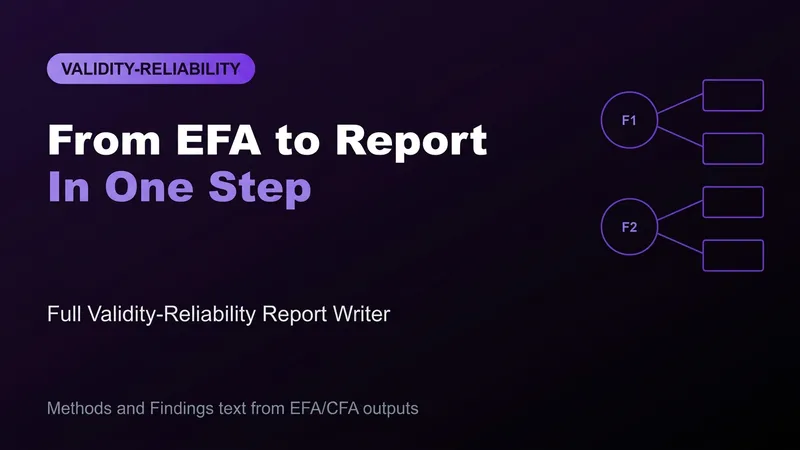 Research
Validity & Reliability Writer
Generates a complete, publication-ready Methods + Results section from your EFA or CFA analysis outputs, including KMO, Bartlett’s test, factor loadings, fit indices, and Cronbach’s alpha/CR/AVE. Correctly classifies fit index thresholds (CFI/TLI ≥ .90, RMSEA ≤ .08, etc.) and reports validity concerns such as AVE < .50 without hiding them. Suitable for academics and graduate students conducting scale development or adaptation studies.
 Research
Descriptive Statistics Writer
Converts the user's descriptive statistics outputs (mean±SD or median(IQR), n(%)) into an academic "Participant Characteristics" paragraph that can be added directly to a paper, as well as a table in Table 1 format. Selects the correct descriptive statistic (mean±SD vs median(IQR)) based on normality and never mixes them up. Suitable for: graduate students and academics conducting quantitative research who want to write the "Participants" section of their paper quickly and accurately.
 Research
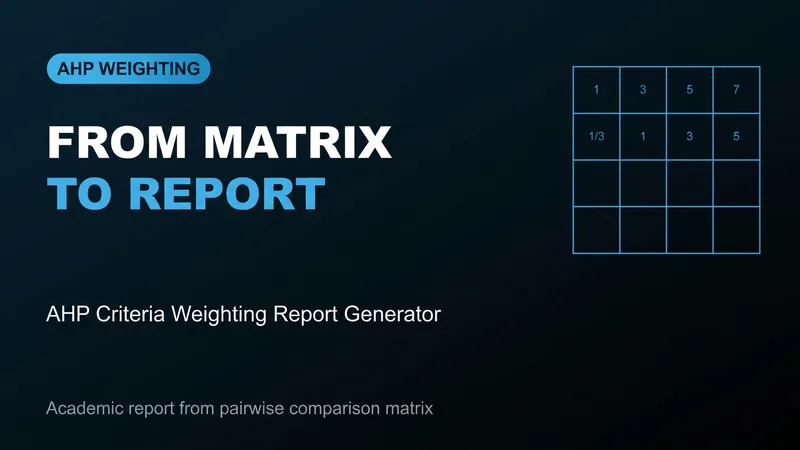
AHP Criterion Weighting Writer
Transforms the user's AHP (Analytic Hierarchy Process) pairwise comparison matrix outputs—criterion weights and consistency ratio—into an academic "Criterion Weighting" section that can be directly added to a paper. If the consistency ratio (CR) exceeds 0.10, it states this clearly without hiding it. Suitable for researchers and graduate students who use MCDM methods such as TOPSIS and VIKOR and determine criterion weights with AHP.
Information
- Version
- v2
- Last updated
- Runtime credits
- Usage-based
- Models
- Auto
- Use cases
- Writing & contentResearch & analysisLearning & education
- What you get
- ArticleReportData