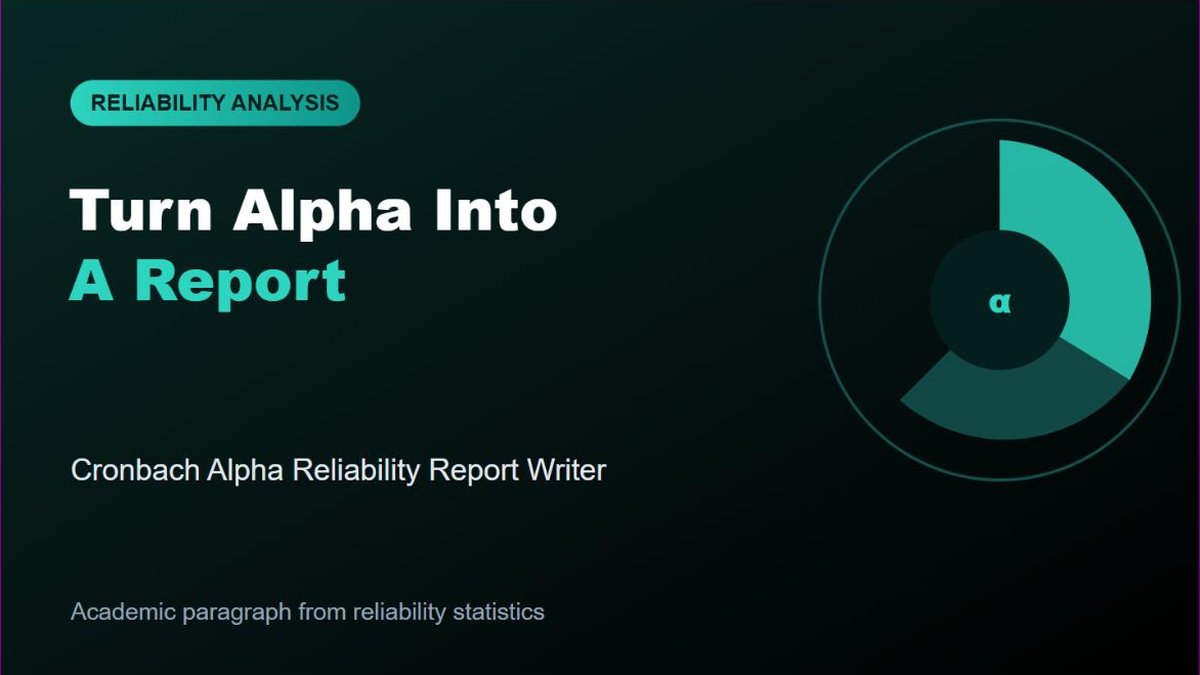
Cronbach Alpha Reliability Writer
Turns your reliability stats into an academic paragraph
Cronbach Alpha Reliability Writer
Turns your reliability stats into an academic paragraph
Showcase
Description
Converts the reliability statistics you enter (Cronbach alpha, item count, subscales) into an academic "Reliability Analysis" paragraph ready to drop straight into your manuscript. Provides an acceptability table by subscale and, if it detects a low alpha (<.60), states this openly rather than hiding it. Suitable for: graduate students and researchers using scales who want to write the method section quickly and correctly.
Recommended by
Shuting@YouMind
Why we love this skill
An editor’s pick for turning raw Cronbach’s alpha results into manuscript-ready reliability reporting. It stands out by pairing polished academic prose with a clear subscale table, calibrated interpretation by item count, and transparent warnings when reliability falls below acceptable levels.
Best for
Graduate students and researchers who need clear, manuscript-ready reporting of scale reliability statistics.
How to use this Skill
Provide your input
Provide the scale name, subscales, item counts, Cronbach’s alpha values, total alpha, and sample size.
Run the Skill
The Skill turns these statistics into academic reliability-reporting text and interprets the reported alpha values.
Review your result
Receive a manuscript-ready Reliability Analysis paragraph, a subscale reliability table, and an explicit note when a low alpha warrants review.
Related Skills
View all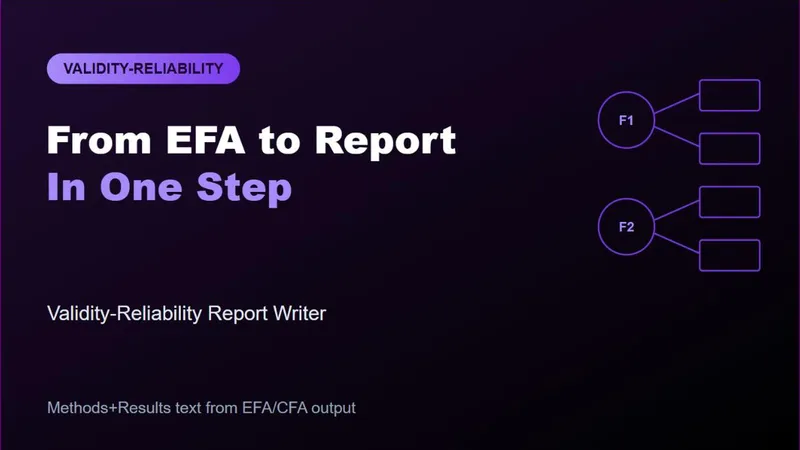 Research
Validity-Reliability Report Writer
Produces a complete manuscript-ready Methods + Results text from your EFA or CFA analysis outputs (KMO, Bartlett's test, factor loadings, fit indices, Cronbach alpha/CR/AVE). Correctly classifies fit index thresholds (CFI/TLI≥.90, RMSEA≤.08, etc.) and reports validity issues like AVE<0.50 without hiding them. Suitable for: academics and graduate students conducting scale development or adaptation studies.
 Research
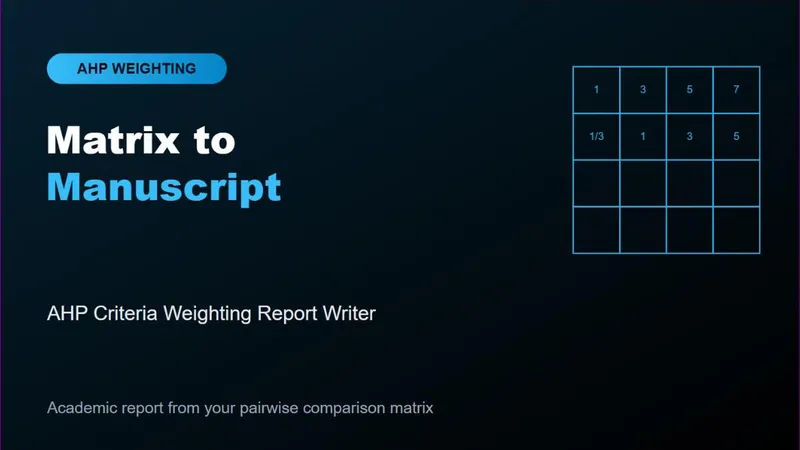
AHP Criteria Weighting Writer
Converts the user's AHP (Analytic Hierarchy Process) pairwise comparison matrix outputs (criteria weights, consistency ratio) into an academic "Criteria Weighting" section ready to drop straight into a manuscript. If the consistency ratio (CR) exceeds 0.10, it states this openly rather than hiding it. Suitable for: researchers who use MCDM methods such as TOPSIS/VIKOR and determine criteria weights with AHP, and graduate students.
 Research
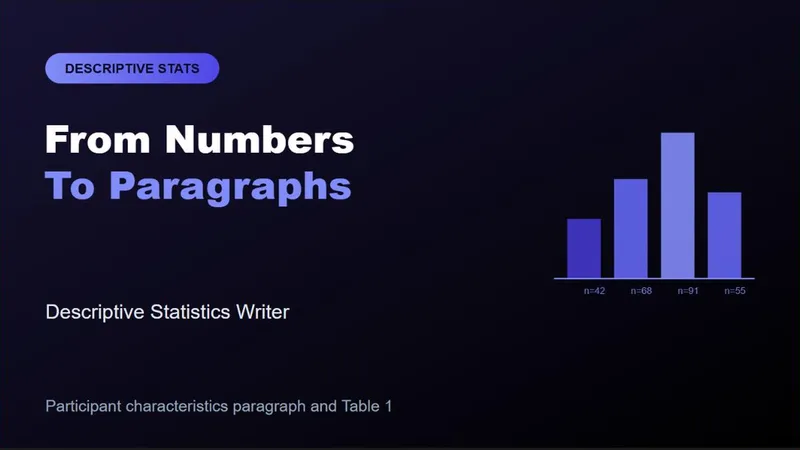
Descriptive Statistics Writer
Converts the user's descriptive statistics outputs (mean±SD or median(IQR), n(%)) into an academic "Participant Characteristics" paragraph ready to drop into a manuscript, plus a Table 1 formatted table. Selects the correct descriptive statistic (mean±SD vs. median(IQR)) based on normality status and never mixes the two up. Who it's for: graduate students and academics running quantitative research who want to write the manuscript's "Participants" section quickly and correctly.
Information
- Version
- v2
- Last updated
- Runtime credits
- Usage-based
- Models
- Auto
- Use cases
- Writing & contentResearch & analysis
- What you get
- ReportDocument