Borrowed Soul Method v1.0
Borrowed Soul Method v1.0
Showcase
Description
# Borrowed Soul Content Creation Methodology ## How It Works A complete workflow for WeChat public account article creation, consisting of four steps: 1. **Structure Deconstruction**: Analyze sample article structure across five dimensions 2. **Apply Structure to Generate**: Use real material to produce the first draft 3. **Polish Transitions**: Optimize paragraph connections (second version) 4. **Refine Opening & Closing**: Polish the beginning and end (third version) Core concept: Borrow the framework of others, infuse it with your own soul.
Recommended by
Nico@YouMind
Why we love this skill
It introduces the unique 'Borrowed Bones' four-step content creation method, from deconstructing model article structures to refining openings and closings, providing a systematic and efficient WeChat public account writing workflow that makes your content both insightful and distinctive.
Related Skills
View all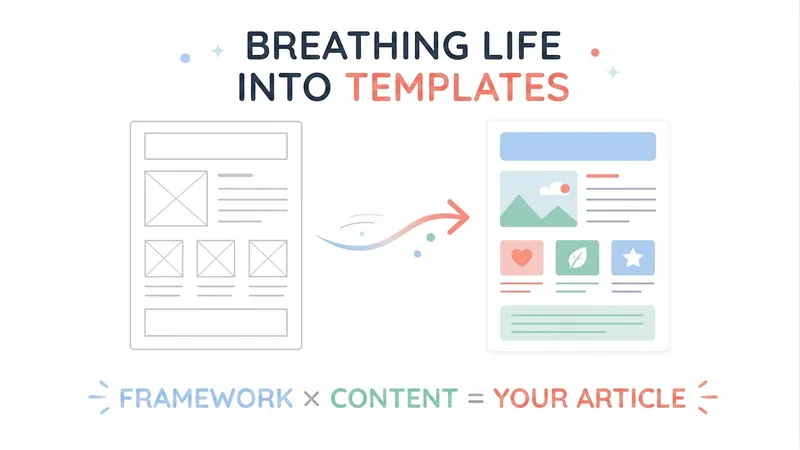 Write
Borrow Bones Return Soul v2.0
Integrates the Borrow Bones Return Soul four-step creation method with minimalist illustrations, offering a one-stop solution from structural breakdown to image pairing for WeChat Official Account articles. Supports flexible selection of starting point and process; after each step, you decide whether to continue, ultimately outputting a complete article with minimalist illustrations.
 Write
Micro-Course Rescuer
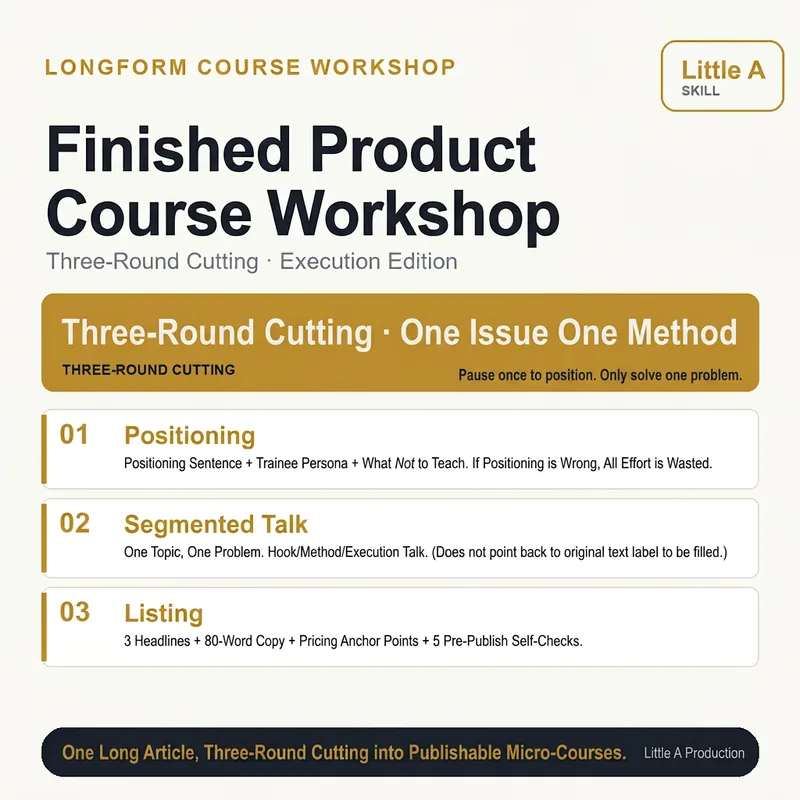
Turn a long text into a breakdown table, lecture handouts, and publishing copy for a 3-part mini-course through three rounds of segmentation. Uses only the source text without inventing anything. **Core Selling Point**: Beyond planning tips—directly generates your course profile, 3-part breakdown table, lecture handouts, and publishing kit. Each lecture solves one real problem, and every point links back to the source text. **Best For**: Content creators and knowledge bloggers looking to quickly test the waters; anyone with a long text, notes, or book excerpt who doesn't know how to structure it into a course. **Input**: A source text (1,800+ words of long text, notes, book excerpt, or draft) + goal (free lead-magnet course or low-priced entry-level course). **Output**: 8 content pieces + 4 finished pieces (12 total). Course profile, breakdown table, lecture handouts, and publishing kit are generated one by one. If tools are unavailable, a copy-pasteable package is provided with unproduced items marked. ## [Exclusive Methodology] Three-Round Segmentation · One Problem Per Lecture If your positioning is wrong, the next two rounds are wasted—so the first round must pause to confirm the course profile, which is the most efficient step in the entire workflow. 1. **Anchor**: Positioning formula "Help [who] achieve [result] in [scenario] using [method]" + 3 student persona questions + clarify what "not to teach" (cut anything the source text cannot support or exceeds capacity). 2. **Segment**: Each lecture solves one real problem (lecture titles written as questions); default hook lecture -> method lecture -> practical lecture; each point maps to a source paragraph, unmapped items marked as [To Be Added], no fluff. 3. **Publish**: 3 titles from result/pain-point/scenario angles + 80-word short copy (pain point -> what you get -> who it's for -> call to action) + pricing anchor + 5 pre-release self-checks. Remember it in one sentence: **Pause to anchor first, solve one problem per lecture.** ## [Grounded in Rules] Standards Based on Current Official Guidelines Anchored only in real public standards: target platform skill package guidelines, copyright duplication and fair use, AI-generated content labeling requirements, and restrictions on absolute terms and earnings promises in publishing copy. **Any fields, clauses, or rules that are unclear will be marked as "To Be Verified"—never filled from memory**; rules unrelated to this scenario are explicitly marked as not applicable. ## [v1 New · From Intermediates to Finished Files] Older versions provided editable intermediates; this version turns content **into ready-to-use files**: first detects your current session's tool capabilities, tells you what is about to be generated and the consumption cost, and only acts after your confirmation— - **Breakdown Table + Course Profile File**: Positioning sentence, what not to teach, 3 lecture problem titles, and corresponding source paragraphs in one table; - **Lecture Handout Drafts**: Five-section format per lecture (hook/explanation/demonstration/practice/summary) + take-away checklist, written as an editable draft; - **Publishing Kit + Checklist**: 3 titles, 80-word short copy, pricing anchor, and 5 pre-release self-checks. **No generation tools in the session?** Delivers a "ready-to-paste finished content package"—formatted entirely in Markdown, ready to use when copied into Word or tables. **Never pretends to generate, never invents file paths.** ## [Details Page Body] ### What Boundaries Are Maintained The service scope is clear: **only arranges your provided real material into a breakdown table / lecture handout drafts / publishing kit**. If you lack workflows, course content, cases, qualifications, data, or student reviews, they remain [To Be Added]; the skill will not invent them just to make the table look nice. It does not copy others' works, cites sources, and does not promise platform review or publishing results. ### Core Architecture 1. Anchor: Positioning sentence + student personas + what not to teach, pause to confirm; 2. Segment: One problem per lecture + five-section handout + take-away checklist; 3. Publish: 3 titles + 80-word short copy + pricing anchor + 5 self-checks. + Authoritative anchoring layer + execution delivery layer (detect -> authorize -> output finished product -> accept/fallback).
 Write
Course Distillation Studio
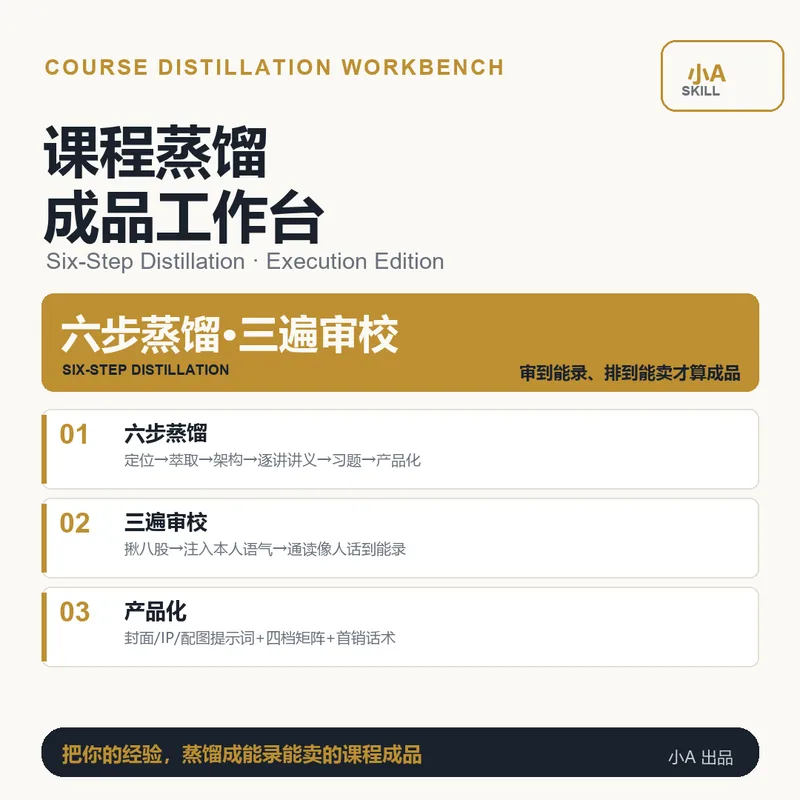
Distill your experience into a course you can record and sell. Using a six-step process with three review passes, this generates a complete outline, record-ready lecture scripts, visual assets, and launch sales copy directly from your personal expertise. **Core Value**: Beyond just a course skeleton—upon authorization, it delivers a positioning report, outline table, record-ready scripts with three review records, visual assets, a product matrix, and initial sales scripts, all derived from your own experience. **Best For**: Knowledge monetizers, trainers, and creators with professional expertise who want to build a course, as well as those who have an outline but find their teaching materials sound like AI and fail to sell. **Input Requirements**: Your genuine experience, articles, or materials, plus your desired topic. Leave placeholders marked as [To be filled] where real-world experience is missing. **Outputs Delivered**: 8 content pieces plus 5 finished products (13 items in total). Positioning report, outline, record-ready scripts, visual assets, product matrix, and initial sales scripts are produced individually as files. If tools are unavailable, a paste-ready content package is provided with an "Unproduced" label. ## 【Exclusive Methodology】Six-Step Distillation & Three Review Passes The six steps solve the outline, while the three review passes ensure the course is record-ready and sellable. Having a skeleton is not enough to make a finished product; this version embeds the final mile directly into the workflow. 1. **Six-Step Distillation**: Positioning (who it is for) -> Extraction (four questions for core insights) -> Architecture (3-5 modules x 2-4 lectures) -> Lecture handouts -> Takeaway exercises -> Productization. 2. **Three Passes to Remove AI Tone**: Eliminate cliché filler words -> Inject personal tone (at least 1 real experience per lecture; leave [Insert your case here] if missing) -> Read aloud naturally (phrase for reading, 600-900 words, include pause points). 3. **Productization**: Prompts for covers, instructor IP, and presentation illustrations provided all at once; a four-tier product matrix (lead-gen, trust, profit, premium) + 3 initial launch scripts (early-bird price, quota, deadline). Remember it in one sentence: **Building a skeleton is not enough; reviewing until it is record-ready and formatting until it sells makes a finished product.** ## 【Evidence-Based】Rules Follow Current Official Standards Anchored strictly in real, public standards: current skill package specifications of target platforms, copyright laws regarding copying and fair use, AI-generated content identification requirements, and restrictions on absolute terms and income promises in launch copywriting. Any unsure fields, clauses, or rules are strictly marked as "To be verified" without relying on memory. Rules unrelated to this scenario are explicitly marked as inapplicable. ## 【v1 New: From Intermediate Artifacts to Finished Files】 Older versions provided editable intermediate artifacts, but this version turns content into usable files. It first detects the tool capabilities of your current session, informs you what will be generated and what the consumption will be, and only proceeds after your confirmation. - **Record-Ready Lecture Scripts & Three Review Records**: Original draft -> changes made -> fully visible record-ready script process. Missing real experiences are left as placeholders without fabrication. - **Visual Asset Prompt Package**: Cover, instructor IP character, and lecture illustration prompts provided with stacking instructions only, without consuming image-generation credits. - **Product Matrix & Initial Sales Script Files**: Four-tier pricing matrix and 3 scripts including early-bird prices, quotas, and deadlines, ready to copy into your listing page. **No generation tools in the session?** A "Directly pasteable finished content package" is delivered in Markdown format so you can paste it straight into Word or spreadsheets. **Never pretends to generate and never fabricates file paths.** ## 【Details Page Body】 ### Boundaries It Maintains Its service scope is clear: **it only arranges your provided authentic materials into a course outline, record-ready lecture scripts, visual asset prompts, product matrix, and initial sales scripts**. Workflows, course content, cases, qualifications, data, and student reviews that you do not provide will be marked as [To be filled]; the Skill will not fabricate them just to make the table look good. It does not copy others' works, appropriately cites sources, and does not promise platform review or listing results. ### Core Workflow 1. Positioning + Four Extraction Questions -> Outline (Pyramid architecture); 2. Lecture handouts go through three review passes to remove the AI tone -> Record-ready scripts; 3. Takeaway exercise checklist + visual asset prompts + product matrix + initial sales scripts. + Authoritative anchoring layer + Execution delivery layer (detection -> authorization -> production output -> acceptance/downgrade).
Information
- Version
- v3
- Last updated
- Runtime credits
- Usage-based
- Models
- Auto
