Article Fact Check
Article Fact Check
Showcase
Description
Say goodbye to content inaccuracies. If you enjoy creating derivative content or writing personal opinions based on news, papers, and other information sources, this skill helps you conduct a comprehensive fact check, ensuring your content aligns with the sources, precisely locating inaccuracies, and providing revision suggestions to make your content authoritative, credible, and worry-free for publication.
Recommended by
nene@YouMind
Why we love this skill
Worried about content authenticity? This skill deep fact-checks your drafts, comparing key facts, data, and original sources to pinpoint issues and suggest revisions. For press releases, reports, or research articles, it ensures accuracy and boosts credibility.
Related Skills
View all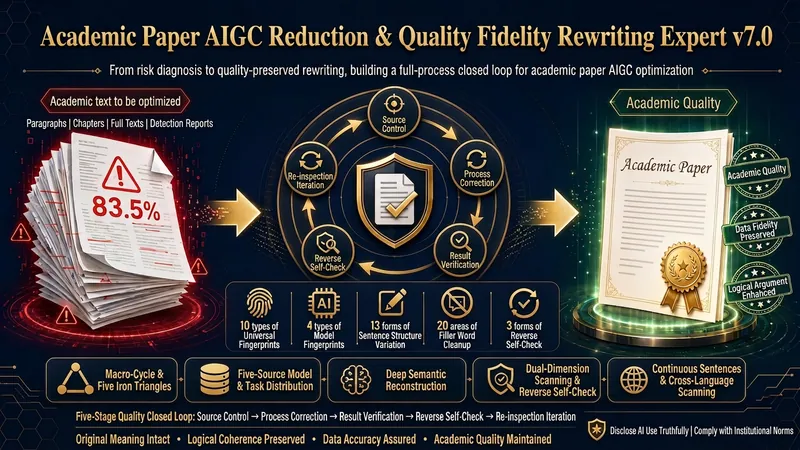 Write
AIGC Reduction & Rewrite v7.0
📚 Academic Paper AIGC Reduction and Quality-Preserving Rewriting Expert v7.0 Designed for graduate students, researchers, and paper authors, this academic text optimization skill operates on a core closed loop of 'source control → process correction → result verification → reverse self-check → iterative re-check'. It systematically diagnoses and optimizes issues such as templated expressions, mechanical logic, vague content, inaccurate terminology, and style inconsistencies while preserving original meaning, technical terms, data, and core conclusions. 🔍📝 🌟 Core Capabilities 🔬 Multi-layer Risk Diagnosis Covers 10 types of universal text fingerprints and assists in identifying common expression patterns of models such as ChatGPT, Claude, DeepSeek, and Wenxin Yiyan. 🧠 Deep Semantic Restructuring Goes beyond synonym replacement to rebuild more natural and in-depth academic reasoning by adjusting proposition expression, information order, argument approach, and evidence organization. ✍️ Quality-Preserving Rewriting Comprehensively applies 13 sentence transformation strategies and 20 methods for cleaning high-frequency templated expressions, improving mechanical sentence structures, repetitive connectors, and overly rigid formatting. 📊 Full-text Structure Diagnosis Through macro-cycle and five key triangles, checks whether research problems, theory, literature review, methods, results, conclusions, and innovation form a complete closed loop. 🧩 Fine-grained Section Adaptation Develops differentiated diagnostic and rewriting strategies for abstract, introduction, literature review, research methods, results, discussion, and conclusion respectively. 🌐 Cross-language Risk Scanning Assists in identifying translationese, passive voice stacking, long sentence nesting, and mixed Chinese-English formatting abnormalities to make Chinese academic expression more natural and accurate. 🔄 Reverse Self-check Loop After rewriting, re-verifies from three aspects: technique distribution, new text fingerprints, and information integrity, to avoid 'becoming more templated' or losing key content. 🛡️ Academic Integrity Protection Does not fabricate literature, data, cases, or policy evidence; separately marks information requiring author verification and reminds users to honestly disclose AI usage. 🎯 Use Cases ✅ Single paragraph or partial section optimization ✅ Targeted modification of marked paragraphs from inspection reports ✅ Polishing of abstract, introduction, literature review, discussion, and conclusion ✅ Full-text AIGC risk feature diagnosis ✅ Language and structure adaptation for target journals ✅ Pre-submission quality review and consistency check 📦 Final Deliverables 📄 Quality-preserving rewritten text 🔎 Risk and issue diagnosis report 🛠️ Rewriting strategy and technique description ✅ Reverse self-check and information integrity report 💡 Items requiring author verification and subsequent revision suggestions 🎓 Original meaning preserved · Logic intact · No fabricated data · Academic quality maintained ⚠️ This skill aims to improve academic expression quality and reduce text risk features. It does not guarantee passage through any specific detection platform or achieving a particular detection score.
 Write
Academic Paper Writing
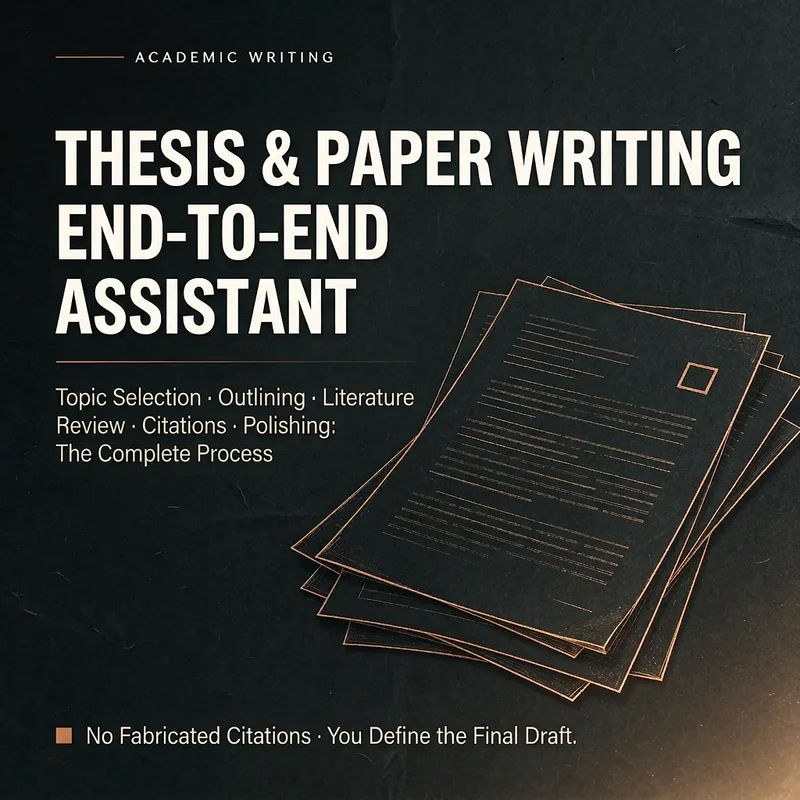
Provides writing support for Chinese humanities academic papers from topic conception to submission self-check, suitable for degree papers, journal papers, conference papers, proposal reports, and research plans in fields such as Chinese studies, history, philosophy, and literature. Whether you are in the process of determining research directions, planning paper outlines, writing the main text, revising the first draft, or preparing for submission, you can get assistance tailored to your current stage. It can help you propose feasible topics, build paper structures at the chapter, section, and subsection levels, sort out research backgrounds, research questions, methods, and expected contributions, and organize literature reviews, analyze research contexts, and identify research gaps based on the materials you provide. During main text writing, it can also optimize paragraphs around arguments, evidence, and logical relationships, provide more standardized academic Chinese expressions, and mark positions where literature or materials need to be supplemented. For footnotes, references, title hierarchies, punctuation, and paragraph formatting, it can also organize and check; the revision stage covers language, logic, format, and academic integrity. All literature, authors, page numbers, data, and academic viewpoints are based on the real materials you provide, without fabricating information, and missing content is clearly marked to help you complete Chinese academic writing more securely.
 Write
Social Content Precheck
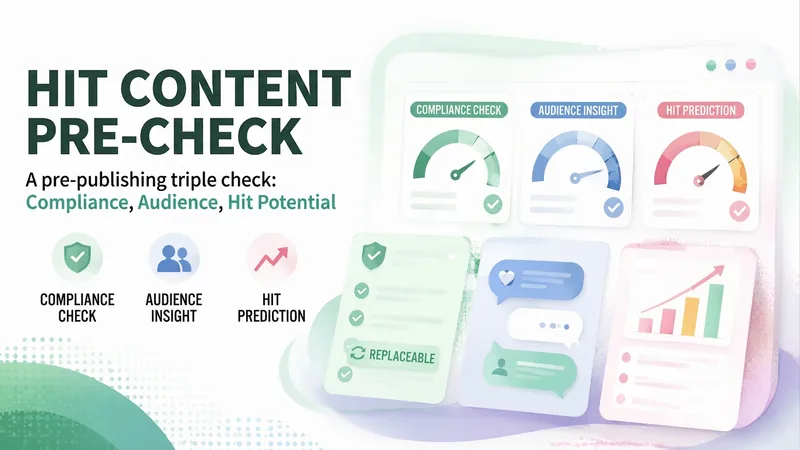
Before publishing on WeChat Channels, WeChat Official Accounts, Douyin, Xiaohongshu, Kuaishou, Bilibili, Zhihu, Weibo, or other platforms, get a precheck covering compliance risks, audience response, and reach potential. Whether it is a short-video script, image-and-text post, WeChat Official Account article, Moments copy, livestream script, or direct-message script, the precheck starts with the original text, identifies the platform, category, target audience, and publishing goal, then flags risks such as performance promises, absolute claims, restricted areas in regulated industries, and inducements to move users off-platform. The precheck uses traceable, up-to-date rules to flag high-, medium-, and low-risk wording line by line, explain the basis for each judgment, and provide ready-to-use replacement copy that preserves the original tone and rhythm. It also highlights differences in review standards across platforms. For the target audience, it simulates reactions in the first three seconds or at the start of reading, generates authentic-sounding comments showing support, skepticism, and backlash, and identifies the sentence most likely to attract criticism. For reach evaluation, the Skill provides explainable scores based on the hook, emotion, information gain, identity, quotability, likelihood of being read or watched to completion, and path to action. It gives platform fit, probability ranges, and the highest-priority changes. The final delivery includes an in-chat overview and a full report, helping you quickly decide whether to publish as is, publish after revisions, or rewrite—and provides a clean version of the copy for retesting.
Information
- Version
- v1
- Last updated
- Runtime credits
- Usage-based
- Models
- Auto
