Conclusion or Closing Remarks
Conclusion or Closing Remarks
Showcase
Description
Write conclusions or closing remarks for academic papers.
Related Skills
View all
Thesis Outline V2.0
Thesis Outline description: Professional academic thesis outline generation, covering 5 types: undergraduate thesis, master's thesis, doctoral dissertation, journal submission paper, course paper. Includes 8 major chapter structures, introduction writing methods, literature review methodology, research method selection, results presentation standards, discussion and conclusion logic, academic language standards, citation formats (APA/MLA/Chicago/IEEE), and common pitfalls. Applicable to: (1) university students' thesis writing, (2) researchers' paper writing, (3) journal submission preparation. Trigger keywords: thesis, outline, graduation thesis, dissertation, journal submission, research methods, literature review, introduction, references, APA, MLA, IEEE.
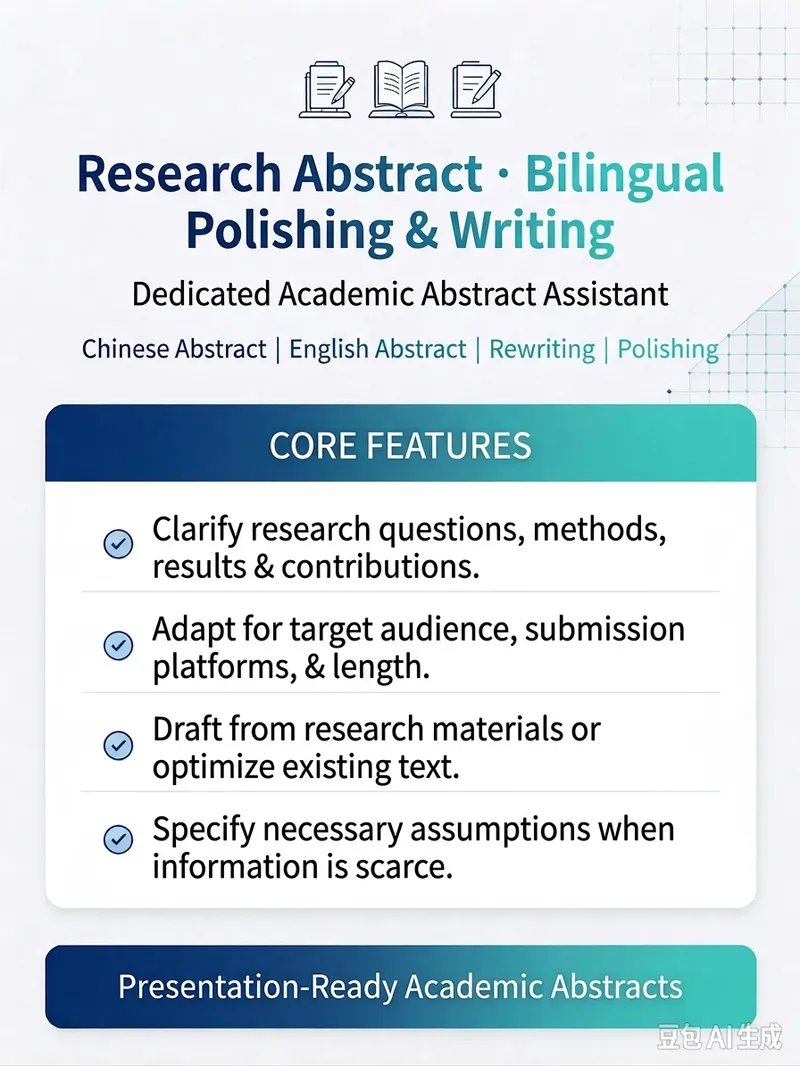
Bilingual Paper Abstract Writer
Designed for paper abstracts and academic writing scenarios, this helps you write, rewrite, and polish Chinese or English abstracts, making research questions, methods, results, and contributions clearer, more accurate, and aligned with academic contexts. Whether drafting from research materials or optimizing existing text, it adapts to your target audience, submission platform, length, and language style to produce ready-to-use versions, clearly stating necessary assumptions when information is insufficient. Beyond bilingual abstracts, it supports structured writing for introductions, literature reviews, methodology, results, discussion, and grant proposals. When handling complex or lengthy materials, it first outlines headings, core arguments, and paragraph relationships before drafting the main text, reducing logical leaps, redundancy, and empty clichés. During revisions, it explains key adjustment directions to help you continue refining your work. Outputs focus not only on language fluency but also on verifying factual basis, citation and copyright risks, academic expression, sensitive phrasing, and compliance boundaries, while distinguishing facts, opinions, speculations, and citations. For legal, medical, financial, or other high-risk research, it serves as a writing draft and review checklist to help you spot issues before submission, publication, or further revision.
 Write
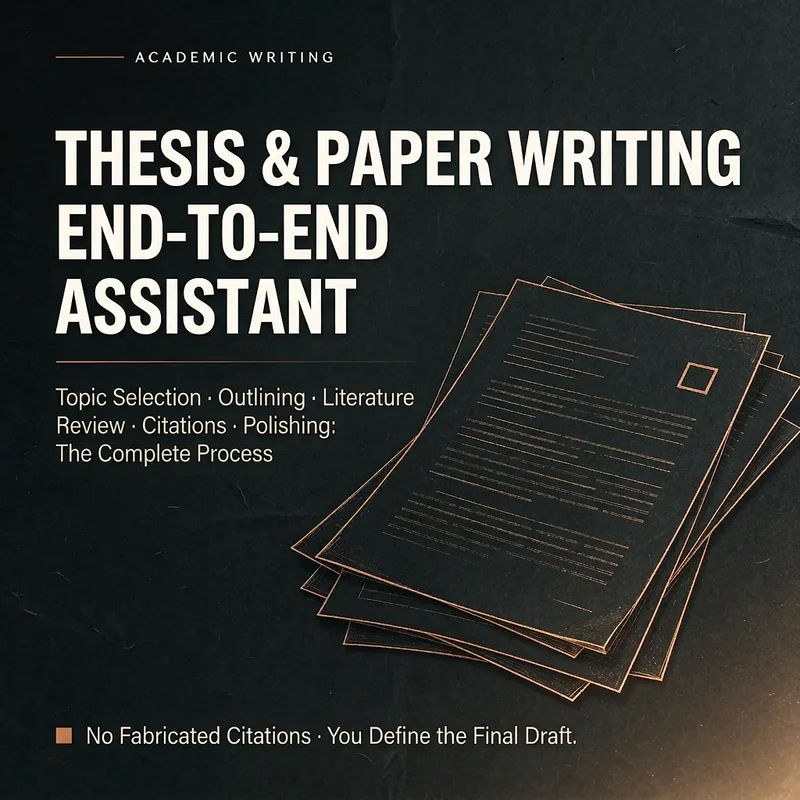
Academic Paper Writing
Provides writing support for Chinese humanities academic papers from topic conception to submission self-check, suitable for degree papers, journal papers, conference papers, proposal reports, and research plans in fields such as Chinese studies, history, philosophy, and literature. Whether you are in the process of determining research directions, planning paper outlines, writing the main text, revising the first draft, or preparing for submission, you can get assistance tailored to your current stage. It can help you propose feasible topics, build paper structures at the chapter, section, and subsection levels, sort out research backgrounds, research questions, methods, and expected contributions, and organize literature reviews, analyze research contexts, and identify research gaps based on the materials you provide. During main text writing, it can also optimize paragraphs around arguments, evidence, and logical relationships, provide more standardized academic Chinese expressions, and mark positions where literature or materials need to be supplemented. For footnotes, references, title hierarchies, punctuation, and paragraph formatting, it can also organize and check; the revision stage covers language, logic, format, and academic integrity. All literature, authors, page numbers, data, and academic viewpoints are based on the real materials you provide, without fabricating information, and missing content is clearly marked to help you complete Chinese academic writing more securely.
Information
- Version
- v1
- Last updated
- Runtime credits
- Usage-based
- Models
- Auto
