
Course Competency Mapper v2.0
Design vocational competency maps & plans
Course Competency Mapper v2.0
Design vocational competency maps & plans
Showcase
Description
An automated system for generating higher vocational course competency maps aligned with Document No. 1 of Vocational Education (Jiaozhicheng [2026] No. 1). Following the reverse design logic of 'Position → Task → Competency → Skill Point → Course → Assessment', it guides through six stages to produce review-level competency maps: position anchors, typical work tasks, five-level structure breakdown, full-chain mapping matrix of position-competency-course-assessment-certification, quantified passing lines, credit hour validation, and red-line self-checks. Built-in anti-hallucination firewall (three-option source tags, no fabrication, source coverage self-check) and parameterized ideological-political mapping (skill points → professional qualities → observable assessment points), automatically handle conflicts in credit hour standards from multiple materials and consolidate with talent cultivation plans.
Related Skills
View all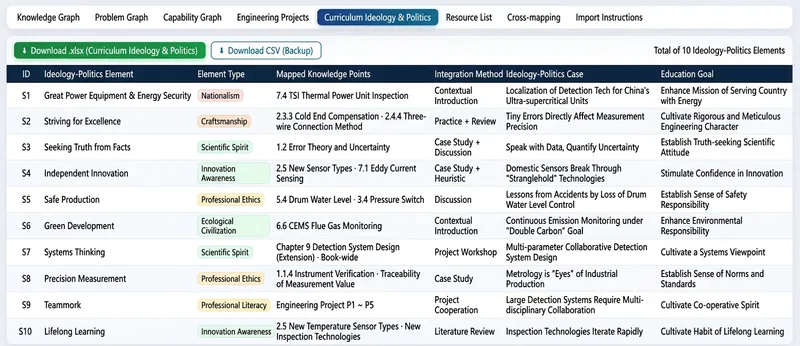
Smart Course Mapping Engine
Turn course webpages, Excel spreadsheets, or textbook text into multidimensional maps and supporting deliverables for smart course development. For both undergraduate and higher vocational courses, it organizes course content into knowledge systems, knowledge-point hierarchies, learning prerequisites and follow-up relationships, and cross-unit connections. The result is a clear, traceable course knowledge map, supplemented with resource, assessment, and teaching application information. Building on the knowledge map, it also creates problem maps, competency maps, engineering project maps, and curriculum-integrated values maps. These show the relationships among knowledge, skills, competencies, project tasks, and educational goals, helping instructors review content coverage, alignment with learning objectives, and the completeness of instructional design. For non-engineering courses, the structure can also be adapted into suitable integrated practice projects. The final deliverables can include interactive HTML visualizations, Excel import sheets compatible with Chaoxing Fanya, and documentation covering development metrics, standards alignment, and quality-check results. During generation, confirmed information is distinguished from items requiring verification to avoid fabricating textbooks, references, links, or platform fields. This makes it suitable for course development, smart course applications, teaching-resource organization, and course quality review.
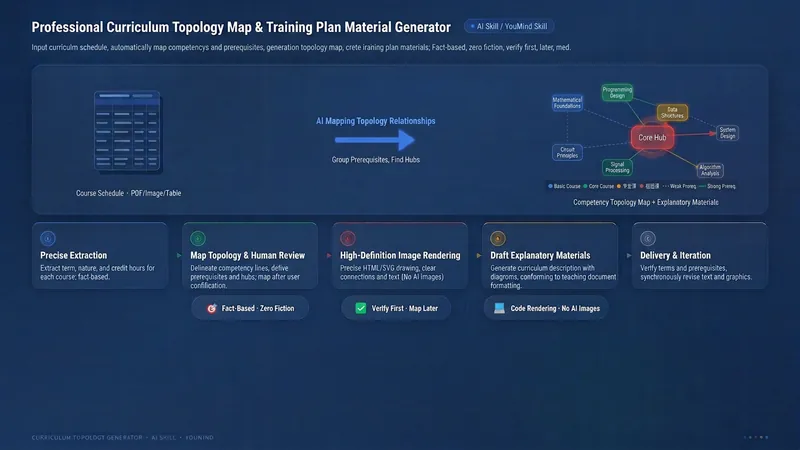
Professional Course Topology Diagram and Curriculum Program Material Generator
Input a professional course schedule, and the system automatically identifies competency lines and prerequisite relationships, generates a high-definition topology diagram using code, and produces training program description materials; it is fact-anchored with zero fabrication, and the diagram is created only after verification. Input the professional course offerings in any university's talent training program (PDF/image/text table are all acceptable), and the system automatically identifies the topological relationships between courses—grouping them by professional competency lines, identifying strong prerequisite dependencies and competency responses, locating core hub nodes, handling limited elective/specialized courses, and connecting them to the internship in the 5th/6th semester; then, it uses HTML/SVG code to accurately render a high-definition course topology diagram with clear Chinese characters and unblurred lines (not an AI-generated diagram), and finally produces a talent training program curriculum system description material that conforms to the style of teaching documents and includes diagrams. Built-in fact-anchoring and manual verification gate control: course names/nature/class hours are strictly faithful to the original table with zero fabrication; prerequisite relationships are clearly marked as teaching logical inferences and are verified by the user before diagram creation; information such as unfounded curriculum standard adjustments is never fabricated.

Multifunctional Course Plan Builder
Generate or revise course plans for universities and vocational colleges based on curriculum standards. Choose from three task paths (targeted revision / structural overhaul / build from scratch) × six instructional method frameworks (BOPPPS, flipped classroom, project-based learning, six-step work process, case-based teaching, theory–practice integration) × two levels of detail (single plan / entire course). When no curriculum standards are available, the system automatically activates a fallback hierarchy using alternative anchors. Before each plan is finalized, it undergoes six mandatory audits: observable verbs, traceable objective anchors, compliant method stages, alignment across objectives, activities, exercises, and assessment, total instructional hours, and anti-fabrication boundaries. The plan itself is the sole primary deliverable. A mandatory self-check gate is applied before delivery, and reports or summaries may not replace the main plan. Note: If you do not need the multifunctional version, consider Course Plan Auto-Generator. This Skill focuses on automatically generating full-course plans based on the OBE approach.
Information
- Version
- v5
- Last updated
- Runtime credits
- Usage-based
- Models
- Auto