
Textbook AI Bypass System 2.0
打破AI 检测工具的核心识别逻辑,识别机械编号,保留术语、教学特点,并配图
Textbook AI Bypass System 2.0
打破AI 检测工具的核心识别逻辑,识别机械编号,保留术语、教学特点,并配图
Showcase
Description
Core Principles for Reducing AI Detection Rate How AI Detectors Work 1. Perplexity: AI-generated text selects the most probable next word, resulting in low overall perplexity. Human writing chooses more uncommon but fitting words, leading to high perplexity. → Rewriting strategy: S4 Vocabulary destandardization. 2. Burstiness: AI-generated sentences have highly uniform length, resulting in low burstiness. Human writing shows great variation in sentence length, sometimes very short, sometimes very long, leading to high burstiness. → Rewriting strategy: S1 Sentence length mutation injection. 3. Transition word density: AI relies excessively on explicit transition words (e.g., 'furthermore', 'however', 'therefore', 'in conclusion'), with abnormally high density. Humans use more implicit semantic connections. → Rewriting strategy: S2 Template word removal. 4. Structural templating: AI tends to use 'general-specific-general' three-part structure, parallel items of equal length, and 'first-second-last' sequential structure. Human structure is more flexible and varied. → Rewriting strategy: S3 Structure breaking. 5. Lexical diversity (TTR): AI has high word repetition in long texts, resulting in low TTR. Natural human writing has a wider vocabulary range. → Rewriting strategy: S4 Vocabulary destandardization. 6. Information presentation linearity: AI tends to present information in a straightforward logical order with uniform density. Humans use nonlinear techniques such as flashback, interjection, contrast jumps, etc. → Rewriting strategy: S6 Information density reorganization. Special Constraints of Textbook Style • Academic rigor baseline: No internet slang, overly colloquial expressions, or emojis. • Terminology accuracy baseline: Subject-specific terms must remain unchanged; do not replace with inaccurate synonyms. • Logical integrity baseline: The logic of causal relationships, classification systems, and operational steps must not be altered by rewriting. • Citation standard baseline: References, regulations, and standard numbers must not be tampered with. • Teaching suitability baseline: Rewritten text must remain suitable for student comprehension; readability should not be sacrificed for lowering AI detection rate.
Related Skills
View all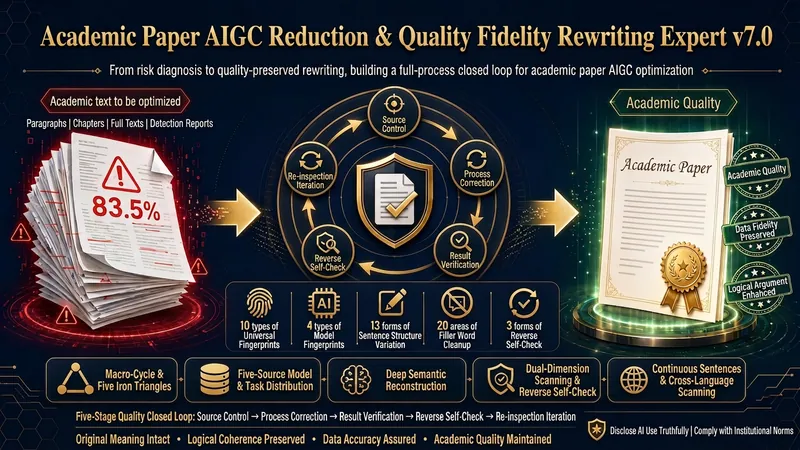 Write
AIGC Reduction & Rewrite v7.0
📚 Academic Paper AIGC Reduction and Quality-Preserving Rewriting Expert v7.0 Designed for graduate students, researchers, and paper authors, this academic text optimization skill operates on a core closed loop of 'source control → process correction → result verification → reverse self-check → iterative re-check'. It systematically diagnoses and optimizes issues such as templated expressions, mechanical logic, vague content, inaccurate terminology, and style inconsistencies while preserving original meaning, technical terms, data, and core conclusions. 🔍📝 🌟 Core Capabilities 🔬 Multi-layer Risk Diagnosis Covers 10 types of universal text fingerprints and assists in identifying common expression patterns of models such as ChatGPT, Claude, DeepSeek, and Wenxin Yiyan. 🧠 Deep Semantic Restructuring Goes beyond synonym replacement to rebuild more natural and in-depth academic reasoning by adjusting proposition expression, information order, argument approach, and evidence organization. ✍️ Quality-Preserving Rewriting Comprehensively applies 13 sentence transformation strategies and 20 methods for cleaning high-frequency templated expressions, improving mechanical sentence structures, repetitive connectors, and overly rigid formatting. 📊 Full-text Structure Diagnosis Through macro-cycle and five key triangles, checks whether research problems, theory, literature review, methods, results, conclusions, and innovation form a complete closed loop. 🧩 Fine-grained Section Adaptation Develops differentiated diagnostic and rewriting strategies for abstract, introduction, literature review, research methods, results, discussion, and conclusion respectively. 🌐 Cross-language Risk Scanning Assists in identifying translationese, passive voice stacking, long sentence nesting, and mixed Chinese-English formatting abnormalities to make Chinese academic expression more natural and accurate. 🔄 Reverse Self-check Loop After rewriting, re-verifies from three aspects: technique distribution, new text fingerprints, and information integrity, to avoid 'becoming more templated' or losing key content. 🛡️ Academic Integrity Protection Does not fabricate literature, data, cases, or policy evidence; separately marks information requiring author verification and reminds users to honestly disclose AI usage. 🎯 Use Cases ✅ Single paragraph or partial section optimization ✅ Targeted modification of marked paragraphs from inspection reports ✅ Polishing of abstract, introduction, literature review, discussion, and conclusion ✅ Full-text AIGC risk feature diagnosis ✅ Language and structure adaptation for target journals ✅ Pre-submission quality review and consistency check 📦 Final Deliverables 📄 Quality-preserving rewritten text 🔎 Risk and issue diagnosis report 🛠️ Rewriting strategy and technique description ✅ Reverse self-check and information integrity report 💡 Items requiring author verification and subsequent revision suggestions 🎓 Original meaning preserved · Logic intact · No fabricated data · Academic quality maintained ⚠️ This skill aims to improve academic expression quality and reduce text risk features. It does not guarantee passage through any specific detection platform or achieving a particular detection score.
 Write
Remove AI Traces
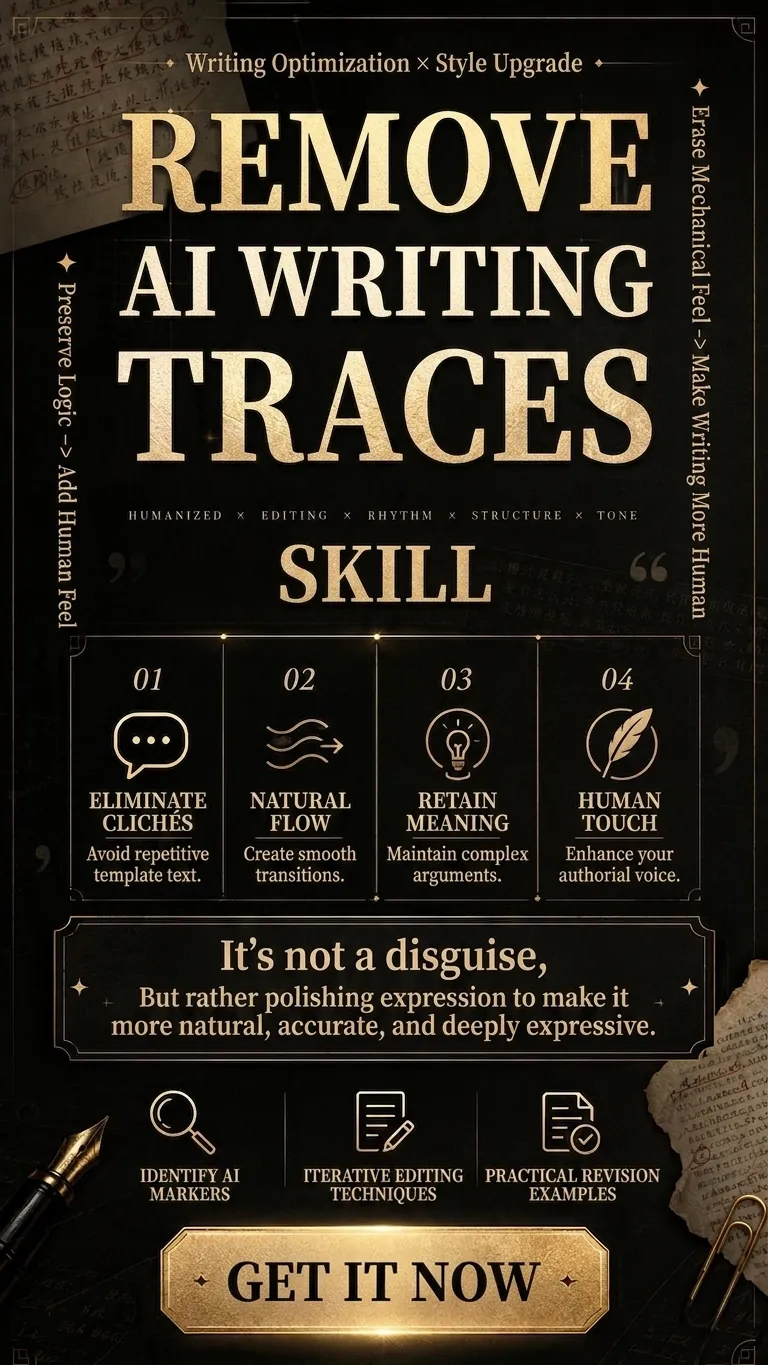
For more high-quality AI efficiency agents, contact Qiao Chuan (WeChat: EVA36814) Removes AI-generated traces from text. Suitable for editing or reviewing text to make it sound more natural and human-written. Based on Wikipedia's "AI Writing Characteristics" comprehensive guide. Detects and fixes patterns: exaggerated symbolism, promotional language, shallow -ing analysis, vague attribution, overuse of dashes, rule of three, AI vocabulary, negative parallelism, excessive connective phrases. New additions include: other signs (structural organization, timeline confusion, contradictory statements), signs of human writing (specific details, imperfect structure, cultural references), historical indicators (outdated indicators), model-specific features (ChatGPT/Claude/DeepSeek/Gemini), and cross-validation suggestions.
 Write
AI Writing Humanizer
Want to eliminate the common 'industrialized' traces in Chinese AI text, giving your writing genuine human warmth and depth? This skill focuses on removing formulaic expressions in AI writing, injecting lively judgment, natural rhythm, unique emphasis, rich details, and authentic tone. It is especially adept at handling in-depth content such as comments, personal essays, historical analysis, political philosophy, social observations, reading notes, and long-form WeChat articles. By identifying and rewriting rigid aspects—from word choice and sentence structure to overall argumentation—this skill helps you transform grand, universally correct narratives into specific, nuanced insights, giving your writing a smooth and natural flow. Without altering the original meaning, it carefully diagnoses AI traces, such as identifying vague clichés, repetitive sentence patterns, and overly balanced tones. It replaces these mechanical elements with more concrete and insightful expressions, infusing your article with the author's personal thoughts and judgments rather than a cold logical construct. Additionally, for issues that mere polishing cannot solve, it points out where facts, examples, or arguments are needed, ensuring both depth and breadth. The result is a Chinese article that is not only clear in viewpoint but also full of human touch and personalized expression. It retains necessary professionalism while removing exaggerated adjectives and stiff connectors, making the text as natural as breathing—powerful yet warm, and far from being 'correct nonsense'.
Information
- Version
- v4
- Last updated
- Runtime credits
- Usage-based
- Models
- Gemini 3.1 Pro
