
Teaching to Research Questions
Convert teaching issues to research questions
Teaching to Research Questions
Convert teaching issues to research questions
Showcase
Description
Helps college faculty without an education background turn everyday teaching challenges into actionable research questions. Through a guided step-by-step dialogue, it helps identify variables, focus on key entry points, and generate research problem statements that meet academic standards, a list of key variables, research method suggestions, and expected outcomes. Suitable for grant applications, writing teaching reform papers, and daily teaching reflection.
Related Skills
View all
Social Science Topic Master
Whether you are a novice researcher or an experienced scholar, whether you want to start from scratch to conceive a research direction or hope to optimize an existing topic, the 'Social Science Topic Master' can provide you with professional, systematic guidance. This tool is based on best practice methodologies for topic proposal writing, aiming to solve core challenges researchers face during topic selection: unclear direction, difficulty in refining research questions, ambiguous value judgment, and non-standard academic expression. Through step-by-step interactive guidance, this tool intelligently identifies your research needs and disciplinary background, providing customized theoretical perspective recommendations and policy clues. You will receive high-quality academic topic titles and undergo scientific diagnosis using the 'Five Criteria for a Good Question' to ensure the rigor and innovation of your topic. Ultimately, this tool outputs a structured complete topic proposal, including the academic title, topic element breakdown, results of the five-criteria test, key points for value argumentation, and policy and literature support. In addition, we provide two sets of detailed optimization suggestions: a 'Quick Fix' version and a 'Deep Optimization' version, helping you to improve key issues in a short time or to make systematic long-term enhancements, thereby significantly increasing the success rate of your topic proposal.
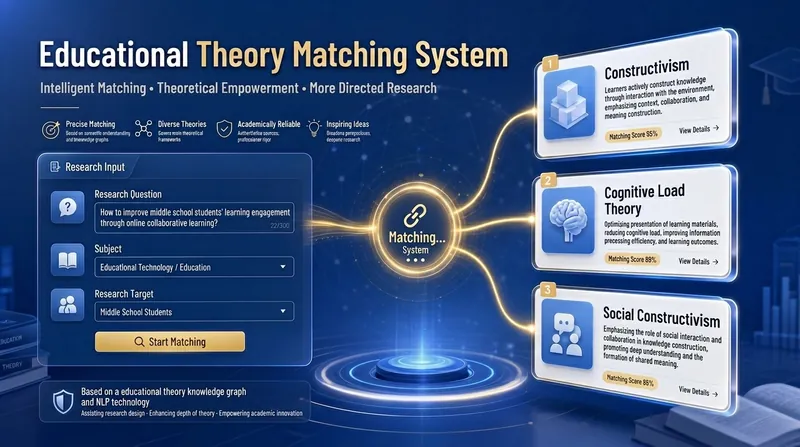
Educational Theory Matching
Match your research topics precisely to educational theory frameworks. Designed for university faculty without an education background, based on your research questions and teaching context, it intelligently recommends 2-3 best-fitting educational theories, explains why they are suitable and how to apply them, and generates actionable research design plans. Rather than overwhelming you with a list of theories, it provides precise scenario-theory mapping and practical pathway design.

Quantitative Topic Selection
Turn a vague research interest into a testable, feasible quantitative paper topic tailored to your target journal. Whether you plan to submit to a CSSCI or SSCI journal, or are comparing cross-sectional and longitudinal research, this Skill helps clarify your research direction, population, and scope while building a clear variable framework around independent, dependent, mediating, and moderating variables. As your topic takes shape, you can develop research questions, a theoretical framework, formal research hypotheses, measurement instruments, sampling and data collection plans, and statistical analysis approaches aligned with your hypotheses. If you already have a policy project or research keywords, you can use them to identify directions with academic publication potential. If you have not yet settled on a specific angle, you can generate and compare multiple candidate topics. The final output focuses on topic feasibility and publication potential: whether the data can be obtained, whether the variables can be operationalized, whether the theory, hypotheses, and methods form a coherent chain, whether the target journal is a good fit, and where the topic can occupy a distinct niche relative to existing research. You will receive a complete topic finalization plan covering the research direction, variable relationships, theoretical hypotheses, cross-sectional or longitudinal design, data and analysis plan, risk considerations, and feasibility recommendations—ready to share with your advisor or use as the basis for a literature review.
Information
- Version
- v2
- Last updated
- Runtime credits
- Usage-based
- Models
- Auto
